
Budget cuts threaten programs meant to improve warning dissemination
Aug 28, 2025
Starting off this morning with some news that demonstrates how cuts to funding in one part of government can have cascading consequences. Major cuts to federal funding for public broadcasting have been headlines in the media for last several weeks. As a result of that funding loss, the Corporation for Public Broadcasting (CPB) announced earlier this month that it would be terminating operations at the end of this fiscal year, September 30.
Public broadcasting performs a lot of roles for our society, but one aspect that is likely underappreciated is public warning notification and providing the public with reliable information in times of crisis. When I was meteorologist-in-charge for the National Weather Service in Jackson, MS, Mississippi Public Broadcasting was one of our most important partners. They hosted NOAA Weather Radio transmitters on their broadcast towers, they were a key dissemination path for the Emergency Alert System, and during major weather events such as hurricanes and winter storms their statewide radio network would provide round-the-clock coverage in partnership with federal and state entities such as the NWS and Mississippi Emergency Management Agency.
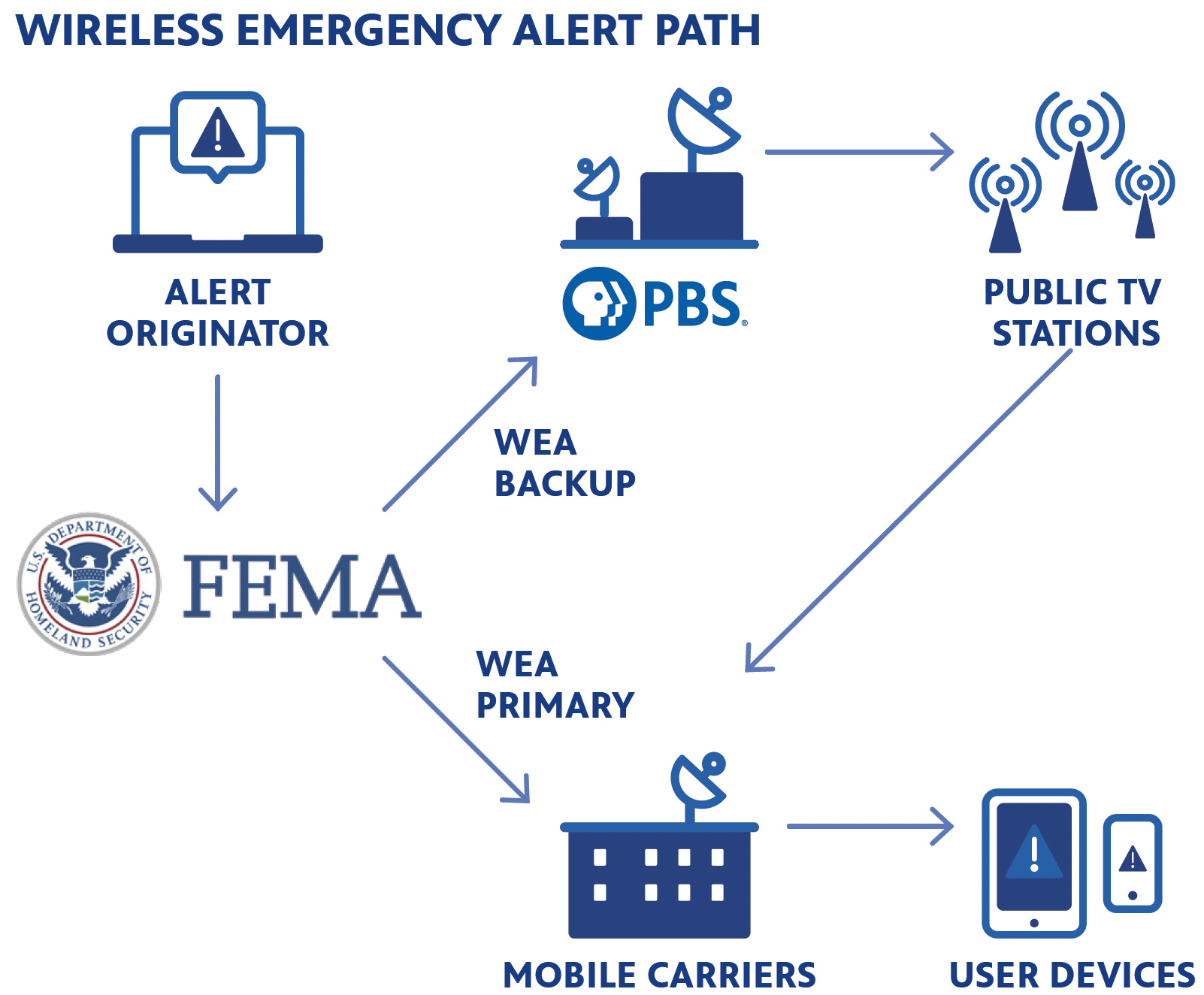
In recent years as FEMA has developed its national public alerting system, IPAWS (Integrated Public Alert and Warning System), PBS has become a formal part of this national system. Whenever an alert is issued through IPAWS to the Wireless Emergency Alerts system — it could be a weather warning, AMBER alert, or other emergency management alert — it is transmitted both through the primary WEA channels and through the PBS television network to provide redundancy and ensure that the alert message is successfully transmitted. The PBS part of IPAWS is known as PBS Warn. The PBS Warn website provides a continually updating map of all active WEA alerts in the country.
Obviously, major cuts to public broadcast funding could have serious ramifications for this alerting work. One imminent impact is to the Next Generation Warning System Grant Program (NGWSGP). NGWSGP was established by Congress in 2022 to provide nearly $200M in funding to help public broadcast stations modernize old equipment and develop improved methods for disseminating alerts via new technology such as the Internet of Things (IoT) and NextGen ATSC3.0 broadcast TV. The funding for NGWSGP was provided to FEMA, but CPB is the entity that runs the grant program and actually disburses the funds to public broadcast stations around the country. CPB announced earlier this week that given their imminent shutdown they will no longer be able to administer the program, and that unless FEMA takes it over millions of dollars in the program will not be awarded and unspent.
This article from ABC News provides an excellent overview of the potential implications of the NGWSGP shutting down. It emphasizes that rural areas of the country are the locations that most urgently rely upon public broadcasting for warning and alert notification, and that the stations that serve these areas are the ones most relying on NGWSGP to improve their equipment to ensure robust warning systems. From the article:
Public media is often on the front lines of emergency communications, able to reach areas with unreliable cell reception or broadband connection. “Our people really do rely very heavily on us during emergency situations,” said Tami Graham, executive director of KSUT-FM in Ignacio, Colorado, which reaches nearly 300,000 people in four tribes and five counties across the Four Corners region of Colorado, New Mexico, Arizona and Utah. The area is prone to wildfires and flash floods. “If they’re not able to get an emergency alert on their phone because they don’t have good cell service,” Graham said, “then the radio really is it.”
Graham went onto say that she hopes someone will pay for the $13,000 her station had to spend on a transmitter that was failing, but the rest of their project to replace aging equipment is on hold: “we’ll just continue to kind of duct tape and glue and fingers crossed that our tower sites remain resilient.”
Before I retired from the National Severe Storms Lab, I was involved in research projects working with PBS stations and the group overseeing the development of the NextGen ATSC3.0 new broadcast TV system. These projects were focused on developing new warning and alerting techniques that would take advantage of new capabilities provided by IoT and ATSC3.0 while leveraging improved severe weather forecast and warning information being developed at NSSL. Ironically, a paper of research findings from one of these projects was just published this week in the Bulletin of the American Meteorological Society. The paper summarizes social science work done to evaluate warning and alert information displays, and included authors from the University of Albany, NSSL, the University of Oklahoma, the University of Illinois, and NBC and Nebraska Public Media.
All of the efforts I describe above are type of work that government funded scientists and staff work tirelessly on every day to try to ensure that the public is getting critical weather and emergency management situation to keep them safe. Cutting public broadcasting funding is just one example of how a governmental action can have consequences far beyond what the public voices pushing for it may envision. Tami Graham from KSUT-TV summarized it well in her interview with ABC: “It’s really frustrating because there’s nothing partisan about emergency alerting in rural areas,” she said. “That is just an absolute basic need.”
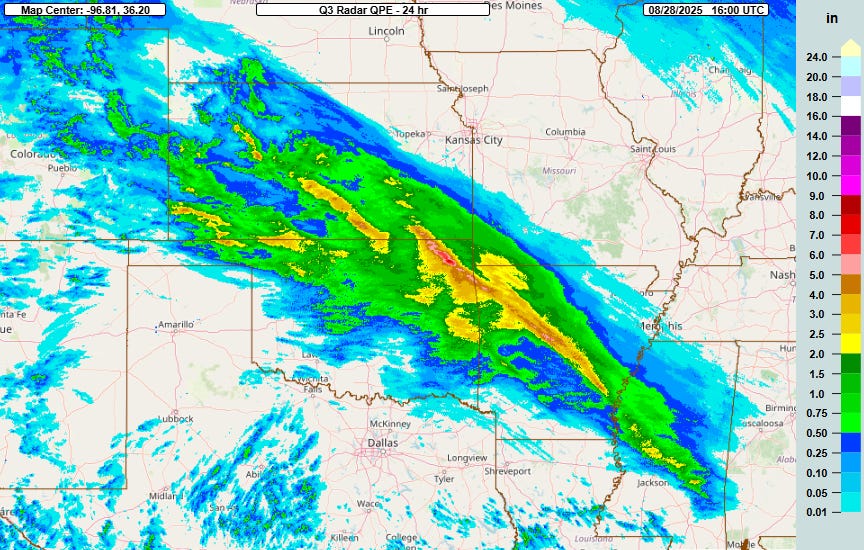
Turning to the weather, a northwest-southeast oriented stationary front has focused showers and storms with heavy rainfall from the Colorado Front range to Mississippi the last 24 hours. A narrow band of 4-9” of rain from northeast Oklahoma across central Arkansas resulted in flash flooding this morning.
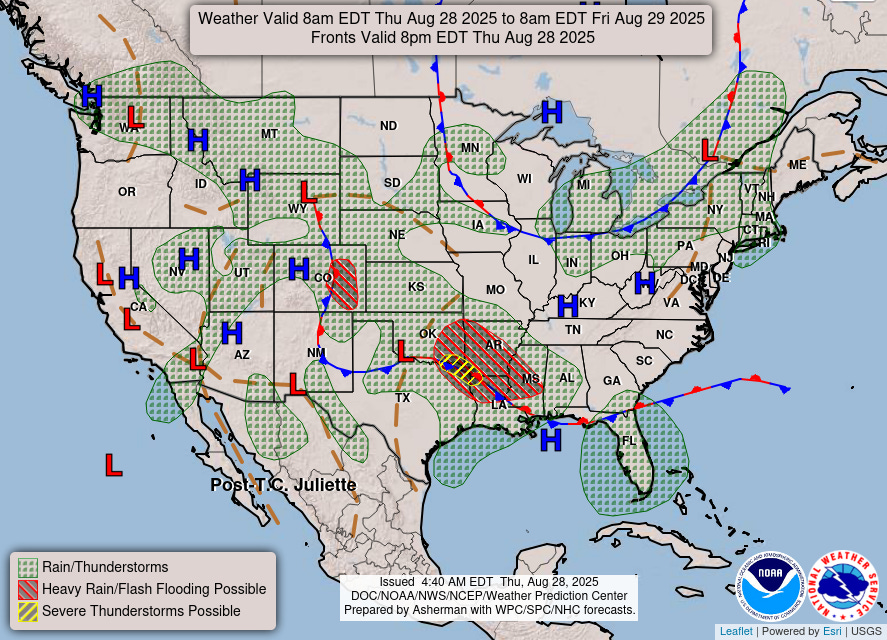
This area will also be the focus for thunderstorm activity the rest of today, with risks of both flash flooding and severe weather. Monsoonal moisture and moisture from the remnants of Tropical Storm Juliette will continue to result in scattered showers and storms over parts of the West, with some localized flash flooding possible.
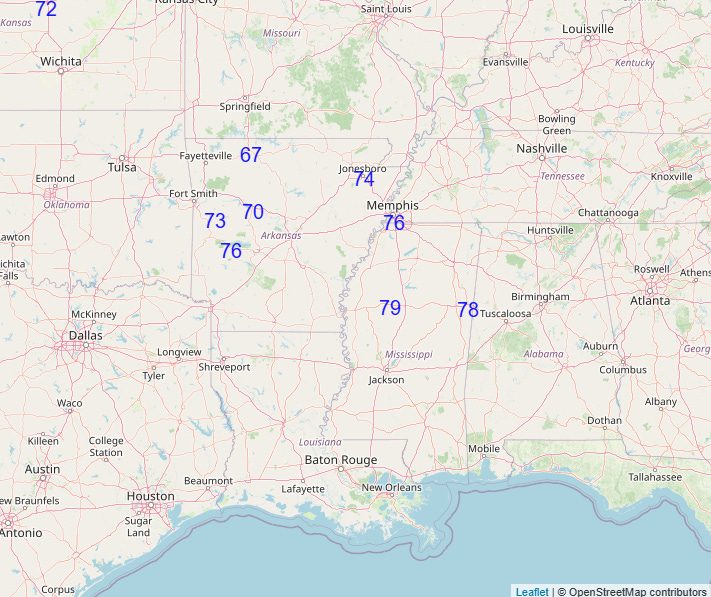
The combination of widespread rainfall and below normal temperatures will result in some record low maximum temperatures today across parts of the Mid-South. Several record low temperatures were set this morning in the central Appalachian regions.
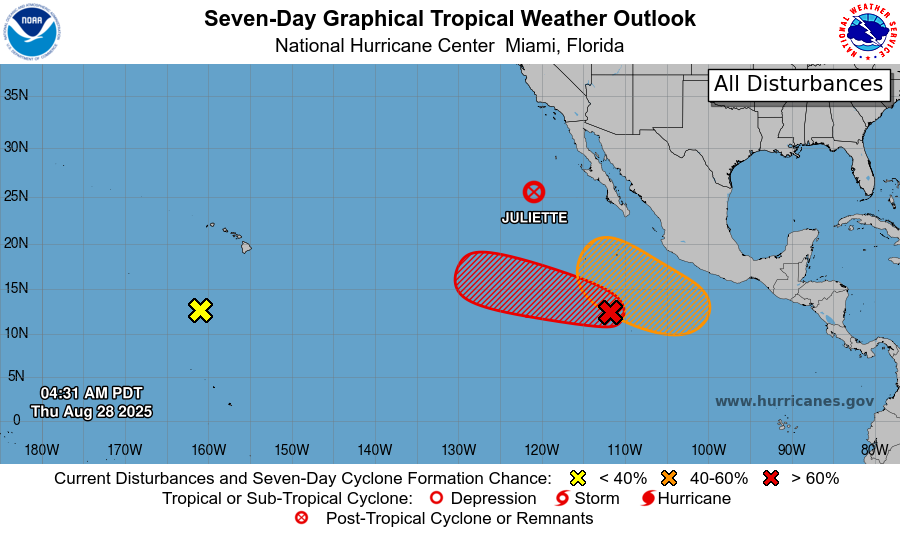
In the tropics, the Atlantic remains generally quiet as Fernand has become post-tropical and a system emerging off Africa looks to have a very low chance for development in an overall unfavorable environment. The Pacific is where the action is at, with two systems being monitored closely by NHC. The westernmost system has a high (80%) chance of development over the next several days, and this system will be worth keeping an eye on as the models suggest it could maintain itself into the central Pacific. The easternmost system is just beginning to take shape and has a 40% probability of development in several days. This system looks to have some potential to impact Baja California and possibly the Southwest with at least some moisture influx next week, so we will also keep an eye on it.
 Balanced Weather
Leave a comment