
Weather Act Reauthorization hearing a cheerleading event for NOAA weather efforts
Sep 11, 2025
As I mentioned a few days ago, the House Science Committee on Wednesday held a hearing to “markup” the Weather Act Reauthorization bill. This bill was introduced by Oklahoma Republican congressman Frank Lucas earlier this summer, and it is intended to reauthorize the 2017 Weather Research and Forecasting Innovation Act. The initial 2017 Weather Act was passed by Congress and signed into law by President Trump. It provided Congress’ priorities for NOAA as far as weather forecasting and research.
This new Weather Act reauthorization bill is similar to the bill that was passed by the House last year but failed to clear the Senate before the end of the Congress. The Weather Act Reauthorization bill that moved through the House last year was the result of a bipartisan effort and passed with very little controversy. It was (and is) essentially a restatement of Congressional priorities for NOAA to continue weather research programs such as the VORTEX-USA severe weather research program, the Hurricane Forecast Improvement Program, the EPIC weather modeling effort, as well as direction to NWS to continue prioritizing Impact-Based Decision Support Services, cloud computing and new commercial observation purchasing programs.
Obviously, the overall political environment is radically different today versus a year ago. The Trump Administration in its FY2026 budget announced plans to eliminate NOAA’s research office, the Office of Oceanic and Atmospheric Research, and make significant changes and reductions to NOAA’s geostationary satellite program, and in recent weeks has taken actions to move these plans forward. However, there was very little acknowledgment of any of this in Wednesday’s hearing. Rather, it seemed more like a full-throated bipartisan endorsement of what NOAA does with its weather operations and research efforts.
As a markup hearing, the purpose was to go through the various amendments to the bill offered by committee members, vote them up or down, and then provide a final vote on the amended bill. A number of amendments were offered that can be viewed on the committee’s webpage; other than a couple that were withdrawn, they were all approved. Most were fairly minor, although Rep. Scott Franklin (R-FL) inserted an additional section focused on improving the infrastructure and support for the use of artificial intelligence in NOAA’s weather programs. The overall tone of the hearing was very bipartisan and supportive of NOAA and its weather agencies and programs.
Of course, this is consistent with what we have seen to date with the appropriations processes in both the House and the Senate, which have essentially disregarded most of the administration’s proposed or intended cuts for NOAA. While this is encouraging for those concerned about the future of our weather research and warning programs, given statements by the Office of Management and Budget Director that “the executive branch (is) ensuring that it’s not cowing to a legislative branch’s understanding of its own authorities and powers,” clearly there continues to be concern that the administration will continue to move forward with its plans regardless of Congressional intent or actions.
The bottom line is that what the House Science Committee discussed today as far as advancing NOAA weather research and operations bears no resemblance to what the Trump Administration has announced as its plans and priorities for NOAA. When there will be a true acknowledgment of this fact and a face-off between the disparate NOAA worldviews of the executive and legislative branches that gives the community some clarity on the future remains to be seen.
Of course, the weather aspects of the federal budget and legislative efforts are a very small part of the larger picture being dealt with in Washington. The federal budget year ends September 30th, and if there are not new appropriations laws in place for the various departments — which seems very unlikely at this point — either a continuing resolution will have to be passed and signed into law or the government will shut down on October 1st. Each shutdown is unique depending on how the given administration handles it as guidance to the agencies on what they can or cannot do without appropriations varies. Hence, we will be waiting to see what sort of guidance NOAA receives as a potential shutdown gets closer.
Learn about other BalancedWx Services
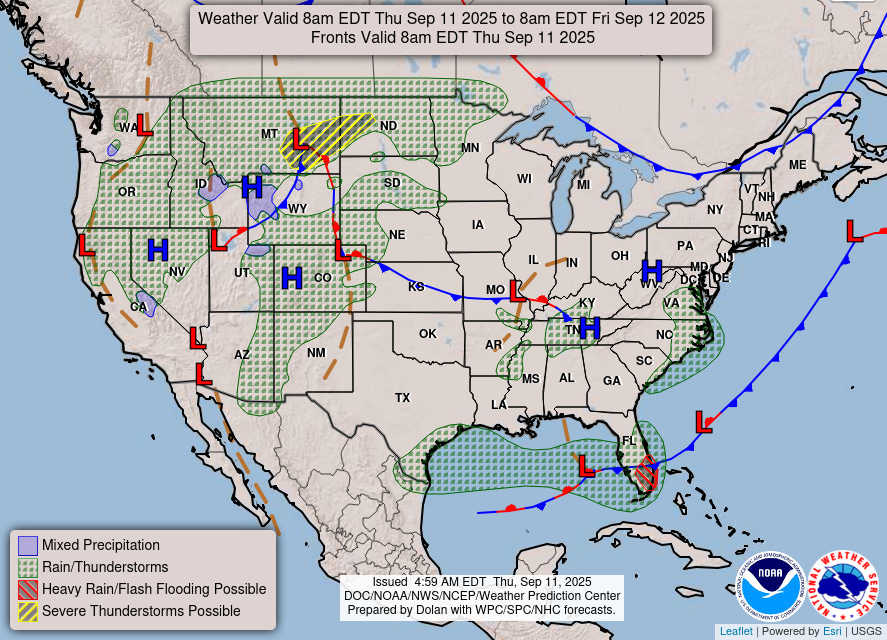
As far as the weather scene today, thunderstorms will be an issue on the northwest and southeast sides of the country. A slight (level 2 of 5) of severe storms is in place for parts of Montana and North Dakota, with scattered severe storms capable of damaging winds and large hail expected. The stationary front across Florida will continue to bring waves of showers and thunderstorms there, with locally heavy rain potentially causing some flash flooding, particularly over southern Florida.
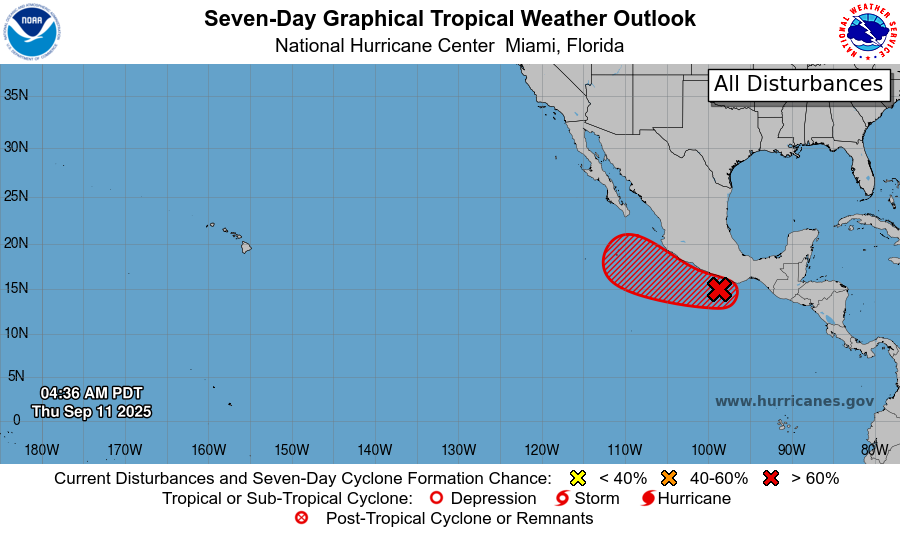
In the tropics, Kiko has now dissipated north of Hawaii, and the system we have been discussing southwest of Mexico has been designated Invest 95E by NHC. This system will very likely (90% probability) become a tropical depression or storm in the next 24 hours as it moves slowly west-northwest offshore the southern coast of Mexico. As we have talked about, this system could be close enough to the coast to cause some impacts, especially rainfall related, over the next couple of days.
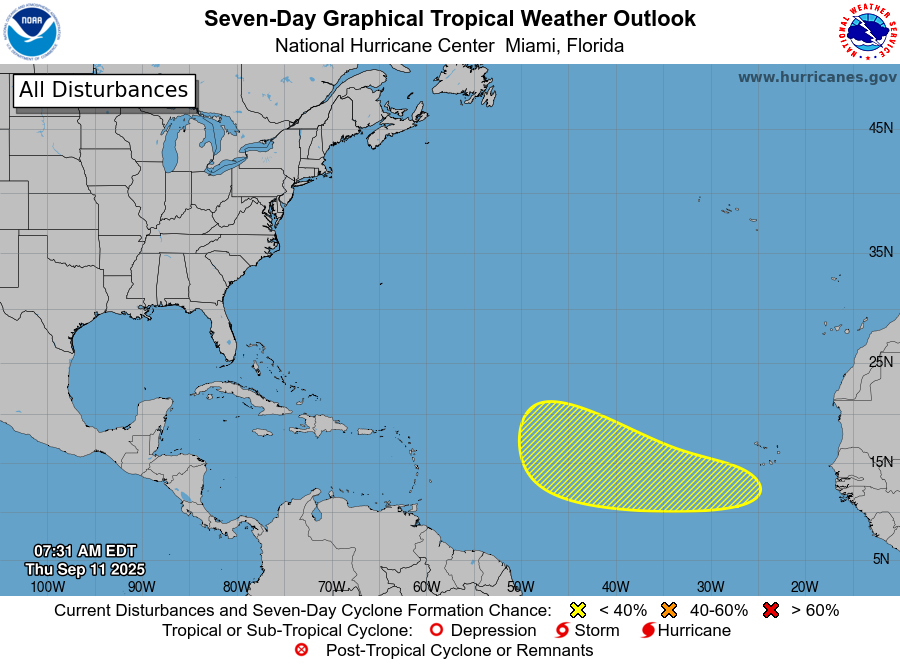
In the Atlantic, NHC is now highlighting the next wave coming off of Africa for potential development by early next week. The models continue to be bullish on this system, as well as the next system coming off Africa several days from now. There are also more signs in the models now of the possibility of something developing closer to the US in the western Caribbean or southwest Atlantic in the week 2 period. Obviously, right now there is nothing specific to be of any concern for the US as far as the Atlantic tropics — but all of this is pointing toward what was discussed in the Colorado State University update I talked about yesterday, namely that the latter half of September will likely be much more active than the first half.
Programming note: I will be attending the Mississippi Book Festival in Jackson this Saturday. From 10:45 am to Noon CT, there will be a panel discussion on the 20th anniversary of Hurricane Katrina featuring former Mississippi governor Haley Barbour, who was governor during Katrina. I am planning to do a live Substack chat of this event for paid Balanced Weather subscribers, internet access permitting. I will be sharing highlights from the panelists as well as my own perspectives from being the NWS meteorologist-in-charge in Jackson at that time. I hope you can join me for this event.
 Balanced Weather
Leave a comment