
Staffing levels and morale still concerning as head into the fall
Sep 24, 2025
Earlier today, the Associated Press published a story about the chaos that has occurred due to Department of Government Efficiency (DOGE) staffing and budget cuts to the General Services Administration, the federal agency that manages real estate and purchasing for the government. Per the article, GSA is attempting to rehire hundreds of GSA employees who were let go in staffing cuts earlier this year:
Those who accept must report for duty on Oct. 6 after what amounts to a seven-month paid vacation, during which time the GSA in some cases racked up high costs — passed along to taxpayers — to stay in dozens of properties whose leases it had slated for termination or were allowed to expire…As a result of the internal turmoil, 131 (federal real estate) leases expired without the government actually vacating the properties, the official said. The situation has exposed the agencies to steep fees because property owners have not been able to rent out those spaces to other tenants.
A former GSA official summarized the situation thusly — “ultimately, the outcome was the agency was left broken and understaffed,” said Chad Becker, a former GSA real estate official. “They didn’t have the people they needed to carry out basic functions.”
Of course this article — and particularly the summation by Mr. Becker — reminded me starkly of the situation that has faced NOAA, and especially NOAA’s National Weather Service, in the wake of DOGE and Office of Personnel Management (OPM) spurred staffing and budget cuts earlier this year. As we talked about here back in early May, after a spring of terminating probationary employees and offering early retirement and buyouts, NOAA lost about 2,000 of its previous 12,000 employees.
This left the already hurting NWS so short staffed that for the first time — at least that I am aware of —some NWS Weather Forecast Offices had to close part of the day and turn services over to adjacent offices. In the wake of media reporting about several high profile weather events where there was concern about NWS services possibly being negatively impacted — particularly the late May violent tornado in southeast Kentucky and the Texas Hill Country flash floods — the Trump Administration eventually designated the NWS as a public safety agency, exempting it from a government-wide hiring freeze and allowing it to start the process of hiring back up to 450 employees the agency lost.
In recent weeks, the NWS has worked to post a number of vacancy announcements to recruit dozens of vacant positions, including at least 40 entry level meteorologist positions. Obviously, however, these positions will take many weeks to go through the hiring process — and then new employees will have to be trained, which typically takes months. In the meantime, the NWS is having to continue to provide normal services while navigating significant staffing shortfalls — an incredibly concerning situation resulting from haphazard staff reductions similar to the GSA story reported by the AP.
One of the key NWS activities impacted by the staffing cuts that received a lot of attention both from the media and Congress was upper air weather balloon releases. The NWS had to curtail or terminate the normal twice-daily releases at a number of locations around the country. Several Congressional representatives spoke out about this, and in late April the Congressman for the location of the Omaha, NE office announced that he had been assured that twice-daily upper air balloon release would resume at that office after it was one of two central US offices that the NWS had completely terminated upper air data collection.
From a review of the upper air data for the Omaha site (retrieved from the Iowa State University Iowa Environmental Mesonet website), it appears as though one per day balloon flights routinely occurred there through the end of July. Since August 1, twice per day flights have resumed and there have been two flights per day at Omaha on all but 3 days — and it should be stressed, that missing an occasional flight for a variety of reasons (weather, instrument failure, etc.) is not unusual. The other central US terminated upper air site — Rapid City, SD — also resumed routine twice-per-day flights on August 1.
Even though these offices and others who had seen reduced upper air flights seem to have increased their releases, the cadence of the flights have changed. The standard release times for balloon releases not just in the US but globally are at 0000 and 1200 Universal Time Coordinated (UTC) — release times coordinated internationally to ensure a maximum amount of synchronous global upper air data for numerical weather prediction models and other applications.
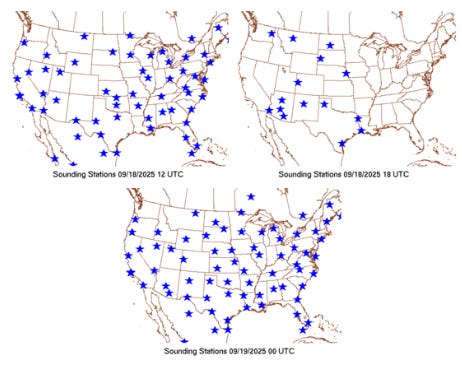
These maps from the Storm Prediction Center’s upper air webpage show the available upper air balloon soundings from a recent example calendar day, September 18 2025, for the three main times of release: 1200 UTC, 1800 UTC and 0000 UTC. While you can see most NWS upper air locations have two flights on this day, 15 of the 69 CONUS upper air sites have 1800 UTC (top right map) as one of their two flights. Most of these have a second flight at 0000 UTC, but two of the Arizona sites did their other flight at 1200 UTC (and Spokane and Great Falls only had one flight on this date).
My understanding from talking to several of my former colleagues is that offices are being allowed the flexibility to time their two releases around staffing availability. From my perspective as a former NWS manager, this makes total sense and obviously having two flights with one at a “non-standard” time is better than only one (or none). However, this does show that staffing is still a constraint on NWS operations — and I will say that I do not know what, if any, impacts this could be having on model or forecast performance. It would actually be an interesting scientific study — hypothetically perhaps the models that are run at 1800 UTC are slightly improved with more upper air data?!
Obviously, the NWS is not the only entity within NOAA or the broader federal weather and disaster management structure dealing with staffing and budget constraints. Just this afternoon, the Washington Post reported on the serious problems FEMA had in responding to the Texas Hill Country flash floods in July, including having an acting director who was unreachable and an inability to deploy resources requested by Texas officials. Some NOAA colleagues have described needed supplies and equipment being unavailable or on back order — and this is before we even get to a period with either a government shutdown or likely constrained funding due to a continuing resolution.
Clearly, the federal weather and disaster apparatus remains in a precarious state. I routinely talk to a lot of friends and colleagues still working in this arena, and while it sounds to me like morale has perhaps improved slightly over where it was 6 months ago, I still get the sense that staff morale and burnout is a real concern. While we have obviously had a handful of tragic weather events over the last several months, we have been lucky to this point that we have not had a major hurricane landfall or wildfire outbreak. With signs that the Atlantic hurricane season might be getting more active over the next several days and fall wildfire season approaching, will our luck hold out?
If there is a government shutdown, the administration will set the policies that will guide what duties agencies such as NOAA will be able to designate as mission-critical and continue to perform. While the potential government shutdown is obviously the looming short term concern for the federal budget process, the resolution of the huge differences between the vision of Congress and the Administration for federal science and disaster agencies is the crucial situation to monitor over the next several months from a longer term perspective. If and when a continuing resolution is put in place to fund the government, the administration will likely have a lot of flexibility on how to administer and execute that short term funding. In my opinion, this will be a pivotal time to watch for potential significant organizational and budgetary changes to be made by the administration to possibly implement their vision for agencies before Congress can try to finalize their ideas through the appropriations process. I expect the next several months will truly be momentous for the future of the federal weather and disaster management structure.
 Balanced Weather
Leave a comment