
In weather: significant coastal impacts expected from East Coast storm, while rain and potential flash flooding continues in the Southwest
Oct 11, 2025
On Friday, the Office of Personnel Management (OPM) announced that it had begun a new reduction-in-force of federal employees. The Trump Administration had been threatening since late September that it would utilize a government shutdown to further reduce federal employment rolls by permanently laying off furloughed employees who work in programs “not consistent with the President’s priorities.” According to a court filing yesterday, more than 4,500 federal employees received RIF notices on Friday, but a senior administration official told USA Today that “more layoffs are coming.”
As of now, I am not aware of any new layoffs in NOAA; the court filing stated that the Department of Commerce would be RIFing 176 to 315 employees, but to this point it does not appear that NOAA was the Commerce agency targeted. From a broader scientific perspective, the major impact of yesterday’s action appears to have been at the Centers for Disease Control and Prevention (CDC). The Department of Health and Human Services (HHS) stated that they would be firing more than 1,000 employees, and last night there were multiple media reports that CDC was the primary HHS agency targeted. Politico reported this morning that entire offices within CDC were being eliminated; social media reports last night indicated that the editors and staff that produce the renowned CDC Morbidity and Mortality Weekly Report (MMWR) were among those impacted by the firings.
It is important to realize that permanent layoffs of furloughed employees is an unprecedented action during a government shutdown. Senate Majority leader John Thune (R-SD) tried to portray the administration as having shown restraint in waiting 10 days to take this action:
“They held off for 10 days,” Republican Senator John Thune told reporters, referring to the White House. “At some point they were going to have to make some of these decisions and prioritise where they’re going to spend money when the government is shut down.”
In my opinion, this is nonsense. The employees who were RIFed yesterday were not costing the government any money during a shutdown because they were already furloughed and not getting paid. To be clear, even essential employees — such as NWS forecasters and technicians — still working are not currently costing the government money because they are not getting paid either: the whole reason there is a shutdown is because the federal government does not have any funding to spend. The government has never had to permanently RIF people during a government shutdown in the past — this new RIF is a choice behavior by the Trump Administration.
While I am obviously concerned that the RIFs at CDC may presage that future RIFs could impact weather and climate programs that have been targeted for elimination in OMB budget documents, I am also gravely concerned about the continued erosion of the federal government as an attractive place to work. Many of the talented scientists that work for the federal government could make much more money in the private sector; they work for the federal government because of their desire to perform public service and because the federal government was seen as a stable place to build a career. For now there are still significant and unique benefits to being a federal employee, but the shutdown and the RIFs are just another example of the long list of actions that have occurred in 2025 to seriously erode the cache of federal employment for the best and brightest scientific talent. Given that OMB is current led by someone who stated that his intent is for federal employees to “be traumatically affected. When they wake up in the morning, we want them to not want to go to work because they are increasingly viewed as the villains,” I am not optimistic that this trend is going to reverse any time soon.
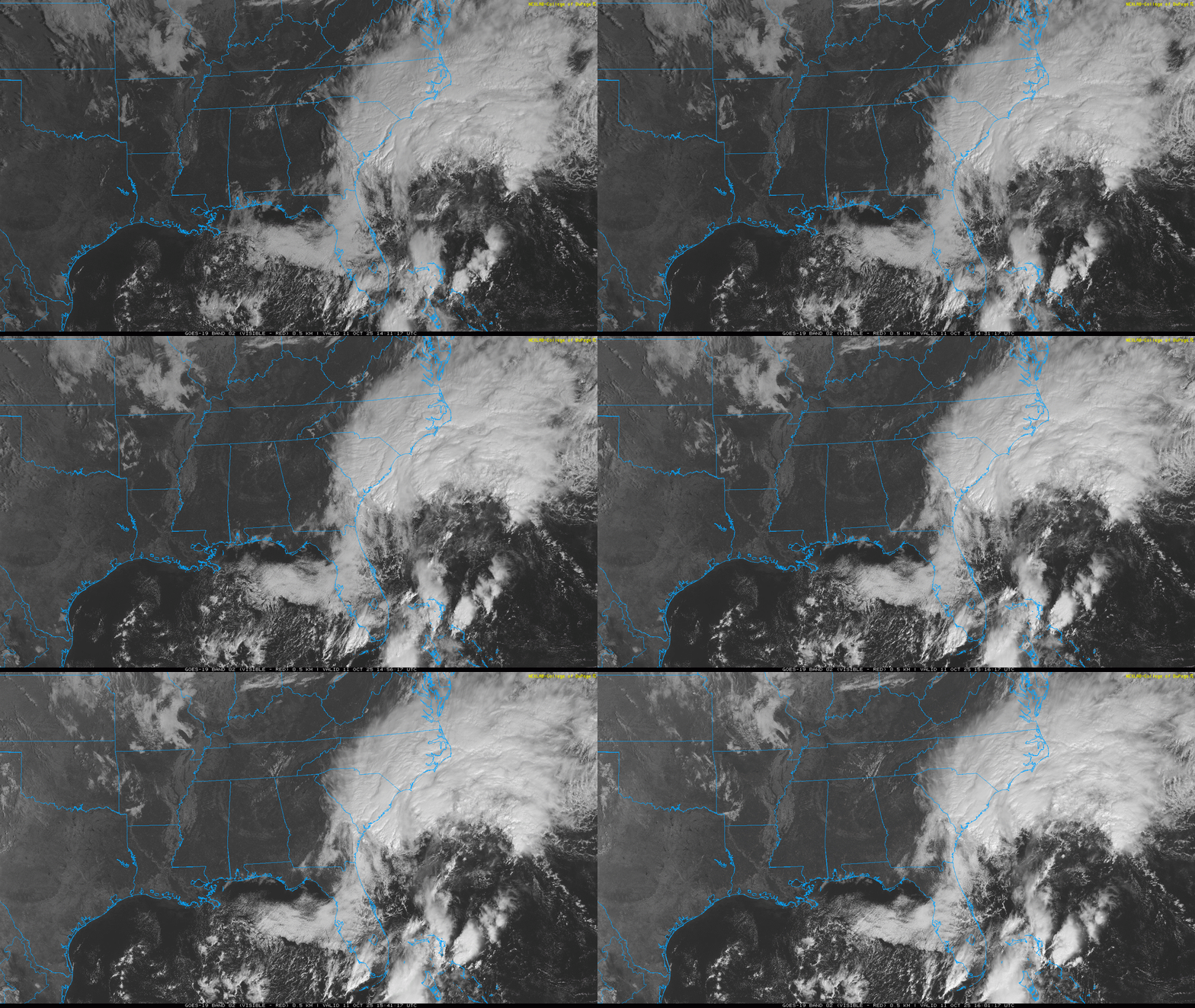
Turning to weather, visible satellite this morning clearly shows the developing low pressure storm system off the Southeast US coast, with widespread shower and thunderstorm activity north of the center. As expected, this system as of now is clearly a non-tropical low, with a well defined warm front extending east-northeast from the center. While there is still a non-zero chance this system could obtain more tropical characteristics over the next several days assuming it remains over water and thunderstorm activity remains robust near it, whether it is non-tropical or tropical will not have any meaningful change to the impacts described below.
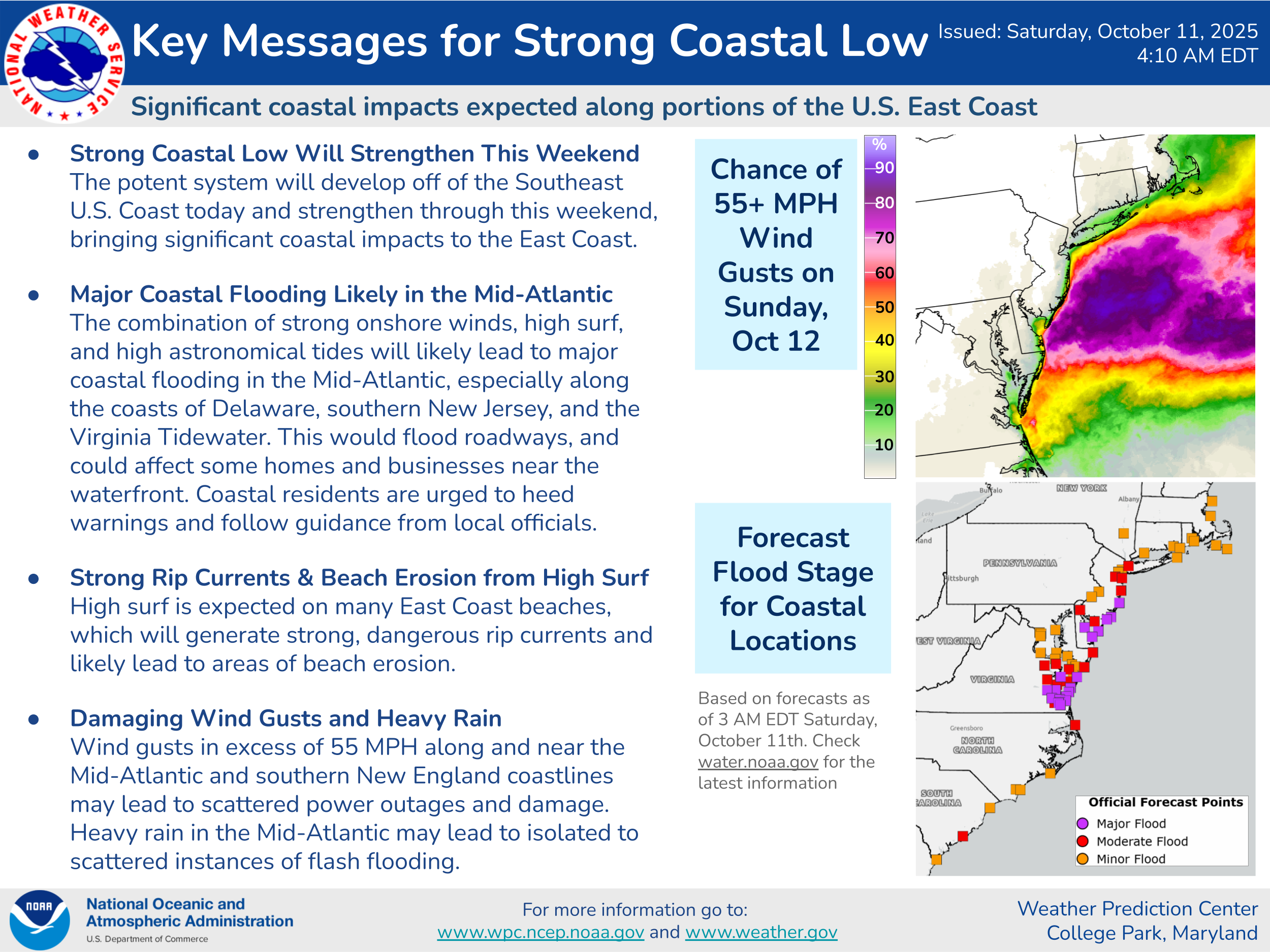
Coastal flooding and strong winds are expected up and down the Eastern Seaboard this weekend as this storm system intensifies and slowly moves north and a new low likely develops to the north off the Delmarva and New Jersey. The most serious impacts look as if they will focus from the Virginia Tidewater area into southern New Jersey where widespread major coastal flooding is anticipated, and as my colleague Matt Lanza noted in his morning post this will likely be the most impactful coastal storm for Delaware and southern New Jersey in the last 10 to 15 years.
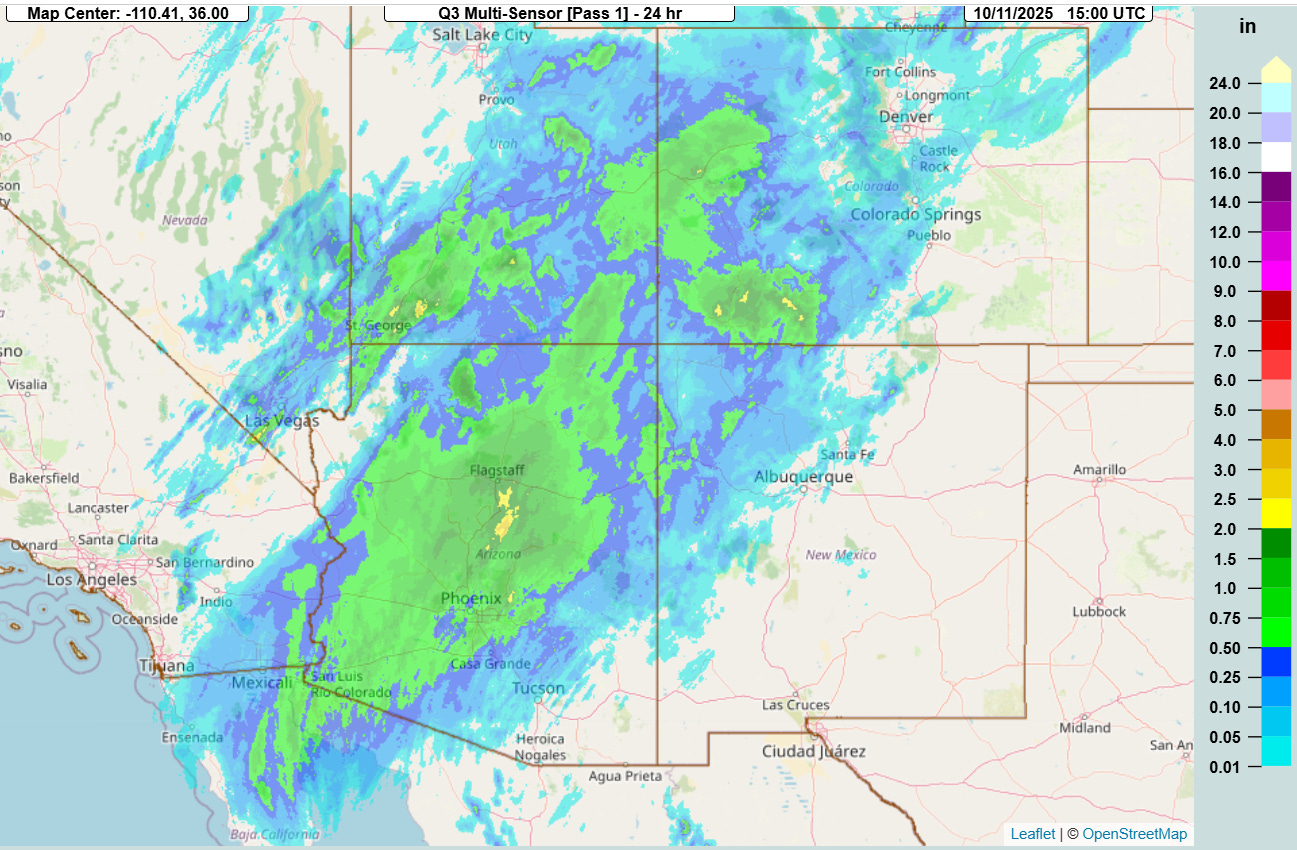
Meanwhile, moisture from Tropical Storm Priscilla has fueled widespread moderate to heavy rain over the last 24 hours over much of Arizona and adjoining parts of Utah and Colorado. Flash flooding has been reported, particularly in central Arizona and southern Utah, as well as in the Las Vegas metro area where thunderstorms produced heavy rainfall. Of course, outside of the flooding the rainfall is very beneficial to a region suffering from significant drought.
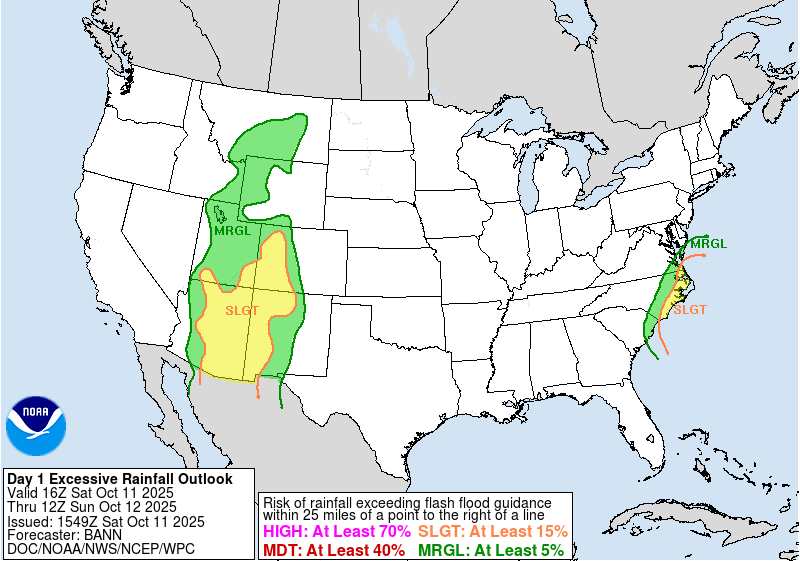
Rain and thunderstorms will continue across much of the region today, with a slight (level 2 of 4) risk of flash flooding in place from the NWS Weather Prediction Center. The flash flood risk will become more confined to southern Arizona and southwest New Mexico on Sunday and Monday as it becomes more focused around moisture coming north from the remnants of Tropical Storm Raymond.
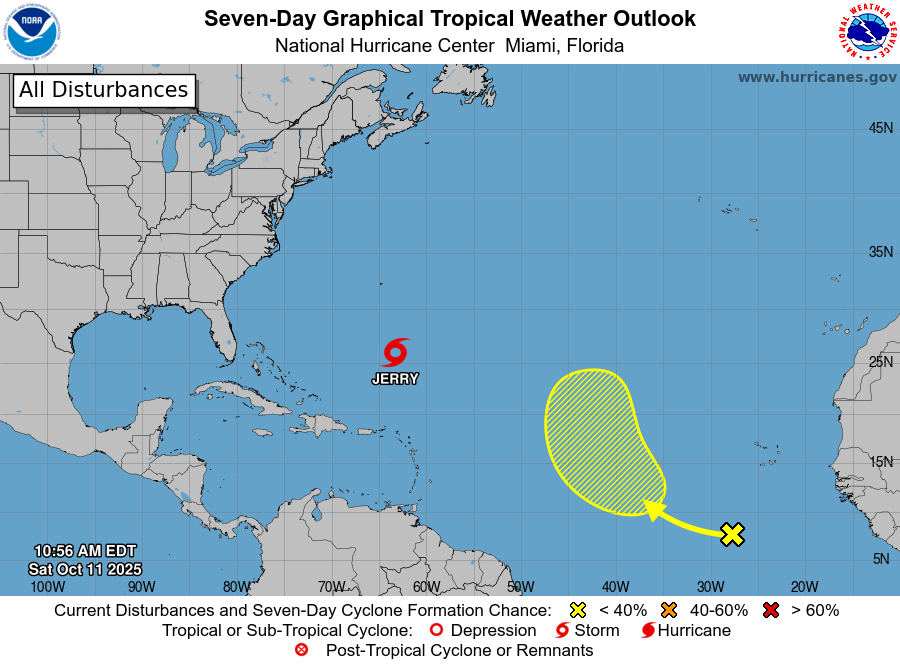
Elsewhere in the tropics, Tropical Storm Jerry continues to struggle with wind shear and is unlikely to last much longer. A few model solutions do show Jerry getting a new burst of organization as its remains eventually turn northeast across the central Atlantic, but regardless it is of no risk to land. NHC is monitoring a new system over the eastern Atlantic, right now the models do not have a particularly strong signal with this system and even if it were to develop it looks to remain over the central Atlantic.
 Balanced Weather
Leave a comment