
Talking about practical implications for federal weather and climate science
Oct 15, 2025
Today marks the 15th day of the federal government shutdown, and there are increasing concerns that this could end up being the longest shutdown on record, eclipsing the 35 day shutdown that started in December 2018. A government shutdown occurs when federal funding lapses due to the lack of appropriations from Congress and the President, and the Antideficiency Act requires all “non-essential” federal government activities to cease. “Excepted activities” to protect life and property and functions related to the constitutional government are legally allowed to continue.
For the federal weather and climate apparatus, this means that most of the main functions of the National Weather Service continue. Each government shutdown is a little different because each presidential administration interprets the laws governing a shutdown through their own political and legal lens. In this shutdown, my understanding is that most (if not all) NWS employees are considered essential and are working as normal. However, obviously they do not have access to any funding, so any activities requiring purchasing or expending funds for things like travel are generally limited to absolute emergencies.
Additionally, these employees are working without receiving any paychecks. All of the stresses that we have been talking about in recent months that NWS employees have been dealing with — short staffing, overtime and double shifts, lack of budget, etc. — now have the additional burden for employees of not receiving any income and all of the personal complications that will arise from that. While the law requires that these employees get paid for their work eventually, if the shutdown drags on for weeks, obviously financial stresses will build and — again — for public servants with jobs requiring complete focus like issuing tornado warnings or controlling the airspace, it really seems to me like a bad idea to be artificially adding additional stress and distractions to their work and lives.
With regard to the research side, at least for NOAA most of the research labs have a combination of federal staff and researchers employed through associated university cooperative institutes (CI). Most university cooperative institute positions are “forward funded,” meaning the money funding these employees was already awarded and thus they can continue to work. Whether or not they can access government computer systems to do their work has varied from shutdown to shutdown, but my understanding is that in this shutdown federal IT systems have remained accessible (at least that is what I have heard from people at the lab where I worked, and I assume it is the same across NOAA).
Of course, the federal scientists who work with the CI scientists and who generally provide the overall science leadership and guidance for CI research are not working, which limits the amount of new work that can actually be done. Additionally, NOAA Research also relies on a number of actual contractors, and the funding mechanisms for those contracts vary meaning that some contractors are working and some are not. This is likely at some level affecting NWS as well where some services in areas such as human resources and IT are reliant upon contract employees.
I think this article from Science magazine does a good job of summarizing the demoralizing impact the shutdown is having on federal scientists within the context of everything else that has gone on this year. As the shutdown drags on, these employees are now also having to worry about threatened and actual layoffs as part of the administration’s shutdown strategy. Just yesterday, the Wall Street Journal reported that the Department of Commerce had submitted a list of 300 NOAA employees to OPM to be laid off if a reduction-in-force is executed within Commerce.
Perhaps what frustrates me most about all of the coverage and rhetoric surrounding this (and other) government shutdowns is that it is not in fact truly a “government shutdown.” Obviously as a long time federal employee who was dedicated to public safety, I completely understand why the Antideficiency Act makes exemptions to allow protection of life and property federal activities to continue. But those exemptions serve as a crutch that allow our political leadership to use exempted federal employees as unwilling and mistreated pawns in their political strategies. If we actually shutdown the National Weather Service, the air traffic control system and TSA and other “excepted” essential government activities, the public would truly understand the federal services they rely upon every day. I am quite confident we would not see weeks long shutdowns if those services truly went away during a so-called “government shutdown.”
Learn about other BalancedWx Services
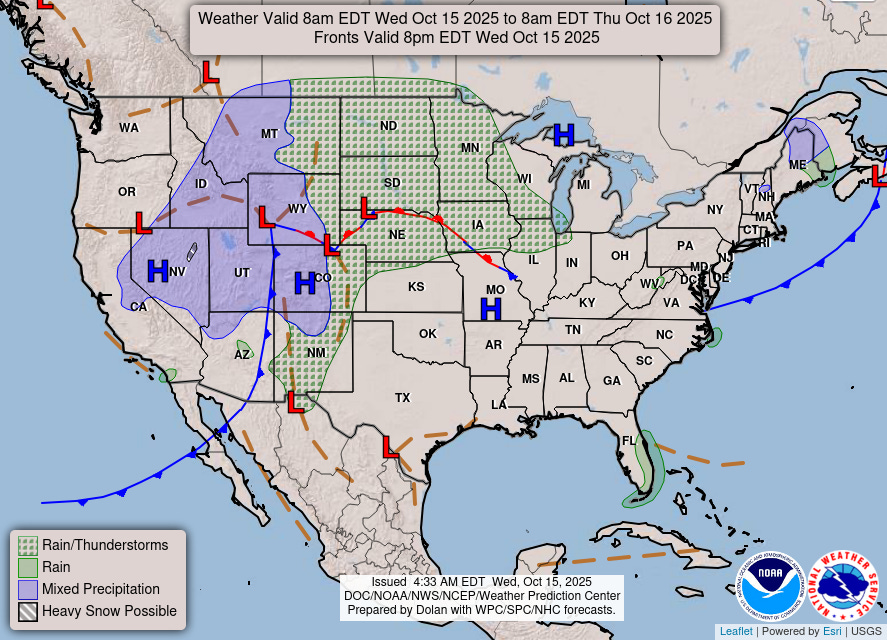
The weather is finally taking a short breather across the Lower 48. While a slow moving storm system will bring some rain and mountain snows to western and central parts of the nation, the overall risk of organized or widespread hazardous weather is low today.
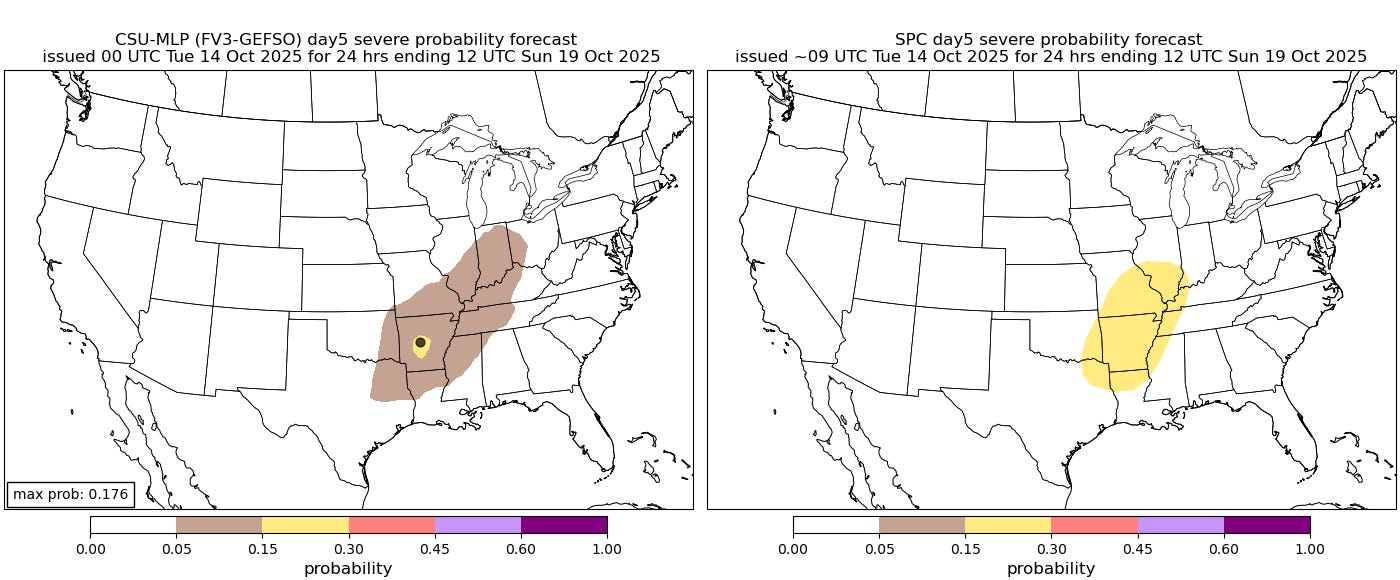
It continues to look as if this storm system will see some reinvigoration late in the week, and at least a low risk of some severe weather looks possible across central parts of the nation.
Much of the central part of the country will continue to see unusually warm weather, and some record highs are possible the next couple of days in the Mid-South while some record warm minimum temperatures are possible in the upper Midwest. Unusually cool weather will be seen in the West, and some record low maximum temperatures are possible today in the Southwest.
In the tropics, Lorenzo is disorganized and has just about completely given up the ghost; it should become a remnant low in the next 24 hours. Meanwhile, we continue to watch the potential for development in several days with a wave that will be moving west into the Caribbean. Interestingly, it seems to me as if the European ensemble has become a bit less bullish on development while the Google DeepMind AI has become a bit more bullish. Regardless, they do seem to be focusing on the idea that any development would likely wait until the wave gets into the western and central Caribbean, an area that is more climatologically favorable for development at this time of year and where the models overall show a favorable looking environment. That would not happen until sometime next week, so right now it is definitely just something to keep an eye on.
Programming note: I will be traveling the next several days on a road trip to and from Florida. As of now, I am planning to keep a relatively typical level of posts going, but will obviously let you know if that changes. I am also planning to make some video posts along the way from the Gulf Coast about hurricanes and particularly Katrina and its recent 20th anniversary. Internet permitting I am planning on some live content — as a reminder, access to live video and chats is a primary benefit of supporting Balanced Weather with a paid subscription.
 Balanced Weather
Leave a comment