
Lack of mission clarity, lack of leadership, and battles with the states are all leading to a federal emergency management agency that looks unable to manage itself, let alone emergencies.
Dec 12, 2025
This week has seen a number of media stories about the two main federal agencies responsible for helping the country deal with weather and water disasters, NOAA and FEMA. With the ongoing historic flooding in Washington the last few days I have been focused on that, but given that a key story regarding FEMA came to a head yesterday, I am going to focus today’s newsletter on the current situation surrounding that agency.
Thursday was supposed to finally bring some clarity to the Trump Administration’s plans for FEMA. As I talked about a few weeks ago, after initial calls to disband the agency, earlier this year the administration formed a FEMA Review Council to draft a plan to radically reform the agency. The work of this council — primarily made up of Republican politicians or emergency management professionals from “red” states with significant weather vulnerabilities — had already been through a lot of debate and scrutiny, as the group leaned toward recommending FEMA being moved out of the Department of Homeland Security (DHS) to become an independent agency, an idea staunchly opposed by the administration and particularly DHS Secretary Kristi Noem. The internal debates surrounding the council’s recommendation had already delayed the release of its report several weeks beyond its initial deadline, but a public meeting scheduled for yesterday was supposed to bring the formal rollout of the plan and the council voting on approving the plan’s recommendations.
However, at the last minute, the meeting was abruptly canceled, and has not been rescheduled. Politico reported that the meeting was canceled because CNN had obtained a copy of the draft report and published an article detailing the recommendations on Wednesday, and that the administration wanted to stress that the report was still subject to change. CNN further reported that White House officials who had reviewed the report objected to its recommendations, and that the meeting was canceled because “White House officials had not been fully briefed on the latest draft of the report, despite some officials at DHS thinking they had been.”
The initial CNN report concerning the draft report indicated that it recommended that FEMA remain a part of DHS, but that the agency be reduced in size by about half, be renamed, and have its focus evolve to primarily focus on rapidly dispersing disaster aid to states and individuals — but with a higher threshold for what disasters qualify for federal aid and states having to provide “a higher cost share than the current rules require.” Encouragingly, the draft report did apparently maintain some critical federal resources like the Urban Search and Rescue Network, which would be very difficult for most states to maintain on their own given the infrequent need for such resources at an individual state level.
Obviously, given that the draft report was not actually publicly released yesterday, there is no way to know whether what eventually is released will be the draft that CNN obtained, or if there will be further changes to the report now that White House officials have apparently raised concerns about the report. What is clear is that this agency which plays a crucial role at the top of the emergency management structure for this country continues to be in a state of uncertainty and chaos.
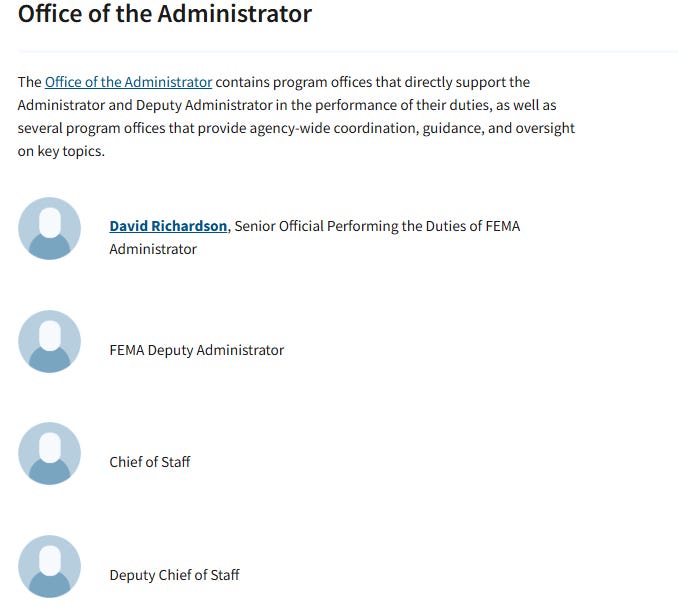
Along with this ongoing debate about the future of the agency, FEMA continues to limp along with acting, inexperienced — or no — leadership at the top of the agency. When you go the FEMA webpage dedicated to the agency’s organization and leadership, the above screenshot is what you see for the Office of the Administrator, i.e., the office of the agency director. The webpage still lists David Richardson as the “Senior Official Performing the Duties of the FEMA Administrator” even though he resigned last month, and all of the other three senior leadership positions are shown as vacant. Of the eleven senior positions at the top of FEMA listed on the website, only three are shown as being currently occupied, and two of those are with “acting” individuals. Only one position, Deputy Associate Administrator for Mission Support Tami Franklin, is shown as a permanent employee. To me, all of this is a clear demonstration of the disorganization and chaos that currently exists at this public safety agency.
Furthermore, earlier this week multiple media outlets reported that Gregg Phillips, a Republican activist who played a key role in promoting claims that millions of votes were cast illegally in 2016 through the True the Vote nonprofit, was hired to oversee FEMA’s Office of Response and Recovery, a position that a former FEMA official described as the “second most important role in the agency behind the administrator.” Regardless of what his political background is, Phillips does not appear to have any of the formal background in emergency management that one would expect for someone in a position at this level, with his primary experience in the field appearing to be criticizing FEMA’s response efforts. From a CNN article about his hiring:
Phillips has been a vocal critic of FEMA. In a post this fall, he wrote, “I’ve seen the failures up close and personal, watching people suffer. I’ve seen the best of America’s contractors walk away in disgust over the inept FEMA contract managers.”
“It is almost always true that those with a Christ centered approach show up first and leave last bringing hearts, hands and supplies when darkness hits,” the post continued. “FEMA has taken credit for their work — pushing DEI and ‘woke’ even into this program. The fails have been epic.”
Again, I do not think that anyone who is a part of or works adjacent to the emergency management apparatus in this country is unaware that FEMA has significant problems and needs reform. However, I do not see any evidence that what this administration has actually done in its first year in office is anything but making an already challenging situation for this agency much worse. FEMA is clearly in limbo waiting for some sort of direction from this FEMA Review Council, and is rudderless at the top, with senior leadership positions either vacant or held by people with little in the way of formal emergency management experience.
It is also important to again reiterate that FEMA sits at the top of a large emergency management structure that extends down through the state, county and municipal governmental levels. While the primary responsibility for emergency management does in fact reside at the more local levels of government, FEMA provides the overall structure and organization within which those entities operate. As FEMA limps along in this kind of purgatory, the rest of the country’s emergency management apparatus is also in a related state of uncertainty, waiting to see what sort of a new environment they will be operating in going forward.
An example of how the chaos at the federal level is radiating out to the states and locals came yesterday when a federal judge ordered FEMA to restore billions of dollars of disaster mitigation funding within the Building Resilient Infrastructure and Communities (BRIC) program. I wrote back in June about BRIC and how it is one of the key programs to provide state and local communities with federal funding to build capacity to reduce the impacts of weather and water events. BRIC came to be as a result of a law passed by Congress and signed by President Trump during his first administration, but the new administration canceled about $4.5 billion in ongoing and new funding under the program.
This cancelation was protested by a number of both Democratic and Republican led states, and a multi-state lawsuit was filed in opposition to the funding cancelation. The ruling by a federal judge yesterday sided with the states, saying the cancelation was unlawful because Congress specifically appropriated the money for the grants, and there is an “inherent public interest in ensuring that the government follows the law.” The Associated Press article on the ruling also notes that the administration has not approved any requests for hazard mitigation funding since February, and that emergency preparedness grants that “states and local governments rely on to staff emergency management agencies and buy equipment are currently frozen after 12 states sued the Trump administration over unprecedented grant stipulations related to the administration’s immigration agenda.”
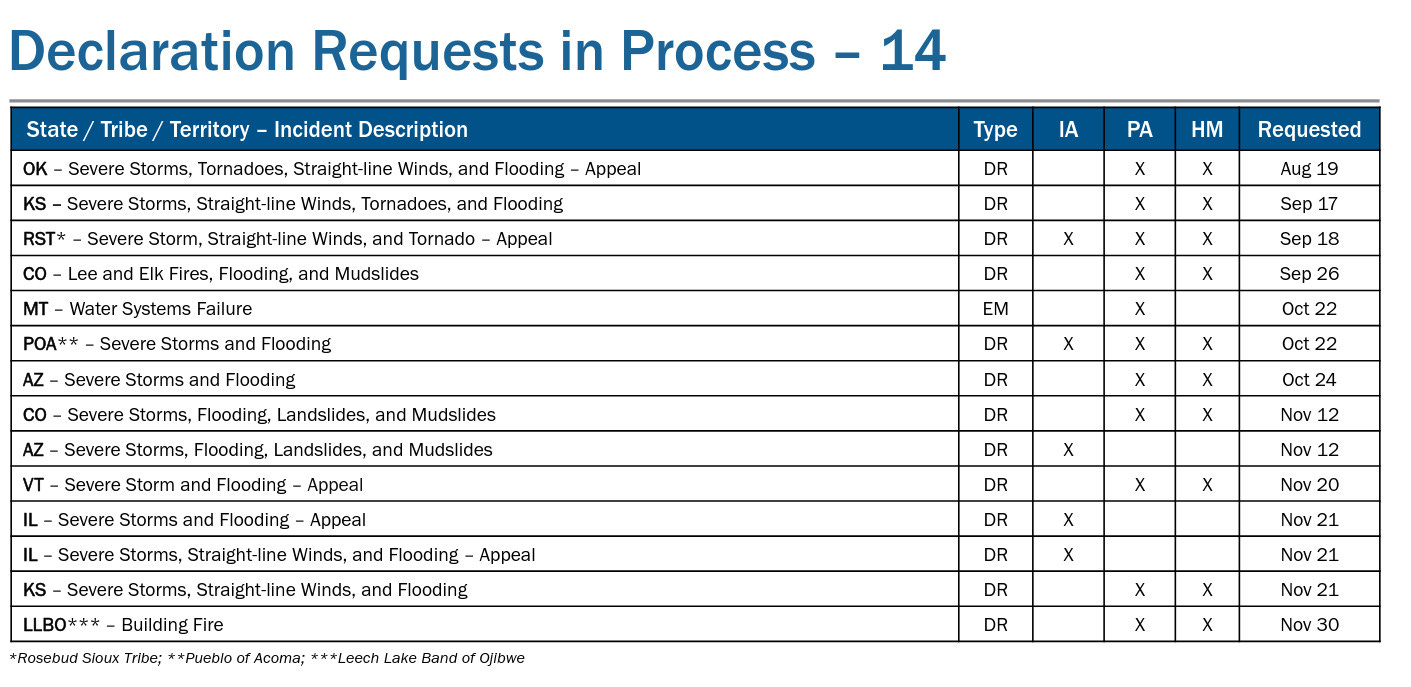
The process for states and tribal nations to request federal disaster declarations is also apparently damaged and marred by unusual delays. Multiple media reports over the last several months have discussed the backlog of disaster requests, and the table above is the current list of pending requests from this morning’s FEMA brief (posted on BlueSky by AI6YR Ben). There are more than a dozen pending requests, including a number of appeals filed for disaster events that occurred months ago. An Associated Press analysis found that over the last decade, federal declaration requests from the states on average took three weeks for FEMA to process. As you can see here, the majority of these current pending requests are more than a month old, with the oldest — an appeal from Oklahoma for a severe weather and flash flood event from earlier this year — nearly four months old.
We have overall been incredibly lucky in the last several months with regard to major disasters. While we obviously had the tragic Texas flash floods in July and are currently dealing with the historic river flooding in Washington state, the United States did not have a landfalling hurricane this year for the first time in a decade, and wildfire season was relatively manageable. Whether it comes from a weather or flood event or an unexpected earthquake or tsunami, the next catastrophic event requiring a coordinated massive emergency response is just a matter of time.
In today’s emergency management world, FEMA plays an important role in helping coordinate such a response, and it provides critical resources to help make the response a success. While that role for FEMA may evolve in the future, disasters are not going to wait for that evolution — and it is clear to me that FEMA is not in the necessary operational or organizational state today to be able to effectively meet its mission as it exists currently. Regardless of what the future of FEMA is determined to be by this administration and Congress, the current state of FEMA should be of concern to every American, and our federal leaders should be working to try to ensure that FEMA can fulfill its crucial responsibilities if disaster strikes today.
 Balanced Weather
Leave a comment