
Important new story from the western Washington flooding demonstrates the importance of the NWS and why it needs our support
Dec 15, 2025
Update 9:45 pm CT December 15: I feel compelled to make an important and urgent update to this article I posted earlier today. In the original article, I talked about how it is difficult to know if NWS staffing issues are affecting core NWS services, and pointed out a few things that had concerned me about the NWS services during the historic flooding in western Washington last week.
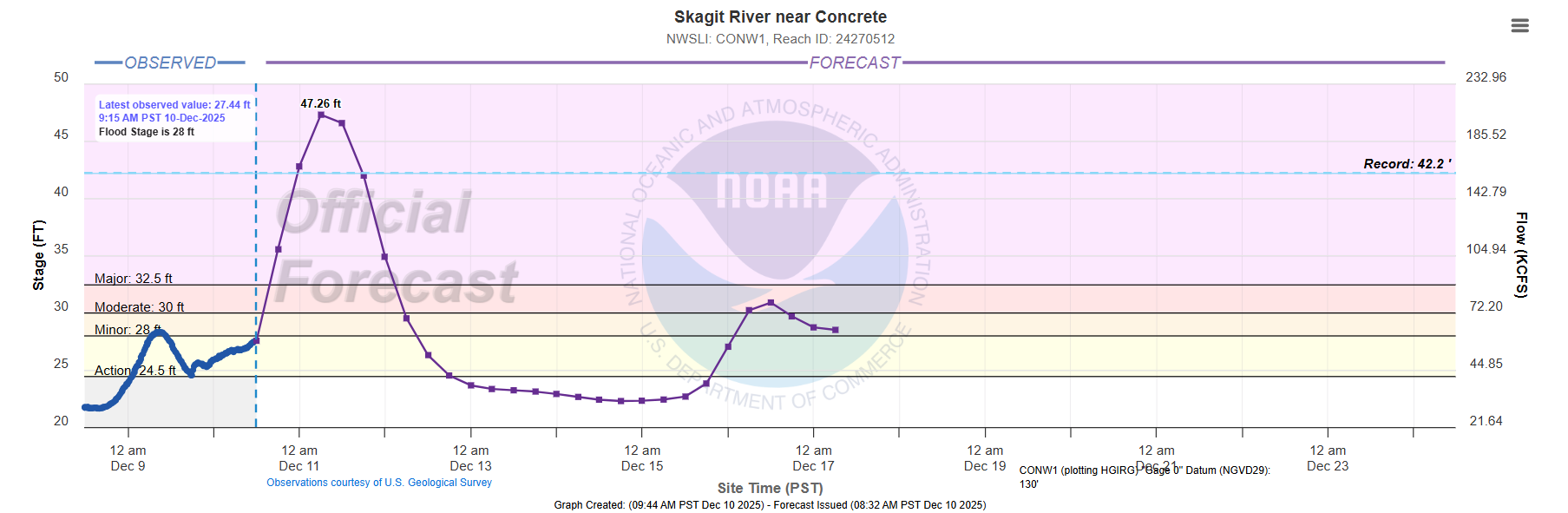
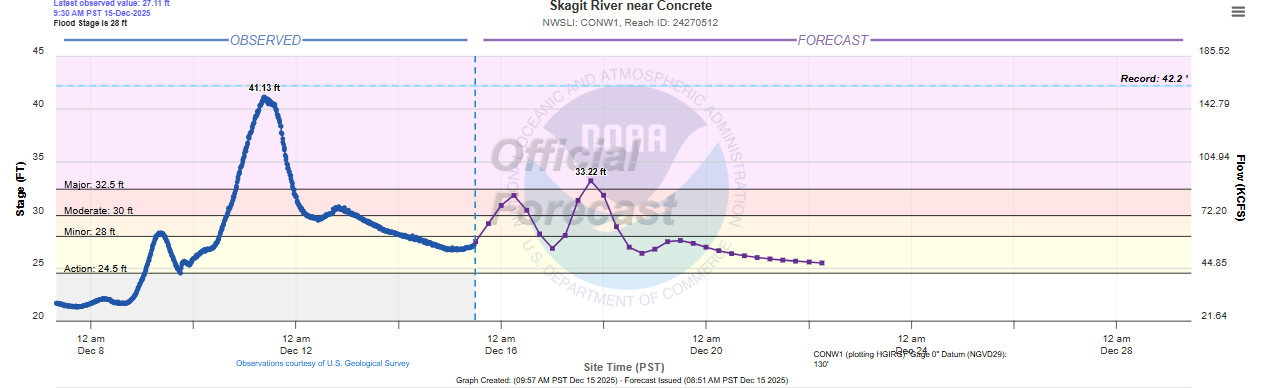
One of the items I pointed out was the apparent substantial miss in the river forecast for the Skagit River. As shown above in top image, the forecast issued Wednesday showed the Skagit at Concrete cresting an incredible 5 feet above the all-time record level, with a similar forecast downstream at Mount Vernon. In reality, the river at Concrete crested on Thursday night more than 6 feet lower than the original forecast (bottom image), while Mount Vernon crested just above its previous record and several feet lower than forecast. I noted that these were substantial forecast errors that were concerning.
This important story published this afternoon by KUOW public radio shows that I was completely and totally wrong in my interpretation of this situation. In fact, what transpired is that based on the NWS forecast of incredible, all-time record flooding, the US Army Corps of Engineers (USACE) took over the operations of two dams on the Skagit River owned by Puget Sound Energy and used the dams to control the downstream flooding of the river. This is why the forecasts were “in error” – the USACE was able to use the reservoirs to store enough water to take 4 to 5 feet off the crests.
While catastrophic, record flooding still occurred along the Skagit, it seems evident that the USACE flood control effort was a huge positive mitigation action that significantly reduced the disastrous flooding impacts. While we will hopefully get more details about how this proactive effort was organized and implemented, in my opinion it clearly could not have been possible without accurate rainfall and hydrologic forecasts by the National Weather Service.
This river has more than a century of records, and a flood event more than 5 feet above the previous all-time record is a true “tail of the distribution,” low probability event. Rather than being a concerning forecast miss, this forecast appears to have been an incredible success that may have literally saved millions of dollars in property along the Skagit River. It is tangible proof of the absolutely crucial role the NWS plays in our society to protect lives and property, and how its collaborative partnerships with various federal, state and local entities can be leveraged when disaster threatens. This is why it is absolutely vital that the NWS is fully supported from a budgetary perspective, and is properly structured and organized to meet the evolving needs that our increasingly weather sensitive society present.
Again, I am hopeful we get more details of exactly how this incredible flood control mitigation effort came to fruition, and if so I will certainly pass that information along. In the meantime, I have removed the discussion about the “forecast error” from my original post below.
Original post from Monday afternoon follows…
I focused my Friday newsletter on the many happenings last week affecting FEMA, and today I want to focus on recent reporting about the other big federal agency we rely on for getting us through weather and water events, namely of course NOAA and particularly the National Weather Service.
Last week, multiple entities including CNN reported on NOAA/NWS hiring efforts as the agency works to onboard 450 new employees they were authorized by the Trump Administration to hire back in July. This hiring authorization came in the wake of losing 550 employees earlier this year when the Department of Government Efficiency (DOGE), Office of Personnel Management (OPM) and NOAA/NWS’ parent the Department of Commerce implemented the “Fork in the Road” Deferred Resignation Program (DRP) and a Voluntary Early Retirement Authorization (VERA).
The CNN article opens:
The National Weather Service is working to hire back hundreds of positions laid off or otherwise cut by the Trump administration, but it’s progressing at a snail’s pace, with about 80 final job offers accepted for meteorologists, hydrologists and other specialized staff.
The agency received permission in late July to add a total of 450 people after about 550 were cut by DOGE earlier this year. The decision to authorize new hires came after lawmakers and citizens expressed concerns about how the NWS cuts would impact public safety.
The slow hiring means the Weather Service is going into yet another critical storm season with more than a dozen forecast offices forced to get by with serious staff vacancies, potentially undermining the accuracy of forecasts and warnings during powerful winter storms.
As someone who was a federal supervisor for 20 years and is intimately familiar with NOAA’s hiring processes, I will honestly state that managing to get 80 NWS jobs completely through the process to the stage of accepted final job offers in about five months is actually pretty impressive to me. Federal hiring has always been a long, complex process, and it has almost certainly become more difficult in NOAA this year due to departing human resources employees and new OPM mandated processes. The 43 day federal shutdown also cannot have helped, although CNN reported that the NWS continued to process new hires during the shutdown, which shows the priority the administration has placed on these hires.
What is frustrating to me is none of this is a surprise. Anyone with any familiarity with the federal human resources system knew that this would be a prolonged process. In my early August article talking about the administration authorizing these 450 hires, I said:
For the 125 positions that the NWS was given emergency hiring freeze exemption for at the start of June, only the nationwide electronics technicians and physical science positions at the Space Weather Prediction Center have even been advertised more than two months later. The bottom line is that we are at the start of a multi-month, multi-layered recruitment process, and even the positions which have already been advertised are at least a couple of months away from having new hires in them. Then once the hires are in place, they have to be trained in their new job, and for highly technical positions like these, that is a multi-month to year-long process, depending on the exact position and role.
While the NWS was already dealing with staffing issues prior to January, this staffing crisis that the agency finds itself in today is clearly an “own goal” of the Trump administration’s making. The NWS did not suddenly become a “critical public safety” agency yesterday, it has been one for decades. The fact is that because of the administration’s DOGE and OPM mandated “fork in the road” and buyout programs, the NWS lost hundreds of meteorologists, hydrologists and electronics technicians with decades of experience in one fell swoop.
This last point is the critical one for me. Even when these 450 positions are finally filled (a NOAA spokesperson told CNN they expect this to be by the end of fiscal year 2026, which means late next calendar year), the thousands of years of experience that was lost is irreplaceable. These 450 new hires will be new to the NWS and will need extensive training. While meteorologists often get the most attention in a situation like this, positions like information technology professionals and electronics technicians are equally (if not more) important. The NWS has very unique IT and observational equipment such as the WSR-88D (NEXRAD) Doppler Radar that takes years of experience to troubleshoot and maintain. Many of the most experienced technical staff who worked on these systems were lost in the staff reductions earlier this year.
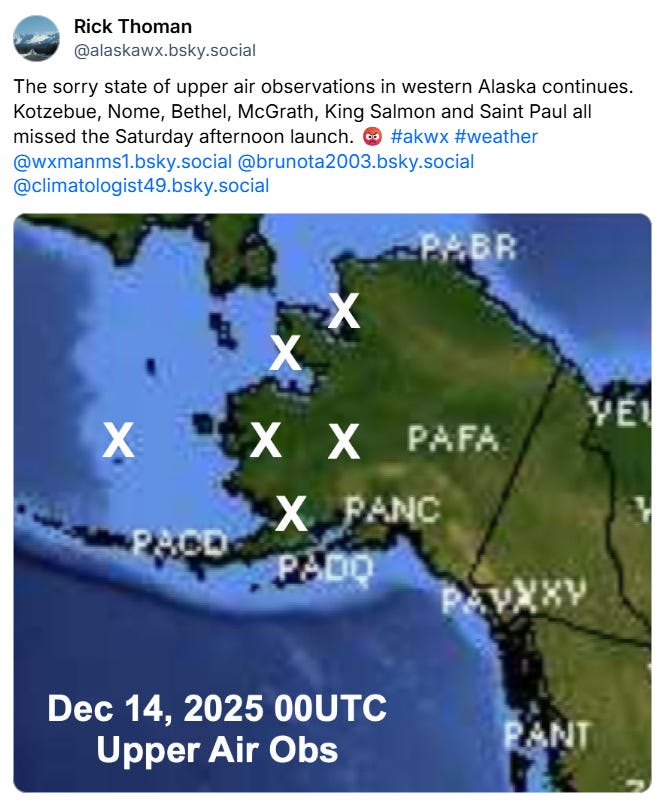
The impacts of the staffing issues continue to be seen most clearly in the NWS upper air observation program. Retired NWS meteorologist Rick Thoman posted yesterday about the continued issues with missing upper air data in western Alaska. As I discussed in posts back in October, this has been a chronic issue for months and likely contributed to less accurate forecasts for the remnants of Typhoon Halong that produced catastrophic, historic coastal flooding in western Alaska.

The staffing impacts are also apparent in the upper air data in the Lower 48, as each day many offices continue to use a midday (1800 UTC) balloon release as one of their mandated twice daily upper air data collections. As a reminder, most global upper air sites do two balloon releases, one at 0000 UTC and one as 1200 UTC. These times are coordinated within the World Meteorological Organization to have common times of data collection to initialize the global numerical weather prediction computer models. The NWS staffing issues have resulted in many offices doing one of their releases at 1800 UTC when they have sufficient staffing to conduct the balloon release. Obviously, having two releases with one at 1800 UTC is preferable to only one daily release, but the impacts of this change on the weather prediction models is unknown. To be fair, it could actually be beneficial in some ways — but it is uncharted territory and more study would be needed to know for sure.
Discerning the potential impacts on core NWS forecast and warning services is obviously even trickier, as even for a local or regional weather event NWS services originate from a variety of national and local offices and there is really no way for an external media entity (or someone like me) to know the exact staffing levels of each of these offices. Having said that, looking at the most recent high impact event, the catastrophic flooding in western Washington, there were a few concerns that caught my attention.
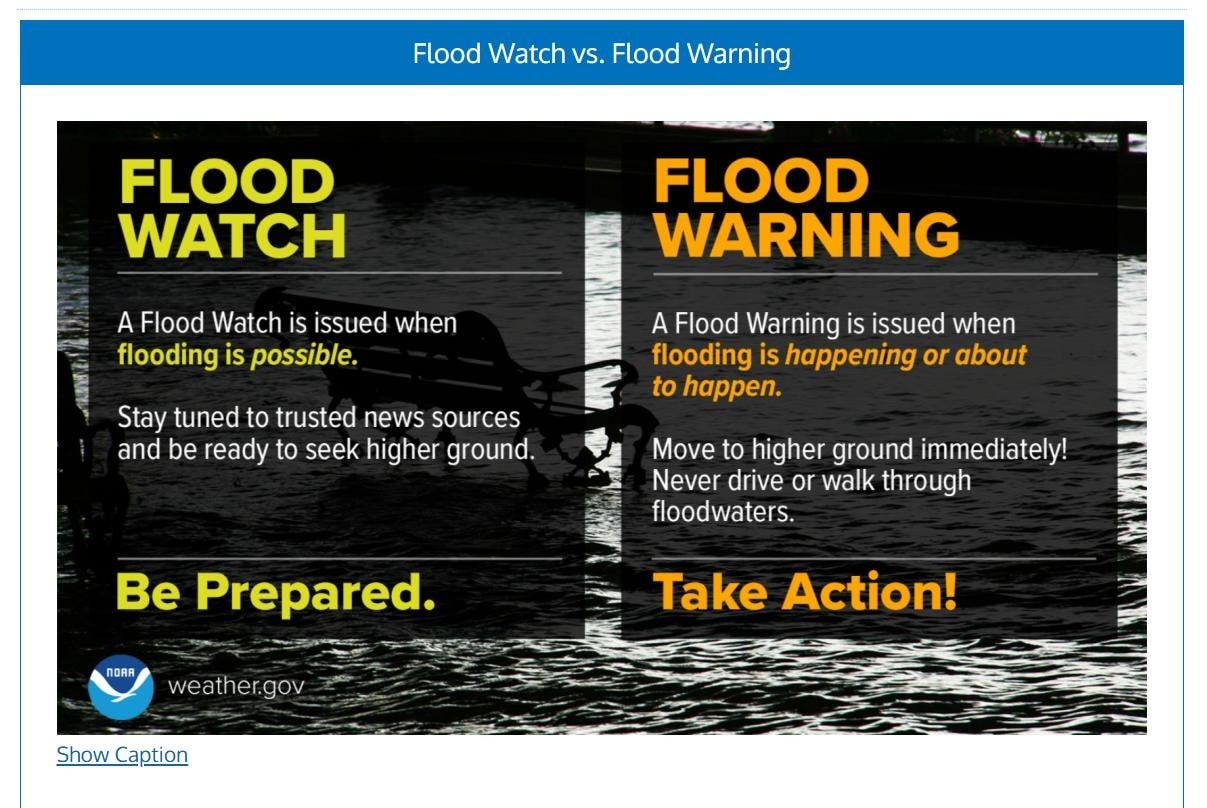
I noted during the event that the NWS Seattle website had little of the kind of specialized graphics that offices often utilize to highlight the ongoing threats during high end events. Canned graphics such as the one above were what were highlighted on the webpage whenever I looked at it (which was frequently).
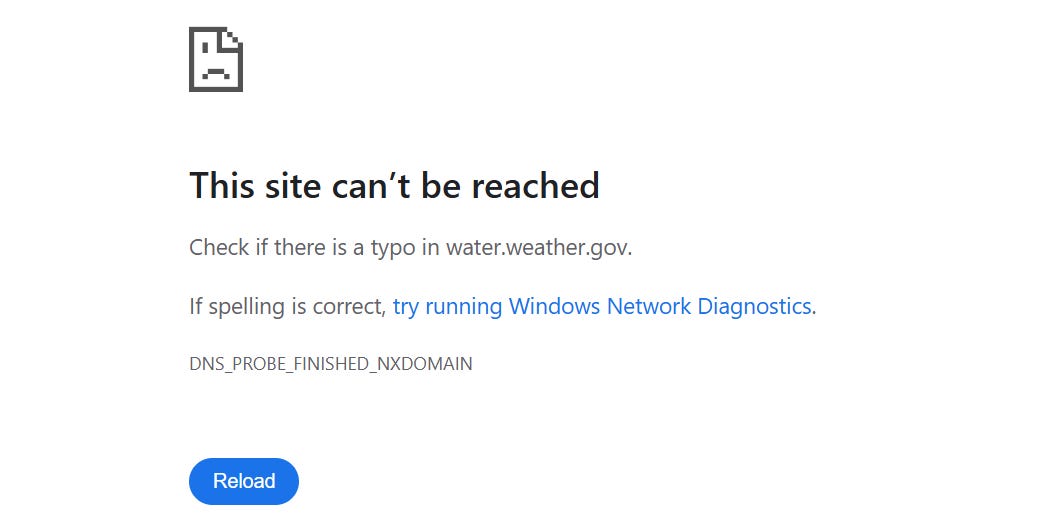
The office’s hydrology webpage also has several links that go to old information or dead links. This includes when getting the above error when you click on the link for “River Observations and Forecasts (AHPS),” nominally the most important link on the site. I am assuming this is because the link was not updated when the NWS changed from its old AHPS hydrology forecast webpage to its new water.noaa.gov. To be fair, as I have become more reliant on NWS webpages in doing these daily newsletters I have found that NWS webpages in general suffer from a widespread, chronic issue with out of date information and dead links, something that the agency needs to urgently work on.
Obviously, I cannot say with any certainty that any of these above service issues are directly a result of the ongoing staffing issues. To be clear, the NWS was already suffering from chronic staffing issues prior to the arrival of the Trump Administration. The Washington Post’s Capital Weather Gang reported in 2017 that agency staff was “demoralized” and “fatigued” due to understaffing. Any limited progress that was made in the intervening years on those staffing concerns was blown up this year — as noted by CNN, even if and when these 450 positions are filled, the agency will be still have less staffing than it did at the start of 2025.
While it is unclear how much staffing may have contributed to the issues I talk about above, what is clear is that the NWS is an agency in need of significant reorganization and refocus. The agency is operating with an operational model that is nearly 40 years old and does not account for the massive advances in science, technology and communication that have occurred in that time. Furthermore, the NWS has documented and serious performance issues in areas such as numerical weather prediction and tornado warning performance that need intensive agency efforts that would likely benefit from significant reorganization.
The type of serious reorganization that the NWS needs is made all the harder to accomplish when the agency’s staff is already so demoralized due to the ongoing staffing and organizational issues, and when agency leadership has to spend so much energy just keeping the basic daily mission provision afloat. My understanding from talking to multiple NOAA and NWS colleagues is that the NWS does have some organizational changes in the works, but that much of these efforts are delayed due to continued uncertainty surrounding NOAA/NWS funding and potential higher level organizational changes.
As I have discussed extensively, OPM has proposed elimination of NOAA’s Office of Oceanic and Atmospheric Research which would likely result in the NWS absorbing current OAR weather focused labs and research functions into the organization of the NWS. This organizational change appears to be still on the table, and is likely part of the reason that any NWS led organizational change is in limbo. The radically different visions for NOAA between Congress and the administration also make any serious organizational changes envisioned by NOAA/NWS leadership difficult to implement.
I want to conclude this post by stressing my tremendous admiration for the staff of the NWS that continues to heroically work each and every day to meet their important public safety mission. My critiques of the NWS come from a place of recognizing the critical importance this agency has to our society, and wanting to ensure that it is properly staffed and organized to best meet its evolving mission in a rapidly changing world. For a multitude of reasons, it seems clear to me that the NWS is not in that optimal place today — and a lot of collaborative effort will be needed across all sectors of the meteorological community (and associated communities) to get it to that improved state.
 Balanced Weather
Leave a comment