
NOAA Office of Oceanic and Atmospheric Research continues to be funded; Congress restates support of key satellite programs and mandates no more than 5% cuts to NSF science areas
Jan 06, 2026
Now that I have had time to more fully read and absorb the FY26 Commerce, Justice and Science (CJS) budget explanatory statement posted on the House Rules Committee webpage yesterday, I want to take a deeper, more organized dive into it today. As I mentioned in my post about this yesterday afternoon, this is a “Joint Explanatory Statement” meaning that even though it was posted by the House, it has been collaborated with Senate appropriators as well. In fact, it was also posted yesterday by Senator Patty Murray (D-WA), the ranking member of the Senate Appropriations Committee. The fact that Sen. Murray also posted this joint explanatory statement makes clear that this is the bipartisan budget plan that Congressional leadership intends to be voted on before the next federal budget deadline at the end of this month.
Something I overlooked in my quick read through of the document yesterday was this wording:
Unless otherwise noted, the language set forth in House Report 119- 272 (·’the House report”) and the Senate Report I 19-44 (’·the Senate report”’) carries the same weight as language included in this joint explanatory statement and should be complied with unless specifically addressed to the contrary in this joint explanatory statement or the act. While some language is repeated for emphasis. it is not intended to negate the language referred to above unless expressly provided herein. In cases where the House report and the Senate report direct the submission of a report, such report is to be submitted to both the House and Senate Committees on Appropriations (“the Committees”).
In other words, the joint statement is providing additional, bicameral instructions to the executive branch for the appropriations and policies of the agencies funded by the CJS budget, which includes NOAA, NASA, and NSF. The individual budget reports of the House and Senate which were approved this summer would also be binding upon the agencies under this statement if this is the final budget bill that is approved by Congress and signed into law. I wrote about the House and Senate budget documents when they were passed this summer.
One important implication of the individual chamber budget reports also being enacted is that VORTEX-USA would still be funded as a program, given that the Senate CJS budget report states that at least $11M and up to $13M of the funding to the Office of Oceanic and Atmospheric Research will be directed to VORTEX-USA. My apologies for implying otherwise in my post yesterday — as you can see, Congressional appropriations is an extremely complex process with multiple long and at times confusing documents having to be digested to get a complete, holistic picture.
Given that what is contained in this joint explanatory statement is the likely budget and policy framework that the federal science agencies will be working with for the remainder of fiscal year 2026 (through end of September), I want to highlight several key implications of this budget plan. I will caveat again that this is my best interpretation of these three complex documents as someone who has been involved in managing Congressionally mandated projects for a number of years — if I make any mistakes I will attempt to correct and clarify as soon as possible.
National Oceanic and Atmospheric Administration (NOAA)
Congress is rejecting the administration’s proposed elimination of NOAA Research, maintaining the Office of Oceanic and Atmospheric Research (OAR) as a line office within NOAA. Within OAR, it also appears that Congress is fully funding the National Sea Grant Program and the Regional Climate Centers (also fully funded through NESDIS), rejecting the Trump Administration’s plans to eliminate both of these programs. The joint explanatory document also directs NOAA to fully fund the Regional Integrated Sciences and Assessment program, including an increase of $1M to the Southern Climate Impacts Planning Program (SCIPP) based at the University of Oklahoma.
While Congress rejected the elimination of OAR, it did accept the administration’s recommendation to move three major research programs from OAR to the National Weather Service: Tornado Severe Storm/Phased Array Radar (PAR), US Weather Research Program (USWRP), and the Joint Technology Transfer Initiative (JTTI). After accounting for the move of those budget lines, the overall funding for OAR’s main climate and weather research programs looks to be generally flat under the FY26 Congressional plan.
As I mentioned yesterday, how the move of these three research program from OAR to NWS will be handled organizationally is unclear. Right now, the PAR program is primarily managed by and research is performed at the National Severe Storms Laboratory. As I reported back in August, the Office of Management and Budget (OMB) canceled the procurement of a new phased array radar research instrument that was anticipated to be an important next step in PAR research-to-operations work. The exact future of the PAR program was already uncertain given that cancellation and that the NWS is in the process of determining the future national weather radar network. The current NEXRAD Doppler weather radar network is aging, and increasing hardware failures and increased unavailability of parts is expected to threaten the viability of the network, particularly in the 2030s. Given this increasingly concerning situation, the Senate budget report directs the NWS to establish a Radar Program Office to develop a plan for a new national radar system, including “an analysis of technologies, as well as alternative architectures, including purchasing radar data as a commercial service.” How the NWS would integrate the PAR research program into that overarching weather radar modernization effort remains to be seen — and to be honest, my guess is that NOAA and NWS leadership do not yet have a firm plan.
USWRP and JTTI are research-to-operations grant programs managed by OAR’s Weather Program Office (WPO). WPO already closely collaborates the research goals for these programs with NWS, so changes to these programs may be more bureaucratic rather than tangible impacts to the grant programs, at least initially.
The actual NWS budget numbers look to be a compromise between the higher numbers proposed by the House and lower numbers proposed by the Senate. Most of the individual divisions of the NWS appear to be receiving a small increase in their budget over the most recent levels. This includes a directed increase of $10M to the primary NWS budget line (Analyze, Forecast and Support) to “support full staffing levels at all NWS offices.”
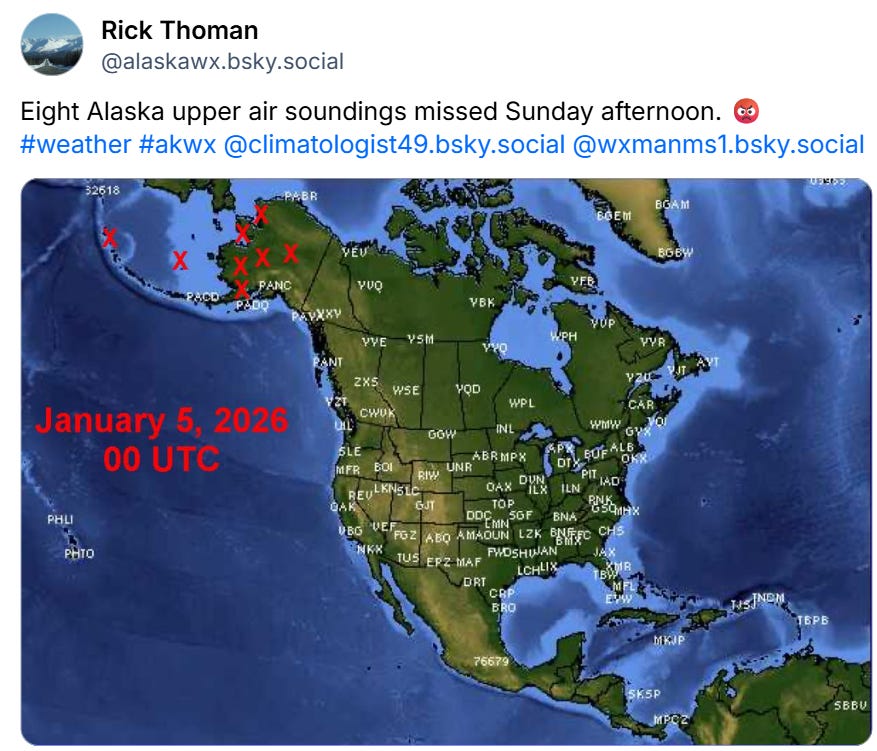
As I posted about a few weeks ago, rebuilding the NWS staffing and operational posture remains a work in progress. As an example, retired NWS meteorologist Rick Thoman posted on BlueSky yesterday that more than half of the upper air soundings in Alaska were missing Sunday evening. The joint explanatory statement specifically adopts the Senate budget report wording for NWS Staffing, meaning that the NWS will be required to provide Congress a report within 90 days that details “current staffing levels, vacancy rates, and a comprehensive plan to achieve full staffing, including timelines and resource requirements.”
The joint statement also adopts the House report wording on the National Mesonet Program (NMP), providing $30M for the NMP to “leverage large investments by other sponsors” (i.e., private sector) to bring into NMP new observations that fill “coverage gaps” and focus on the boundary layer (i.e., lowest level of the atmosphere) and marine areas. Similarly, the House language on the National Data Buoy Center (NDBC) is adopted and provides $5M for NDBC to ingest additional data sources “including existing ocean observing networks and commercially acquired data.” All of this is a continuation of a trend in recent years toward growing bipartisan support for NOAA to support the development of private sector observing networks through purchasing observational data for use by the public sector.
With regard to NWS hydrology, this joint budget plan adopts both House and Senate direction to expand NWS hydrologic research and development of new scientific capabilities through the Cooperative Institute for Research to Operations in Hydrology (CIROH) based at the University of Alabama and collocated with the NWS National Water Center. This includes directing $40M of funding from the NWS to CIROH, and the development of a Forecast Informed Reservoir Operations (FIRO) research-to-operations program.
As far as the National Environmental Satellite, Data and Information Service (NESDIS) and the geostationary satellite program, it again appears that Congress is rejecting the administration’s desired deep cuts to the next generation GeoXO satellite program. The joint statement specifically endorses GeoXO including advanced imaging and atmospheric sounding capabilities on future satellites. It also appears to leave in place Senate language requiring NOAA to continue to use NASA as the procurement agent for satellite acquisition, contradicting the Trump Administration’s stated plans to terminate NOAA’s procurement relationship with NASA.
National Science Foundation (NSF)
Again, Congress appears to be comprehensively pushing back on the administration’s plans to gut NSF’s budget and significantly reduce the number of directorates (scientific programs) within the agency. The topline NSF budget in the joint plan is $8.75B, a reduction of about 3% over the last allocation. However, the agreement requires NSF “to equitably distribute funding to support all basic research directorates” and ensure that “no directorate shall receive more than 5% reduction relative to the fiscal year 2024 enacted level.” This directly pushes back against the administration’s plans to reduce some directorates (including geosciences, the directorate meteorology and climate resides in) by up to 65%, and could potentially impact NSF’s plans to reorganize its directorates and divisions.
As I mentioned yesterday, the joint explanatory statement does not mention anything specifically about NSF’s National Center for Atmospheric Research (NCAR) and the administration’s announced plans to dismantle it. It does include this more generic wording though that would seem to preclude an immediate dismantling of NCAR:
The agreement supports the world-class research performed at the National Science Foundation-funded research and development centers and major scientific facilities. The agreement directs NSF to provide a briefing, not later than 30 days after enactment of this act, on its facilities management and oversight plan for NSF-supported research and development centers and major scientific facilities across all disciplines. The agreement further directs NSF to submit a report, not later than 180 days after enactment of this act, on this plan.
Additionally, the Senate report states, “the Committee expects NSF to fully fund its U.S. scientific research facilities and instruments to adequately support scientists and students engaged in sustained, cutting-edge research.” Given the opening statement on the binding nature of House and Senate reports, it would seem that Congress is directing NSF to continue normally operating all of its facilities, including NCAR.
National Aeronautics and Space Administration (NASA)
Focusing on the atmospheric sciences part of NASA means looking at its Earth Sciences program and budget, and once again here we find Congress rejecting much of what the administration proposed in its FY2026 budget plan. The administration had outlined a more than 50% cut to Earth Sciences in NASA. This included eliminating or significantly rescoping the Landsat Next satellite program which was designed to develop and launch three new satellites to continue to build out the Landsat data record.
The joint budget report funds NASA Earth Science at $2.153B, a slight decrease over FY24 and FY25 but obviously nowhere near the administration’s desired 50% cut. It also has very direct wording about Landsat Next:
Landsat Next.- The agreement provides $110,000,000 for the Landsat Next mission. NASA shall continue development of the three superspectral instruments, with a launch target for the first satellite by the end of 2031, and the remaining two satellites phased thereafter, to ensure uninterrupted continuity of the Landsat data record and maximum use of the Landsat 9 and Landsat Next satellite series.
The report also requires that NASA maintain the Goddard Institute for Space Studies (GISS). GISS has been in the news in recent months because it has been a leading Earth sciences — including climate science — institute since 1966, and it was evicted from its Manhattan location earlier this year when the Trump Administration terminated its lease. The joint budget report requires that “NASA shall ensure that Goddard Institute for Space Studie (GISS) employees are able to continue work with minimal disruption. including by considering a physical location of GISS near its previous location that supports GISS’s strong academic partnerships.”
————
Obviously, taken as a whole, for those of us concerned about the policies and directions being pushed for federal science agencies by the Trump Administration, this bipartisan budget plan is a reassuring rebuke of those plans. Assuming this plan passes Congress and is signed by the President, the next question is: will the executive branch and particularly the Office of Management and Budget (OMB) under Russell Vought allocate and manage the funds as directed. Clearly, Congress is expecting them to and looks to be drawing lines in the sand to try to reassert control over appropriations and agency policies. From the opening section of the joint explanatory statement:
Each department and agency funded in this act shall follow the directions set forth in this act and the accompanying explanatory statement and shall not reallocate resources or reorganize activities except as provided herein…Any program, project, or activity cited in this explanatory statement, the House report, or the Senate report and not changed by this act, shall be construed as the position of the Congress and shall not be subject to reductions or reprogramming without prior approval of the Committees. Further, any department or agency funded in this act that plans a reduction-in-force shall notify the Committees by letter no later than 45 days in advance of the date of any such planned personnel action.
OMB Director Vought has made clear his view that the executive branch should have more direct control over agency budgets and policies, and has been using tactics such as pocket rescissions and withholding agency allocations to exert such influence. The use of a full year continuing resolution in FY2025 helped enable these actions over the last year because of the lack of specific, detailed appropriations language and allocations from Congress. It remains to be seen how OMB will manage the federal budget in FY2026 assuming it receives the clear guidance from Congress provided in this joint explanatory statement — and of course it remains to be seen how Congress will react if its guidance is ultimately challenged by OMB and the executive branch.
 Balanced Weather
Leave a comment