
Federal science funding bill passes House and moves to the Senate. In weather…a quieter week for a change as a major pattern shift evolves.
Jan 12, 2026
Happy Monday! Starting off this morning with an update on where things stand with the appropriations bill that would fund most federal science agencies for FY2026. For a recap of this bill and how it overall pushes back against Trump Administration desired cuts to federal agencies like NOAA, NASA and NSF, you can read my post from a week ago.
This appropriations bill is part of a combined “minibus” appropriations that includes Commerce, Justice and Science (including NOAA, NSF, NASA), Energy and Water (Department of Energy and US Army Corps of Engineers Water projects), and Interior and Environment (including US Geological Survey and Environmental Protection Agency). Last Thursday, the House voted on this bill and it passed with overwhelming, bipartisan support 397-28. This week, the Senate is set to consider the bill.
While the bill easily passed the House, The Hill noted that several “GOP hard-liners in the House threatened to tank the procedural vote on the minibus package over their opposition to various earmarks in the legislation,” and that similar hiccups could occur in the Senate. Additionally, a number of events in the last week such as the US action in Venezuela and the killing of a Minneapolis woman by an Immigration and Customs Enforcement officer have deepened partisan division on Capitol Hill, and there are concerns this could hamper the appropriations processes going forward.
Still, given the overall bipartisan support for this bill, the most likely scenario seems to be that the bill will pass and eventually be signed by the President. If that happens, it will be important to see how the various aspects of the law are executed by the administration. One of these will be obviously be how the future of the National Science Foundation’s National Center for Atmospheric Research (NCAR) is handled.
As I alluded to in my article about the budget last week, NCAR is not specifically mentioned in the new FY26 budget documents in spite of bipartisan calls led by the Colorado Congressional delegation demanding “statutory language be included in the Fiscal Year (FY) 2026 Commerce, Justice, Science, and Related Agencies funding bill to prevent its dismantling.” However, generic language included in the bill would seem to at least require the administration to provide reports on their plans for all of the various NSF federal research facilities before implementing the type of dramatic reorganization and elimination of NCAR programs the administration outlined last month.
Regardless, in my opinion there continues to be reasons to remain concerned about NCAR. During the weeks since the administration announced its plans to dismantle NCAR, President Trump vetoed a bill that had essentially unanimously passed the House and Senate to complete the Arkansas Valley Conduit project which aims to provide a key additional source of clean drinking water to southeast Colorado. The president cited cost as the reason for his veto, but Colorado federal and state officials on both sides of the aisle pointed out the bill would only add about $500K in federal funding and accused the president of making the veto as retribution for the state’s conviction of election official Tina Peters.
Opposition to the veto in Colorado was led by GOP congresswoman Lauren Boebert, a longtime ally of the president who had sharp words for the President about the veto:
U.S. Rep. Lauren Boebert, a Windsor Republican who was the main sponsor of the legislation, and whose district would benefit most from it, has been highly critical of the veto. “Nothing says ‘America First’ like denying clean drinking water to 50,000 people in southeast Colorado, many of whom enthusiastically voted for him in all three elections,” Boebert said of the president when the veto was announced.
The bipartisan pushback against the veto was so strong that Congress took the rare step of proceeding with a veto override procedure. Despite being approved with a vote of 248-177 in the House, it failed to achieve the two-thirds majority needed for it to continue on to the Senate, and thus the veto will stand.
Given that the NCAR dismantling is another administration action that Colorado officials have linked to the administration’s “retribution campaign” against the state, it seems reasonable to remain concerned about how the administration will proceed with NCAR going forward. On Thursday, the Colorado Attorney General added the NCAR dismantling, along with a number of other ongoing or threatened administration actions, to a lawsuit the state filed in October over administration plans to move the US Space Command to Alabama from Colorado Springs. AG Phil Weiser said in a news conference that people should “stay tuned” for further legal actions reacting to “an array of threatened and actual punishments.”
How the NCAR funding and future resolves is obviously a part of a much larger political battle ongoing between officials in Colorado and the administration. I will continue to update on this — as well as of course the federal budget process and the various implications of that bill as it moves forward.
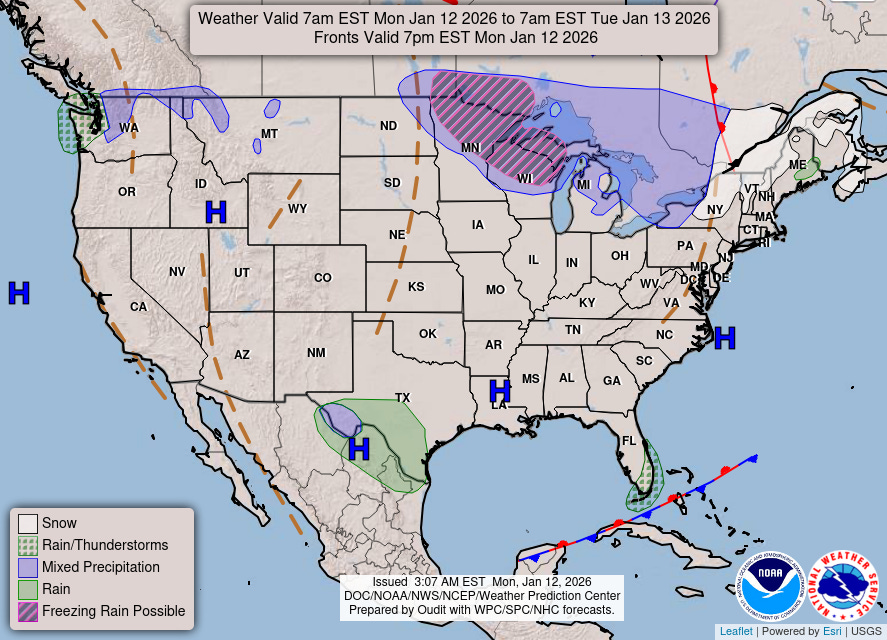
Turning to weather, things are actually very quiet across the lower 48 for a change today as shown by today’s weather map from the NWS Weather Prediction Center above.
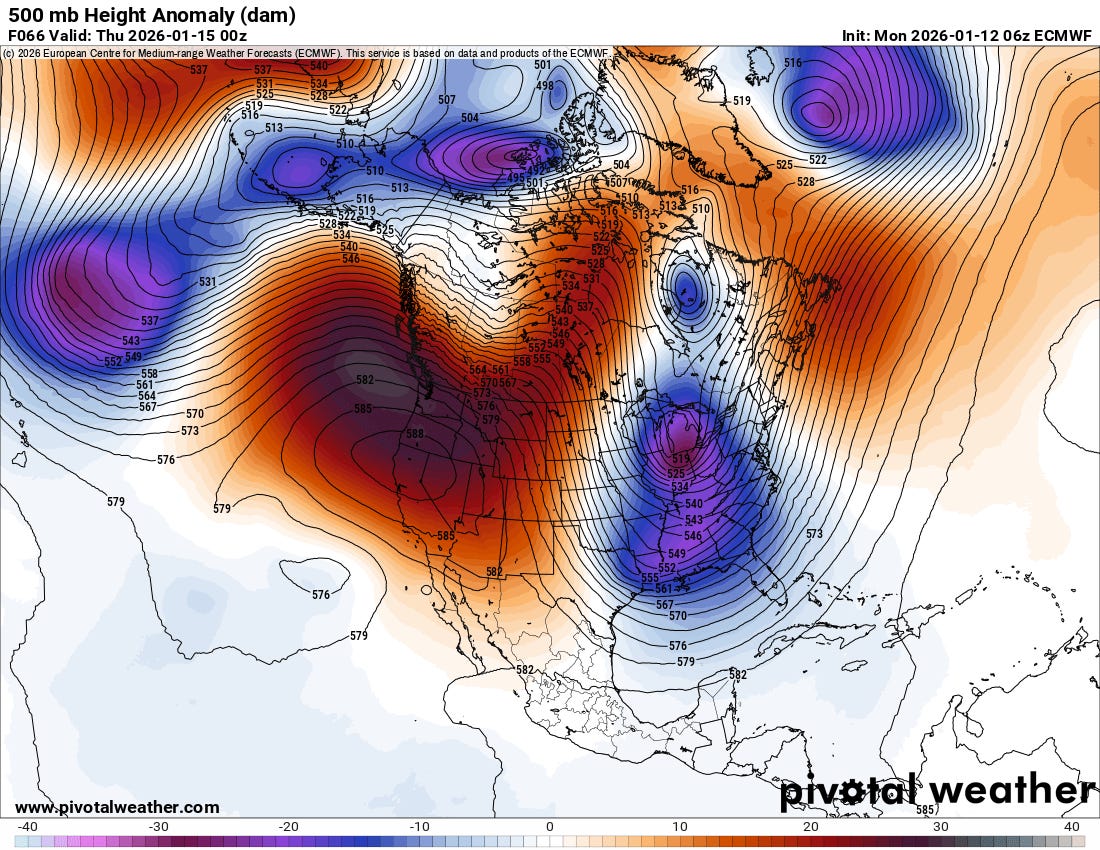
The main focus for this week continues to be on the developing pattern of an unusually large and strong mid and upper level area of high pressure across the eastern Pacific and western US, with a corresponding downstream upper level trough of low pressure across the eastern US. For the West, this should bring mainly dry and warm weather including some record highs. However, as in a very similar pattern in early December, locations like the San Joaquin Valley that are prone to low clouds and fog in stagnant weather patterns will likely see those conditions setup resulting in cooler than normal weather.
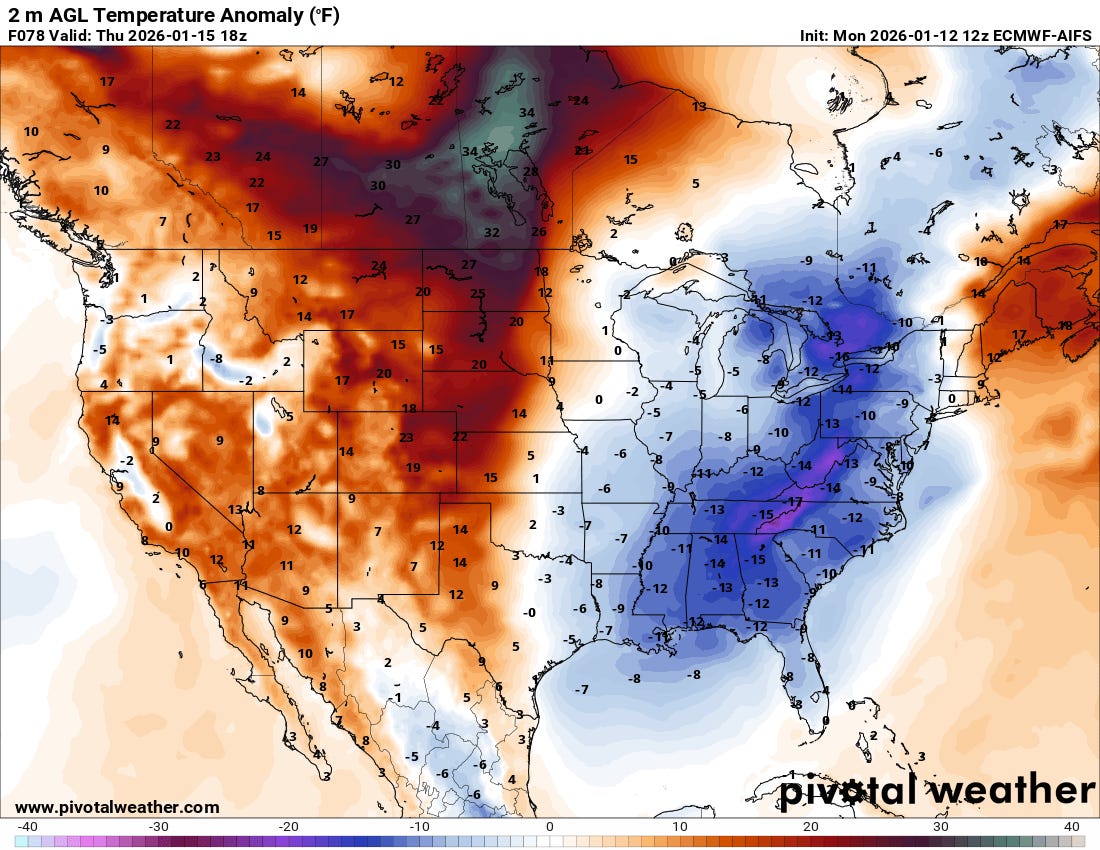
Meanwhile, the East will be setup for colder than normal weather with periodic shots of very cold air. This overall pattern tends to be favorable for East Coast storm systems, but as of now there seem to be too many disturbances rotating through the upper level trough to allow one system to truly consolidate and form a major storm system. Still, periods of snow will be favored for the Great Lakes, central Appalachians and interior Northeast. Given the overall pattern and that occasional model solutions suggest a stronger East Coast system, we will obviously continue to keep a close eye on that potential.
 Balanced Weather
Leave a comment