
NOAA releases 2025 annual summary showing US was warm and dry, but paradoxically also plagued by significant flooding
Jan 13, 2026
After my post yesterday about the status of the appropriations bill that will fund most federal science agencies, the Senate took an initial procedural vote on the “minibus” budget bill yesterday afternoon that overwhelmingly passed. This procedural vote sets the stage for a full vote on the actual bill later this week.
However, the Democratic senators from Colorado, John Hickenlooper and Michael Bennet, made pointed comments about the bill’s lack of specific wording protecting the National Science Foundation’s (NSF) National Center for Atmospheric Research (NCAR) from Trump Administration threats to disband the meteorological research center. These senators held up a vote on the bill before the holiday recess due to the NCAR situation, and made clear that they are unhappy that there is nothing in this bill that specifically addresses their concerns about NCAR.
Bennet told The Hill that his problem with the appropriations package, which includes funding for the National Science Foundation, the entity that sponsors and provides grants to the NCAR, remains unresolved. “Our issues have not been addressed,” he said. Hickenlooper said he wants to add language to the package to ensure the atmospheric research center gets to spend the money Congress already appropriated for it. “I haven’t budged,” he said. “Just spend the money that was appropriated for this fiscal year. I’m not asking for money.”
Sens. Hickenlooper and Bennet formally submitted an amendment to the minibus appropriations bill yesterday that would require the Trump Administration to continue to operate NCAR and utilize the funding allocated to it by Congress. From the Congress.gov website:
SA 4153. Mr. HICKENLOOPER (for himself and Mr. Bennet) submitted an amendment intended to be proposed by him to the bill H.R. 6938, making consolidated appropriations for the fiscal year ending September 30, 2026, and for other purposes; which was ordered to lie on the table; as follows: At the appropriate place in division A, insert the following: Sec. __. The National Science Foundation, in awarding base funds to the National Center for Atmospheric Research for fiscal year 2026 from funds appropriated under this Act, shall provide funding in an amount that is not less than the amount provided to the National Center for Atmospheric Research for fiscal year 2024, and the National Science Foundation shall ensure the continuation of all operations, capabilities, and facilities of the National Center for Atmospheric Research.The Hill article notes that Senate Majority Leader John Thune (R-SD) is unlikely to accept any changes to the bill, as that would force it to have to go back to the House for a new vote. However, Hickenlooper told Politico that “he intends to hold our ground and say, ‘We’re not going to pass this unless the amendment’s there.’”
Given the parliamentary structure of the Senate, individual senators have quite a bit of leverage to slow or stop bills as was seen by the Colorado delegation stopping this bill prior to the holidays. Whether the NCAR situation will truly result in one of the Colorado senators using their political capital to stall the bill or if a combination of the generic checks placed on the administration about NSF facilities in the bill and the visibility the issue now has will suffice for the senators remains to be seen. Clearly, though NCAR is now a key piece in the national political news stories surrounding the ongoing federal appropriations process.
NOAA releases 2025 climate and weather summary
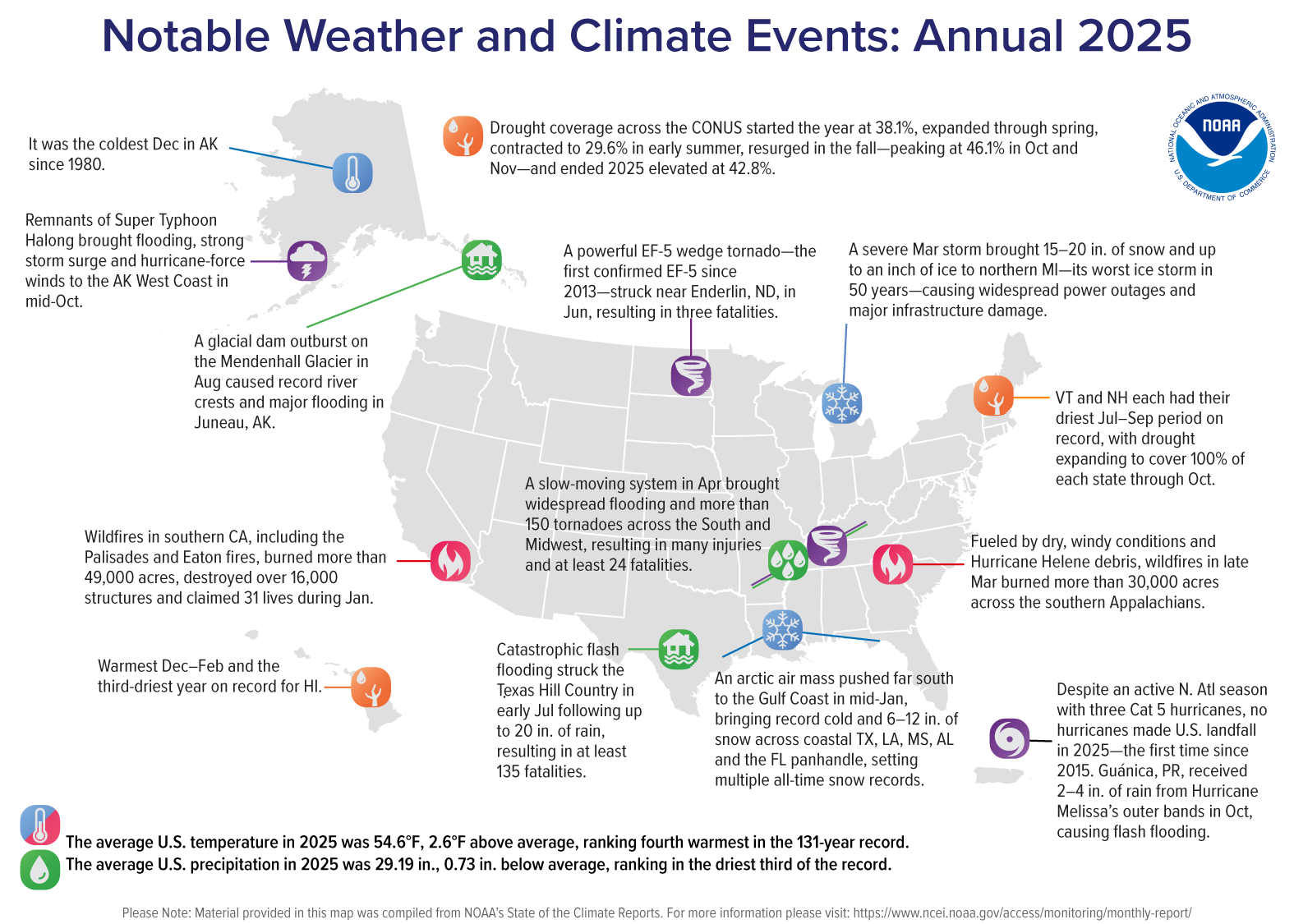
NOAA’s National Centers for Environmental Information (NCEI) released its annual summary of weather and climate for the United States this morning. You can find the entire document here, and I certainly encourage you to read it in its entirety. A few key findings I do want to highlight:
- 2025 was the fourth-warmest year on record for the United States. The area from the West Coast to the Rockies recorded its warmest annual temperature on record. “Warm temperature extremes were widespread in 2025. Extremes in overnight minimums affected more than 85 percent of the West, Northwest and Southwest regions and over half of the CONUS as a whole, while extremes in daytime maximums covered more than three-quarters of those same western regions.”
- Precipitation nationally was below normal, and placed in the driest third of the 131 year record. The Southwest record its fourth-larges extent of extremely dry conditions on record. Alaska was wetter than normal and in the upper third of its 101 year record, while Hawaii had its third driest year in the last 35 years.
- In spite of the below normal precipitation taken on average across the country, the report states that “2025 was characterized by widespread and significant flooding, driven by a combination of atmospheric rivers, slow-moving convective systems and tropical moisture. Significant flood events were observed in every season and region; July alone recorded 1,434 flash flood warnings from the National Weather Service—the second-highest July total in 40 years. Several historic precipitation events overwhelmed infrastructure, producing 1-in-1,000-year rainfall recurrence intervals in parts of Kentucky, Tennessee, North Carolina and Texas.”
Quiet weather again today
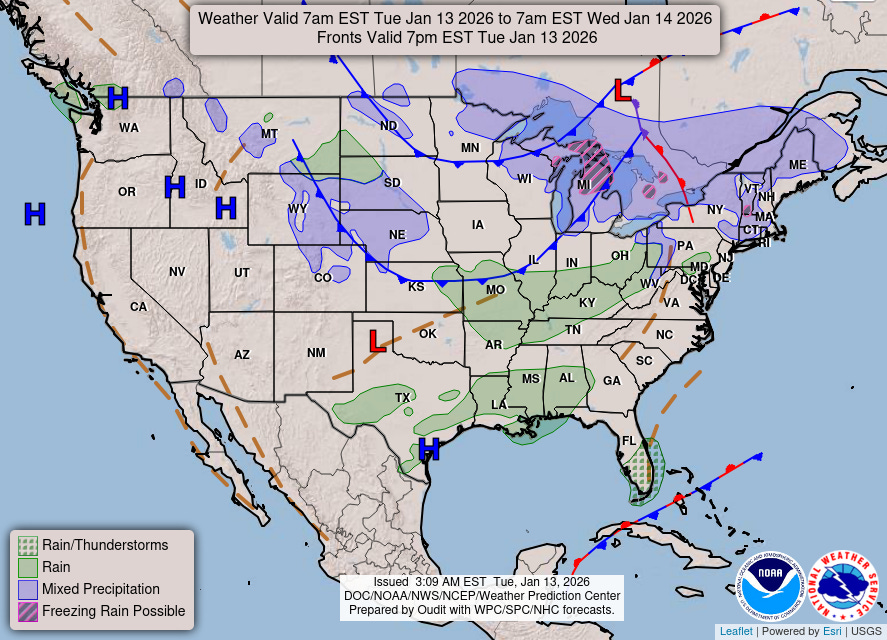
Today’s weather map from the NWS Weather Prediction Center again shows pretty quiet weather across the nation.
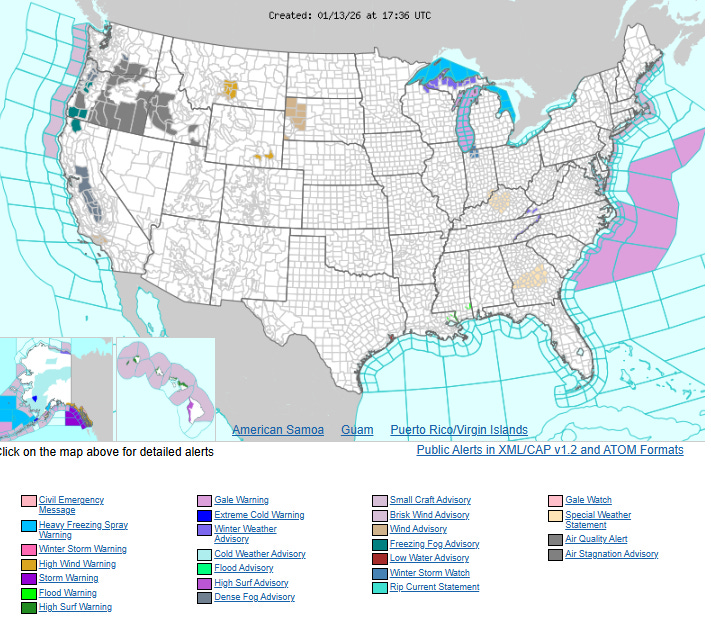
The main weather hazards on the NWS advisory map this morning are dense and freezing fog advisories in parts of the Pacific Northwest.
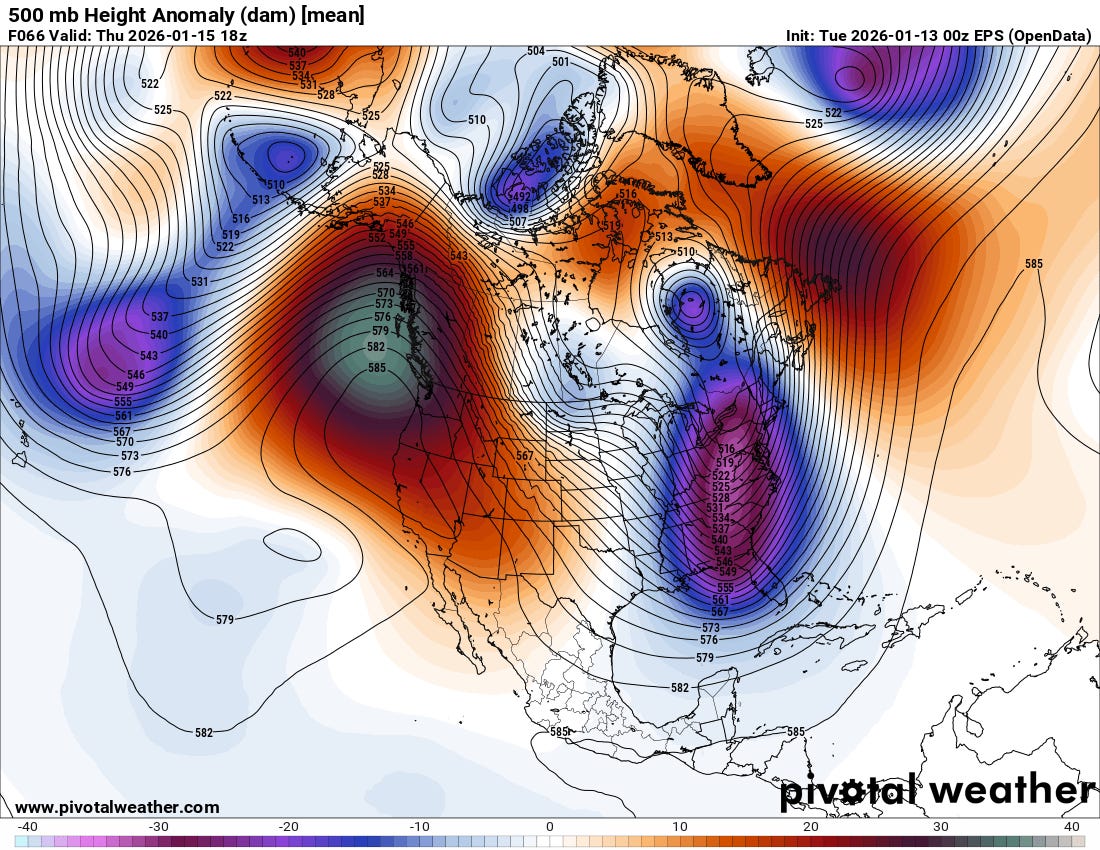
This fog is an issue due to the stagnant weather pattern evolving across the western US under the unusually large and strong area of middle and upper level high pressure developing across the region. This feature will bring warm and dry weather to much of the region through the weekend (valley areas where low clouds/fog remain trapped excepted). All signs continue to point to that high pressure area being the dominant weather feature for the country for the next 7-10 days, with the resultant downstream trough of low pressure bringing colder than normal weather to the East.
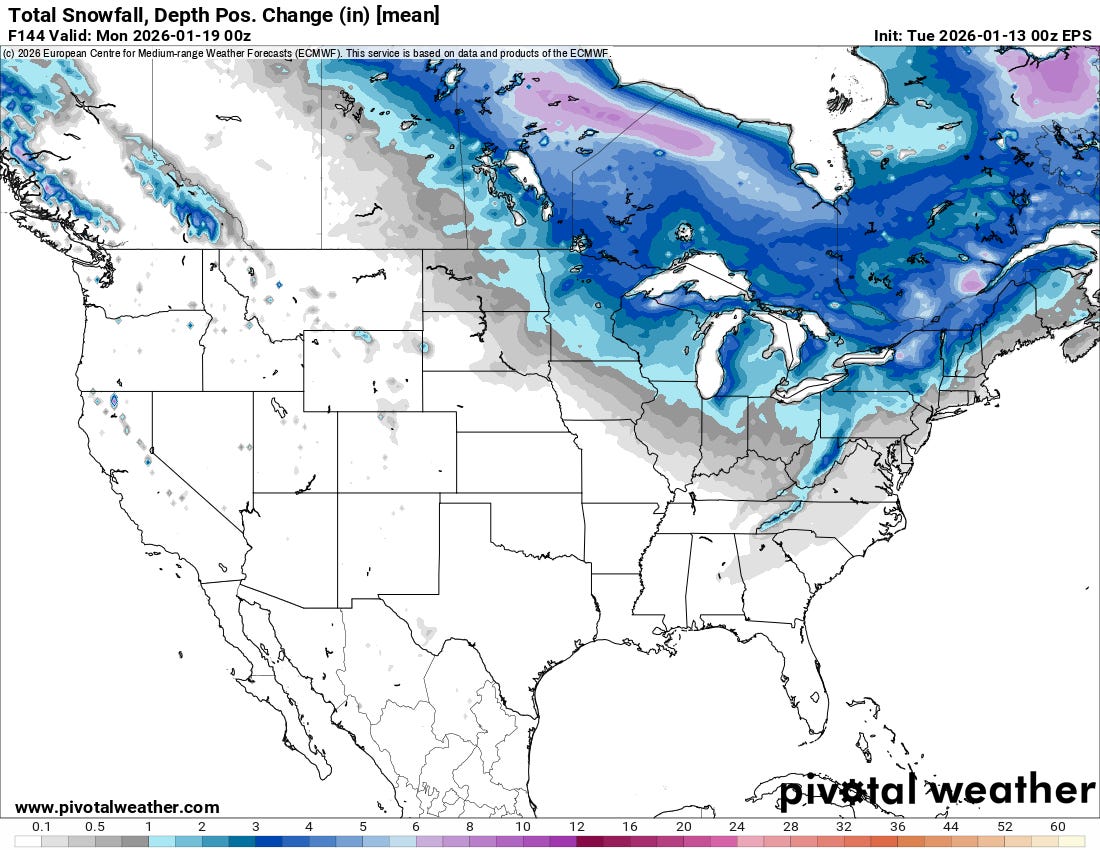
It now seems likely that the continued parade of upper level disturbances dropping through the trough in the East will not allow any one system to dominate, and as a result a major East Coast storm looks unlikely. The latest European ensemble snowfall forecast through this weekend (above) shows any significant snow confined to the Great Lakes and interior Northeast, with the West seeing essentially no snow under the influence of the large upper level high pressure area.
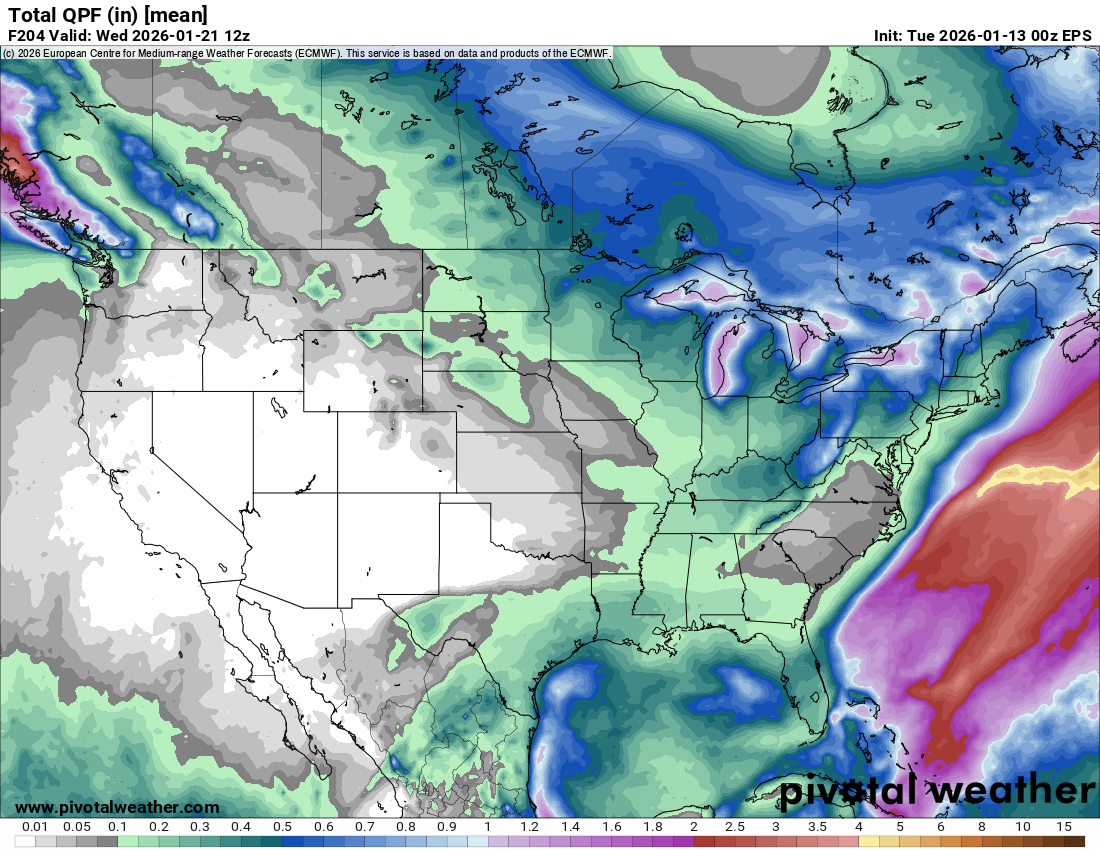
This weather pattern is dry in general for much of the country, with most of the western half of the country looking more or less completely dry for the next 7-10 days, which is concerning for many areas of the Southwest and Plains that have had dry winters so far. The Southeast also looks to expect below normal rainfall over the next week or so.
 Balanced Weather
Leave a comment