
Tuesday was the first of many days of widespread March monthly heat records for the West
Mar 18, 2026
Happy hump day. Before I get into the latest details on the historic heat wave that is really just getting going in the West, I want to provide a few updates on weather and news that I have been following over the last several days.
WOOD-TV in Grand Rapids reported on Monday that the two Democratic Senators from Michigan, Elissa Slotkin and Gary Peters, have sent a letter to the director of the National Weather Service questioning the lack of timely tornado watches and “alerts” ahead of the historic early March tornadoes in southern Lower Michigan that killed 4 people. The letter specifically asks about the staffing levels of each of the local NWS offices in the region and potential impacts short staffing might have had on services, the potential benefits of gap-filling radars in improving tornado alerts, and:
What steps does NWS plan to take in the wake of this fatal storm to improve the accuracy of its weather forecasting and prediction as well as the timeliness of its tornado alerts? What additional authorities and/or funding could Congress provide to facilitate such improvements?
I went into detail about my concerns about the NWS’ process (or lack thereof) for self-evaluating its services and the need for changes and improvements to its severe weather warning operations here, so I will not rehash it beyond restating that the NWS should not be responsible for evaluating itself. We urgently need an independent authority to look at all of the meteorological and societal aspects of weather events such as this and be able to make binding recommendations for improvement.
Sen. Peters is a member of the Senate Commerce Committee that recently approved a new Weather Act Reauthorization Bill and moved it forward to the full Senate for consideration. Hopefully his membership on this key committee and familiarity with the NWS and NOAA will enable him to engender some meaningful steps forward depending on how the NWS responds to this letter. By the way, you can also listen to me and two of my recently retired NWS colleagues talk at more length about this event and what we think are needed as far as changes and improvements to NWS operations in this episode of the new “Debris Ballers” podcast.
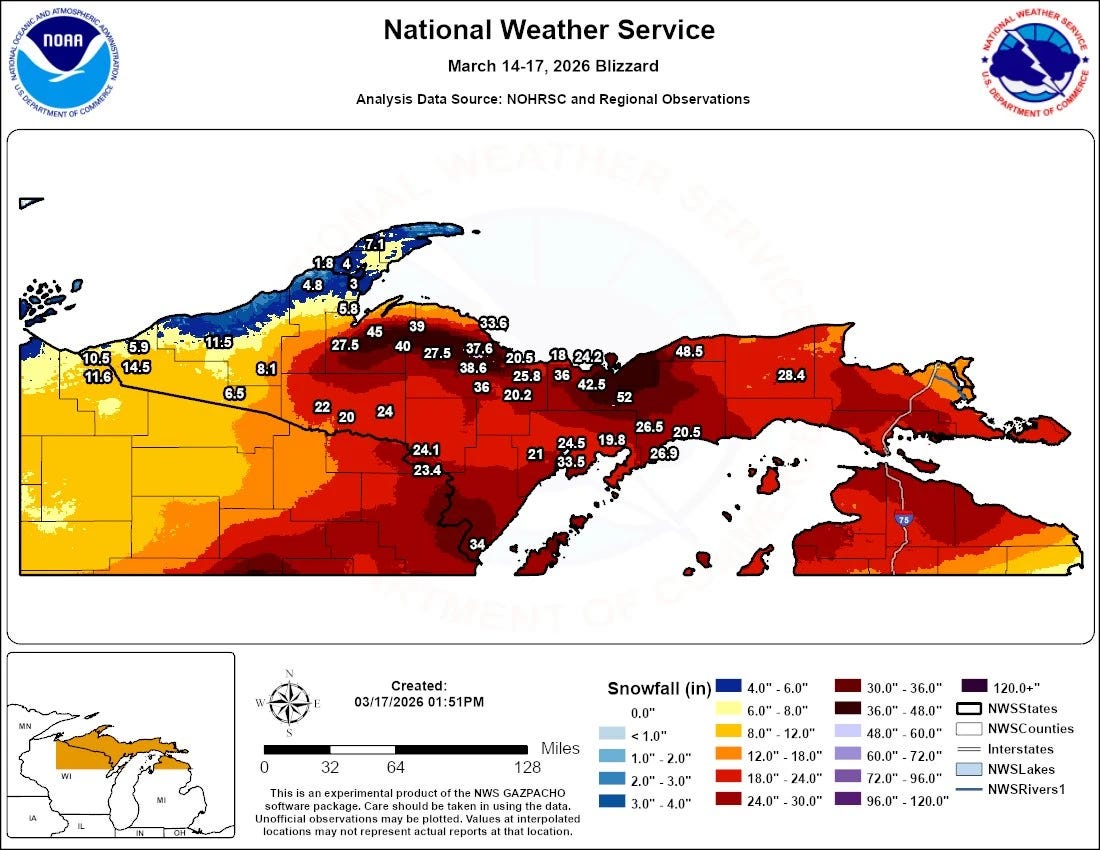
Wrapping up the upper Midwest and Great Lakes blizzard from over the weekend, NWS Marquette produced this excellent analysis of total snowfall in their area for the entirety of the blizzard, March 14-17. A swath of 3-4 feet occurred just inland from Lake Superior, with a maximum amount of 52” just southeast of Marquette. Combine this with the multi-feet amounts in northern Wisconsin and northern Lower Michigan and the daily all-time record snowfall at Wausau, WI, it seems clear that even for this typically snowy part of the country this truly was a blizzard of historic proportions.
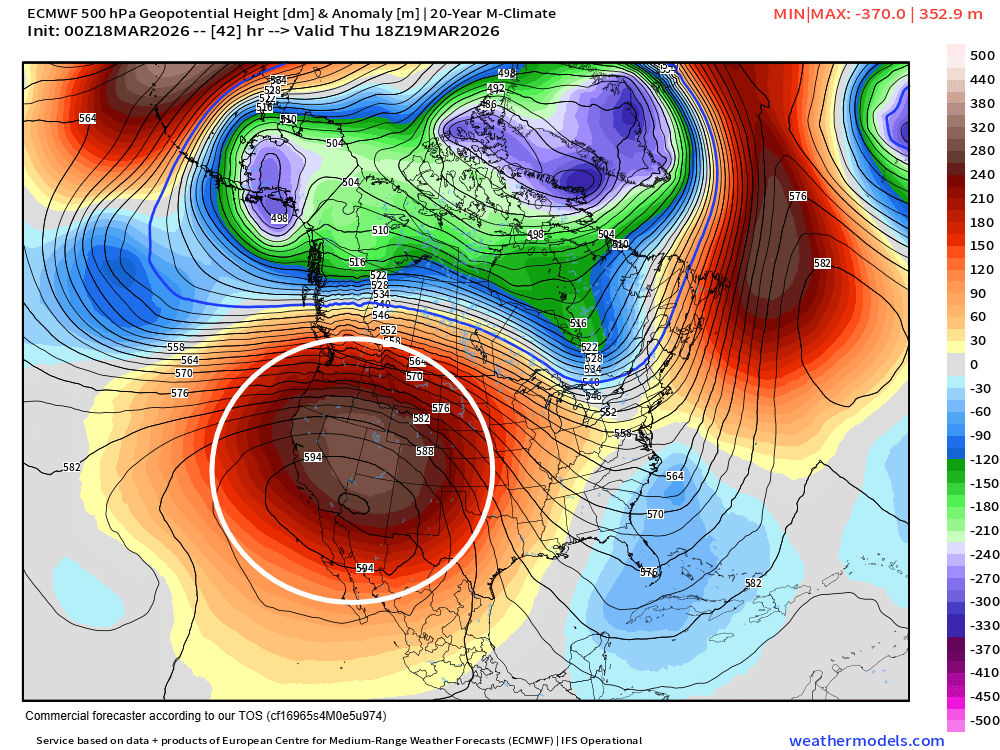
So now let’s turn our attention to the next historic weather event, the strengthening heatwave over the West. Large scale heat waves are generally the result of a strong middle and upper level area of high pressure that meteorologists use forecasts for 500 millibars (mb, ~18,000 ft AGL) to monitor. Above is the 500 mb forecast from the most recent European model for Thursday afternoon — the black contours are “geopotential heights,” more or less equivalent to isobars (pressure lines) on a surface weather map, and the image is the amount the forecast heights are above or below normal.
You can clearly see the very large area of unusually intense high pressure over much of the western United States. The height values at the center of the high over Arizona are about 5980 m. I realize these values mean little to non-meteorologists – but to someone like myself, this is truly a jaw-dropping forecast. This would be an anomalous, intense upper level high for the middle of summer — 500 mb high pressure centers of 6000 m are rare (or used to be rare) beasts that meteorologists look for as showing the potential for record summer heat waves. Seeing an upper level high near this intensity in March is insane – and truly historic. While this map above shows the absolute peak of this intense upper level high, the overall upper level pattern will persist for many days.
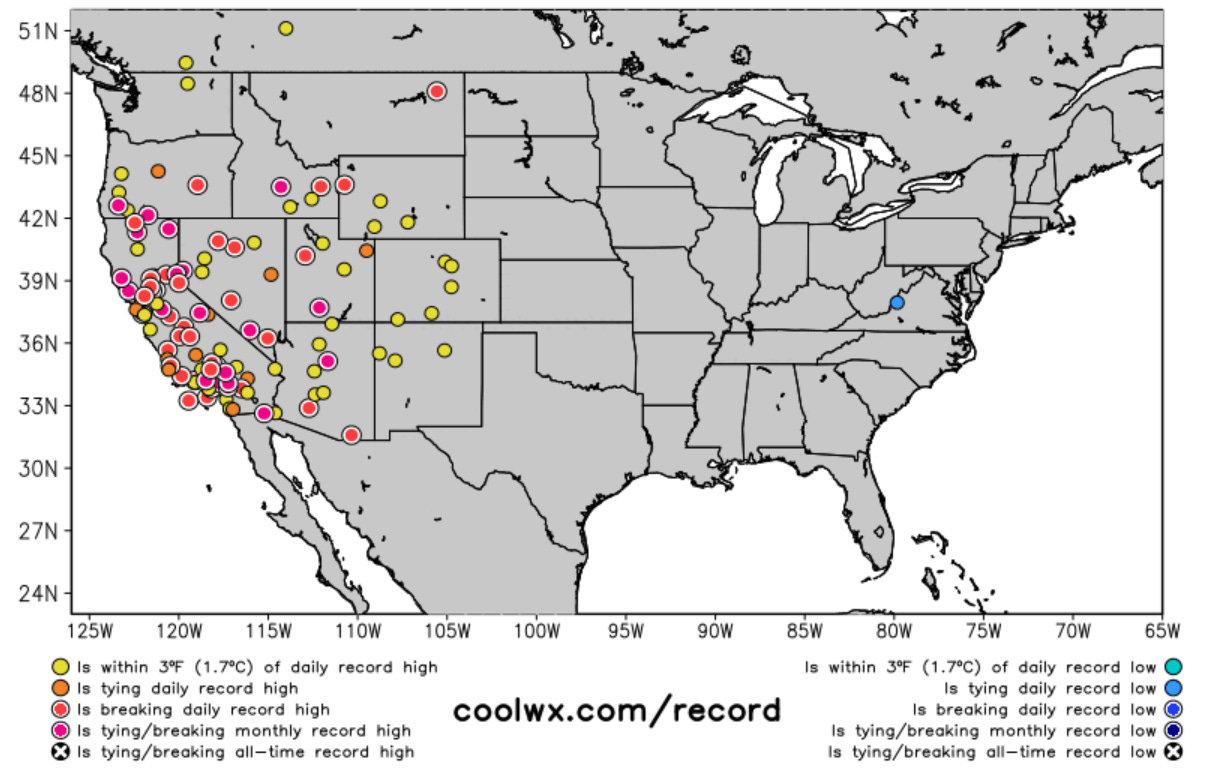
Record high temperatures have been occurring over parts of the West the last several days, but Tuesday saw the heat kick into a much higher gear, with dozens of daily records across the West and a number of locations setting record high temperatures for the month of March across California. Some long term climate stations with March records included Burbank (99F, records back to 1939), Oxnard (94F, tied, records back to 1923), and Indio (104F, tied, records back to 1894). Downtown LA fell a degree short with a high of 98F (previous record 99F set March 29, 1879).
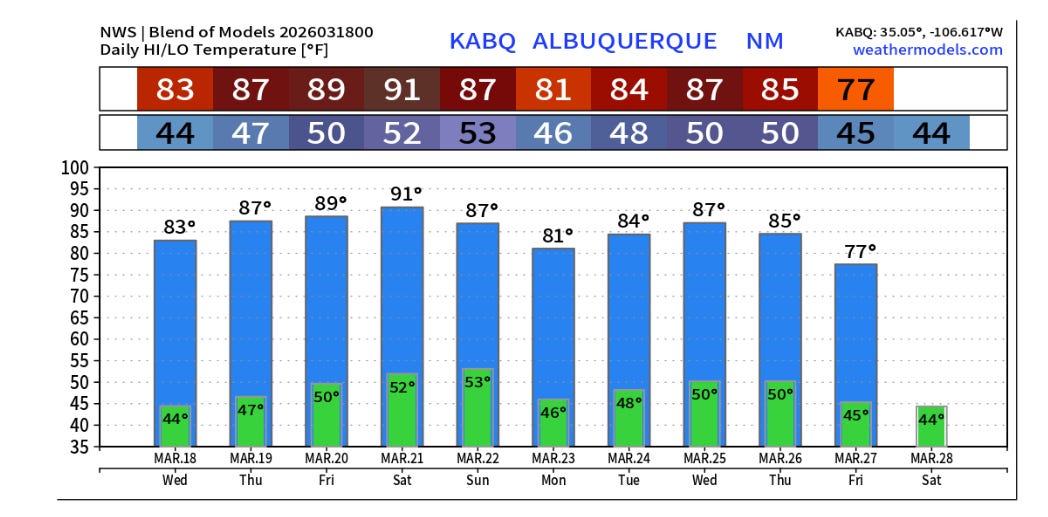
Of course, yesterday was just the start of a multi-day period of extreme heat which will expand to encompass much of the western half of the country. In my post yesterday I used Phoenix and Salt Lake City as illustrative examples, so today I am going to go a bit farther east and look at Albuquerque. Above are the forecast maximum and minimum temperatures here for the next 10 days. Heading into this heat event, the all-time March record high temperature at Albuquerque is 85F. This forecast shows Albuquerque potentially having these stats over the next 10 days:
- Tying or breaking the current monthly record on 6 days
- Breaking the current monthly record by 6F
- Breaking the current April record by 2F
- Breaking the current record for earliest 90F by about 6 weeks (current record is May 3)
For a meteorologist, these are literally flabbergasting statistics – and would be if just one location was doing it due to some sort of anomalous local pattern. The fact that these sorts of records are going to be set over a large region for days is truly incredible — I am not using the words insane or historic lightly.
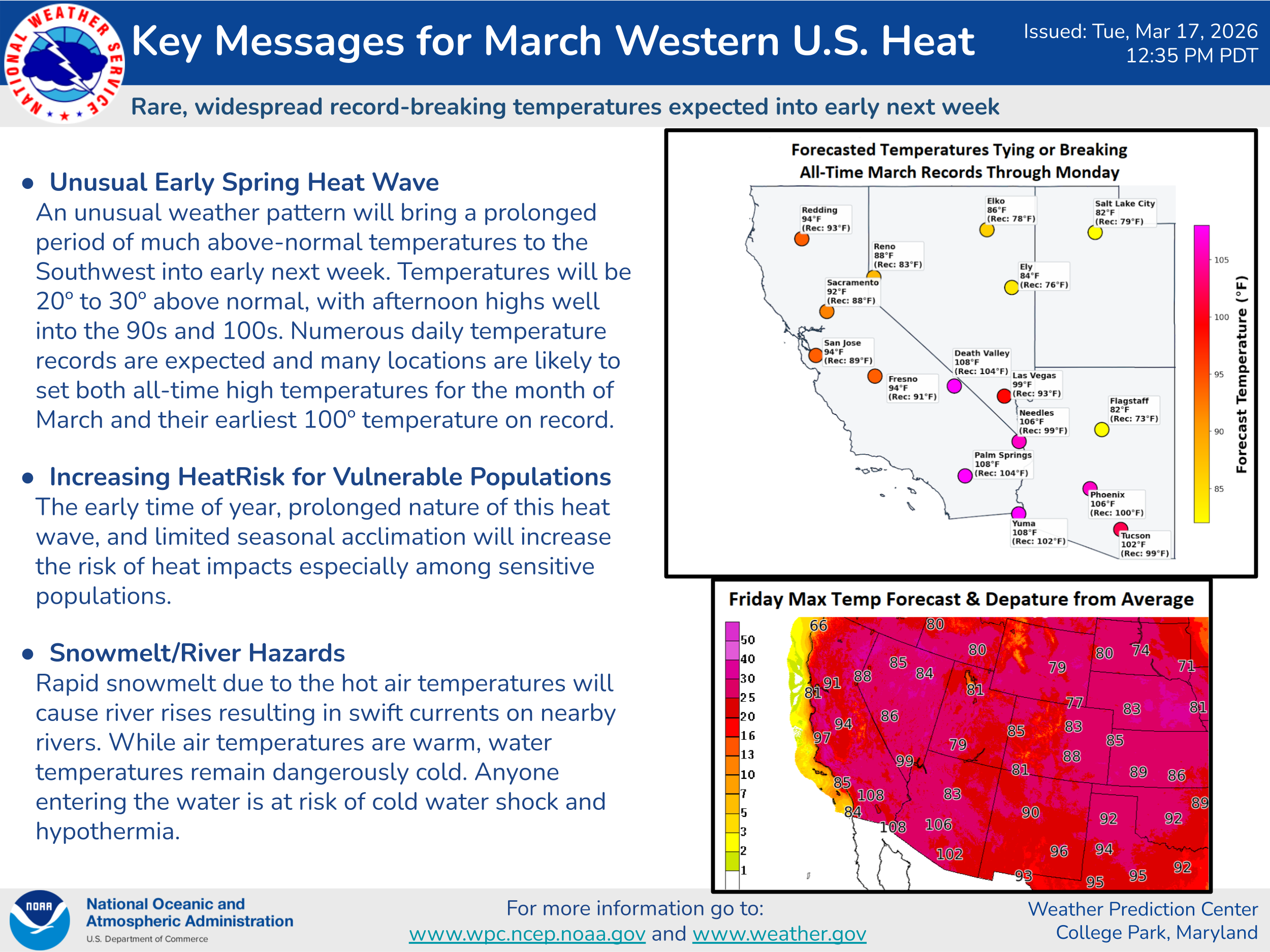
Again, this heat will be extreme enough that heat risk is a serious concern, particularly given that people are not yet acclimated to this sort of warmth given it is March. Obviously, lots more to come about this event in the coming days.
 Balanced Weather
Leave a comment