
Looking at the broader expanse of the National Oceanic and Atmospheric Administration
As always seems to be the case since I retired and started Balanced Weather, there’s so much going on in the weather world that I could potentially write about I have a hard time figuring out where to start. This article I just saw – DOGE Cuts at NOAA, Explained – helped me decide what I want to talk about today. It is a very good article from TheDispatch.com outlining the impacts of the last few months on NOAA’s weather forecasting capacity going into hurricane season, but as such it is not really about “NOAA” writ large, it is primarily about the National Weather Service (NWS) and NOAA’s other weather forecasting capacities. The headline though highlights a trend that I am increasingly worried about: that the public equates NOAA with NWS, and that the tremendous media focus in recent weeks on the precarious situation at NWS is taking awareness away from the even more dire situation that much of the rest of NOAA finds itself in.
The focus on NWS is understandable – the crisis is real and the NWS plays a crucial role in public safety from severe weather. However, NOAA does not equal NWS. NOAA has five line offices in addition to NWS, with many programs and offices that play crucial roles for society. Some of these are related to atmospheric science but many others relate to oceans, marine life, and other earth sciences. To be honest, it is way too much to try to encompass in one Substack post, but I want to spend some time today highlighting once again some of the parts of NOAA that are at risk due to recent cuts by DOGE and the Office of Personnel Management (OPM) and proposed cuts in the FY2026 President’s Budget.
I want to start with what I consider to be an extremely disturbing story that was published today by The Guardian. Meteorologist and climate journalist Eric Holthaus reported that the entire contract staff that managed and produced content for NOAA’s Climate.gov website was terminated as of May 31st, and the future of the site is uncertain.
I am guessing that for some within the administration there is an assumption that Climate.gov is a climate change propaganda machine, but as someone who has used this website for years, I have found otherwise. Similar to what I pointed out with saying NOAA does not equal NWS, “climate” does not equal “climate change.” Monitoring our climate on a global, regional and local scale is hugely important to our society, and providing accurate science to the public about our climate is one of the most important missions for NOAA as a federal agency.
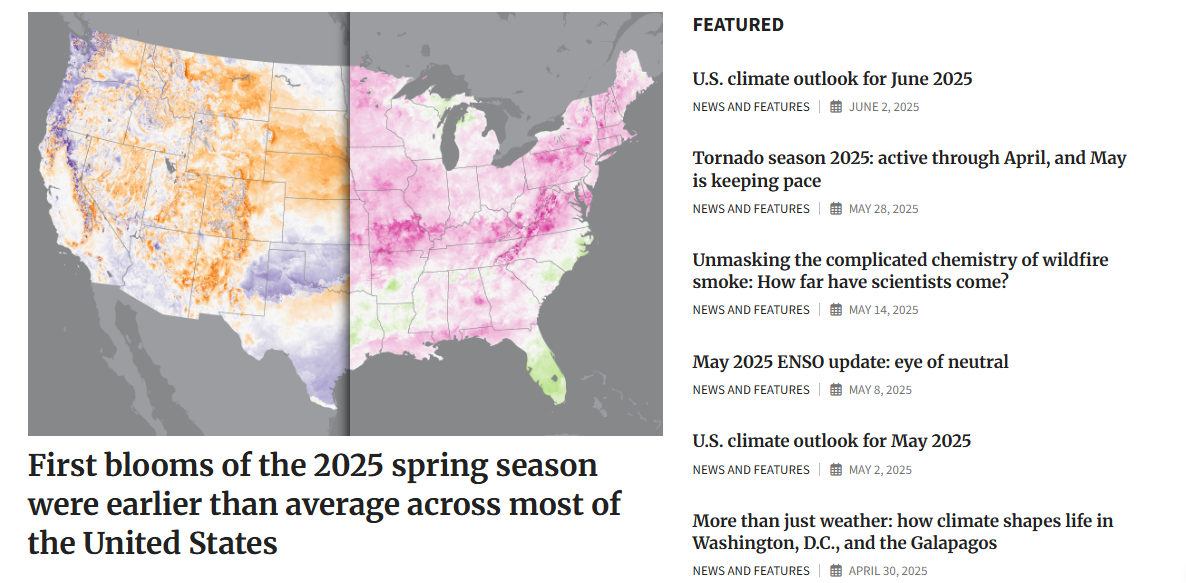
This is the current front page of Climate.gov. There is nothing here that is political, rather it is important science helping to educate the public and help them understand our planet. As Rebecca Lindsey, the former program manager for Climate.gov (she was fired as a probationary employee in February), said to The Guardian:
Lindsey said the content for climate.gov was created and maintained by a contracted staff of about 10, with additional contributions from Noaa scientists, and its editorial content was specifically designed to be politically neutral, and faithful to the current state of the sciences. All of those staff have now been dismissed, she said. “We operated exactly how you would want an independent, non-partisan communications group to operate,” said Lindsey, and noted that climate.gov is housed within the science division of Noaa, not its public affairs division. “It does seem to be part of this sort of slow and quiet way of trying to keep science agencies from providing information to the American public about climate.”
Climate encompasses so much more than climate change: El Nino/La Nina, drought, climatological records, seasonal and subseasonal forecasts, the list goes on. All of this is “climate,” and all of it is important to our society and critical for people to have accurate, science based information about.
If you scroll down below the headlines I shared above, you do find the “Global Climate Dashboard” which highlights a number of real-time global parameters used to track climate change, such as carbon dioxide, mountain glacier extent, sea level, etc. But there is nothing political or controversial here either – it is just the data and science being reported. NOAA cannot help that the data and science incontrovertibly show that global warming is happening.
Obviously, the terminated contractors of climate.gov are concerned that the website will go the way of many federal health sites under the current administration and be taken down. However, an even greater worry is that the site will be used to spread misleading or false information similar to the White House COVID-19 site being used to spread information about the “lab leak” theory of COVID’s origin.
Lindsey said she also feared a “sinister possibility” that the administration may co-opt climate.gov to publish its own anti-science content. Lindsey said the administration could now “provide a content team from the Heartland Institute, leveraging our audience, our brand, our millions of people that we reach on social media every month. That’s the worst-case scenario.” “Climate.gov is one heck of a URL. If you wanted to basically keep the website alive to do something with later, this is what you would do if you’re the [Trump] administration,” said Di Liberto. (ed note: Tom Di Liberto, a former Noaa spokesperson) “It’s clear that the administration does not accept climate science, so it’s certainly concerning.”
Climate.gov is only one relatively small aspect of all of the climate related work that NOAA does. Much of NOAA’s climate research and monitoring is done within the Office of Oceanic and Atmospheric Research (OAR). As I have discussed before, OAR is slated for complete elimination in the FY26 President’s Budget – not 25% or 50% reduction, but complete elimination. A few funding lines from OAR’s budget are maintained in the budget proposal and moved to other NOAA line offices, but these are primarily in weather and ocean research programs. It seems almost certain that OAR’s large role in climate research and monitoring is the primary reason it has been targeted for elimination.
There are obviously many serious negative ramifications of this elimination, but one climate related one I will highlight here is termination of NOAA’s collection of carbon dioxide data, and the potential end of the ubiquitous Keeling curve. Performing carbon dioxide measurements is one of many atmospheric monitoring roles played by NOAA’s Global Monitoring Laboratory (GML). GML is one of the Boulder, CO Earth System Research Laboratories (ESRL), along with the Global Systems Lab (GSL), Chemical Sciences Lab (CSL) and Physical Sciences Lab (PSL). The ESRL labs – in partnership with their university cooperative institute partners at the University of Colorado and Colorado State University – work on a tremendous variety of earth systems problems and projects. Just a few examples: they developed the model used to track and forecast wildfire smoke, they developed the new software platform the NWS uses to issue warnings, they monitor and research atmospheric rivers, they monitor and research the ozone layer.
Again, these are just the Boulder NOAA labs and just a few examples of their tremendous work; there are six other NOAA labs working – in partnership with their own university cooperative institutes – on observing and researching earth, atmospheric and marine science phenomena, varying from hurricanes to Great Lakes water quality to hazardous airborne chemical releases. I am personally most familiar with the National Severe Storms Laboratory (NSSL) given my recent retirement from there. Just in the last ten days, NSSL highlights included:
Performed fieldwork to help improve our understanding of hail using a specialized high speed camera developed by NSSL scientists.
NSSL scientists won an OAR outstanding paper of the year award for a paper on the Warn-on-Forecast modeling system which the NWS is using to help improve tornado warning lead times.
Conducted fieldwork intercepting severe weather and tornadoes as part of the Low-Level Internal Flows in Tornadoes (LIFT) experiment to help improve our understanding of wind flows in tornadoes and warnings.
Collected data using the Advanced Technology Demonstrator as part of its work researching and developing Phased Array Radar.
Continued its citizen science programs such as Tornado Tales and mPING.
I am obviously just scratching the surface of all of the incredible work that NOAA Research labs, programs and cooperative institutes do for our country. Again, all of this (with the exception of a few OAR budget lines that would be moved into NWS and National Ocean Service) and NOAA Sea Grant would be eliminated under the current FY2026 President’s Budget. While this is nominally a budget proposal that needs Congressional approval, as reported by Politico the administration apparently intends to use funding rescissions and impoundment to implement as much of their plans for science agencies as possible, regardless of Congressional action.
NOAA has still not released its FY26 “blue book” where it details its science and implementation plans based upon the proposed President’s Budget, so as of now our understanding of what is planned for NOAA is primarily based upon the OMB higher level document. Hence, the details of what might be expected for the “wet” side of NOAA, National Marine Fisheries Service (NMFS) and National Ocean Service (NOS), are less clear (to me, anyway) than what we can discern from the proposed complete elimination of OAR. Still, these line offices are looking at budget cuts of about 30% in the President’s Budget, so regardless of details, major impacts should be expected.
To give you some idea of what is included in these line offices and might be impacted by this 30% budget cut, the National Marine Sanctuaries system and the Coast and National Geodetic Surveys are in NOS, the Office of Habitat Conservation and Office of Sustainable Fisheries are key offices under NMFS. The NOS survey offices are some of the oldest federal agencies, having been established by President Thomas Jefferson in 1807. Wired just did a great article about the crucial importance of the work of the National Geodetic Survey in our modern GPS culture, and how it is under risk based on recent and proposed budget and staffing cuts.
I recognize I covered a lot in this post – but I think it is important for people to understand all the aspects of our society that NOAA touches – and again, recognize all of what I talked about is just a small part of what the agency does. Bringing it back full circle to weather and the NWS, I will have a lot more to say in future posts about everything going on with the NWS but as I have said before, regardless of how the budget plays out, the NWS needs a significant reorganization and infusion of new science. It is incredibly hard for this to happen when it and its parent agency are under such stress – and would be made all the more harder if the entity that infuses much of its new science in OAR were to be eliminated or even just severely cut.
I will finish this post with a note about the pride I have in being a former NOAA employee. Whether it was through the great extension scientists I got to work with at NOAA Sea Grant, participating in NOAA leadership meetings, or visiting the Florida Keys National Marine Sanctuary while on vacation, in the last several years I had the opportunity to become much more familiar with NOAA beyond just the weather aspects I spent most of my career working in. It is truly an incredible science agency that should be talked about in same breath as NASA. I hope that our society realizes what they have in both of these tremendous entities, and works to keep them vibrant for future generations.
 Balanced Weather
Leave a comment