
BBC reports food and water becoming scarce in areas of western Jamaica as US mounts relief efforts for first time without USAID. In weather, a warm October gives way to a warm start to November.

Good morning and welcome to November. October 2025 will certainly be remembered for category 5 Hurricane Melissa and for the catastrophic storm surge flooding in western Alaska from the remnants of Typhoon Halong. Obviously, I will be continuing to post about Melissa for the foreseeable future, from both the tragic human impact perspective and the meteorological perspective. The incredible radar loop above from Brian McNoldy’s tropical radar webpage (thanks again to Brian for his work) not only shows the jaw-dropping evolution and persistence of Melissa’s intense eyewall, it also shows the many hours that waves of squalls producing torrential rainfall and strong winds trained across western and central Jamaica. The rainfall in this region had to be extreme, and there was surely serious flash and river flooding especially in the mountainous terrain.
The humanitarian catastrophe in the areas of Jamaica west and northwest of the capital of Kingston is only starting, and the magnitude is only beginning to come into focus. I urge you to read this recent article from BBC News from reporters on the ground in the hardest hit Black River region that describes in a compelling and heartbreaking way the increasingly desperate situation there. From the story:
Residents here say they have been living in a state of chaos the last three days since Melissa slammed into them as one of the most powerful category five storms ever recorded in the region. The fierce winds and storm surge that barrelled through here have decimated nearly everything, leaving roads unusable and a trail of destruction that has them increasingly desperate and isolated with no electricity or running water. Capsized boats lie kerbside. Brick buildings are split in half. Giant sheets of metal are twisted between tree branches. Vehicles sit in crumbled pieces.
Residents who spoke to the BBC said they have seen no aid trucks in the area so far and described having to eat what food they can find in debris by the roads in the coastal town, nearly 150km (93 miles) west of the capital, Kingston. Others made their way inside battered supermarkets, taking what they could for themselves.
Another BBC News story describes the broader situation across the region. At least 50 deaths have occurred in Jamaica and Haiti, which was hit by devastating flash floods and landslides due to Melissa. The death toll seems certain to rise, given that many areas are still completely cut off to officials. Much of Jamaica remains without power. In Cuba, more than 200 communities have been completely cut off due to flooding and landslides produced by Melissa.
This will be the first major international disaster since the Trump Administration eliminated USAID, the agency responsible for US international aid including disaster relief. This NPR article discusses that much of the staff in USAID that worked on disaster aid was moved to the State Department and appears to be leading the government’s relief efforts there. Obviously, the efficacy of the US response to Melissa without USAID will be watched closely. If you are interested in contributing to relief efforts in the wake of Melissa, USA Today has a comprehensive list of charities working to respond in the region.
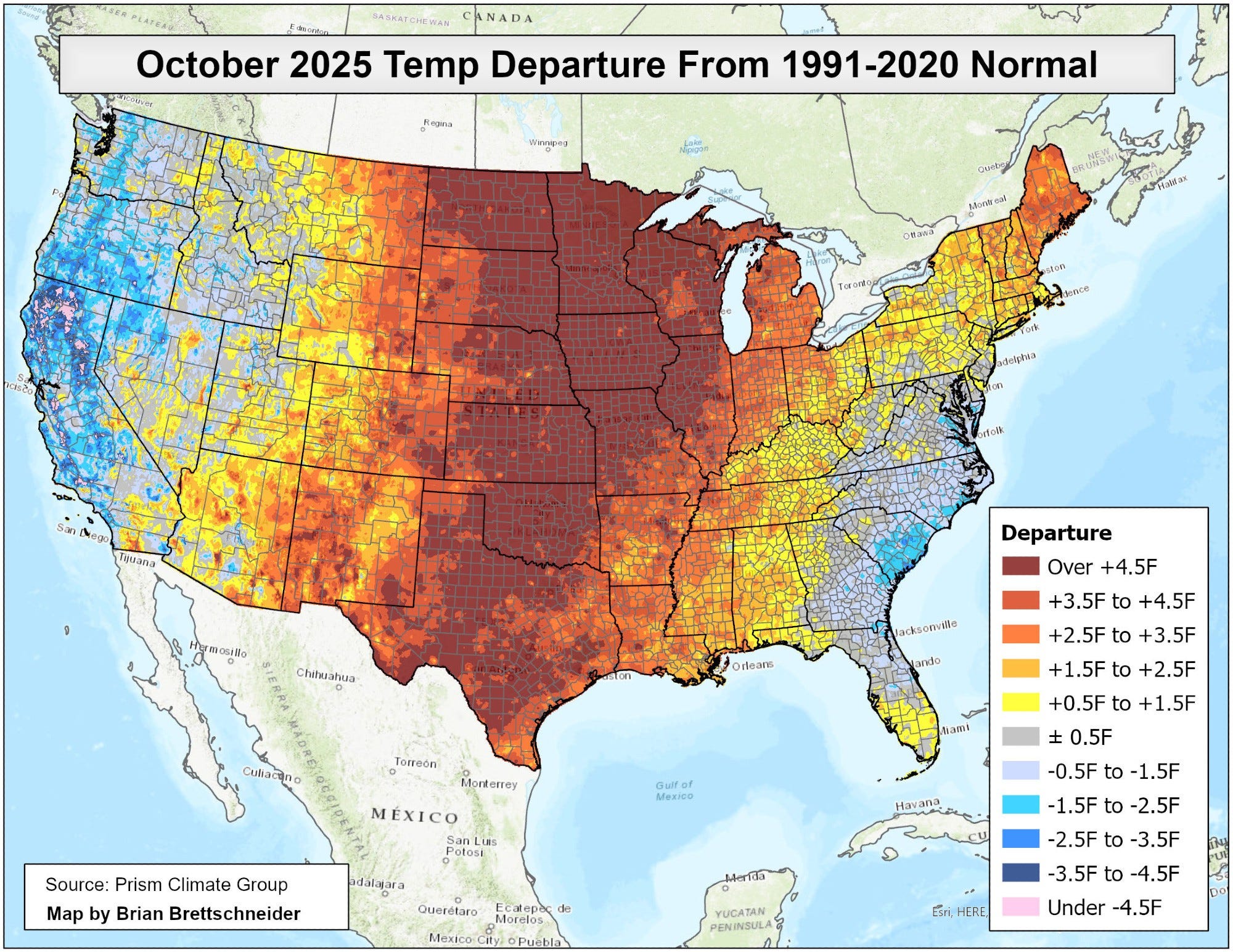
Turning back stateside, for much of the United States other than the west and southeast coasts, October 2025 was another warmer than normal month. Climatologist Brian Brettschneider shares wonderful maps on his BlueSky account providing excellent climate information, and at the end of each month shares summary graphics. His October temperature map above shows that most of the country saw well above normal temperatures, as much as 5F above normal in the central part of the country.
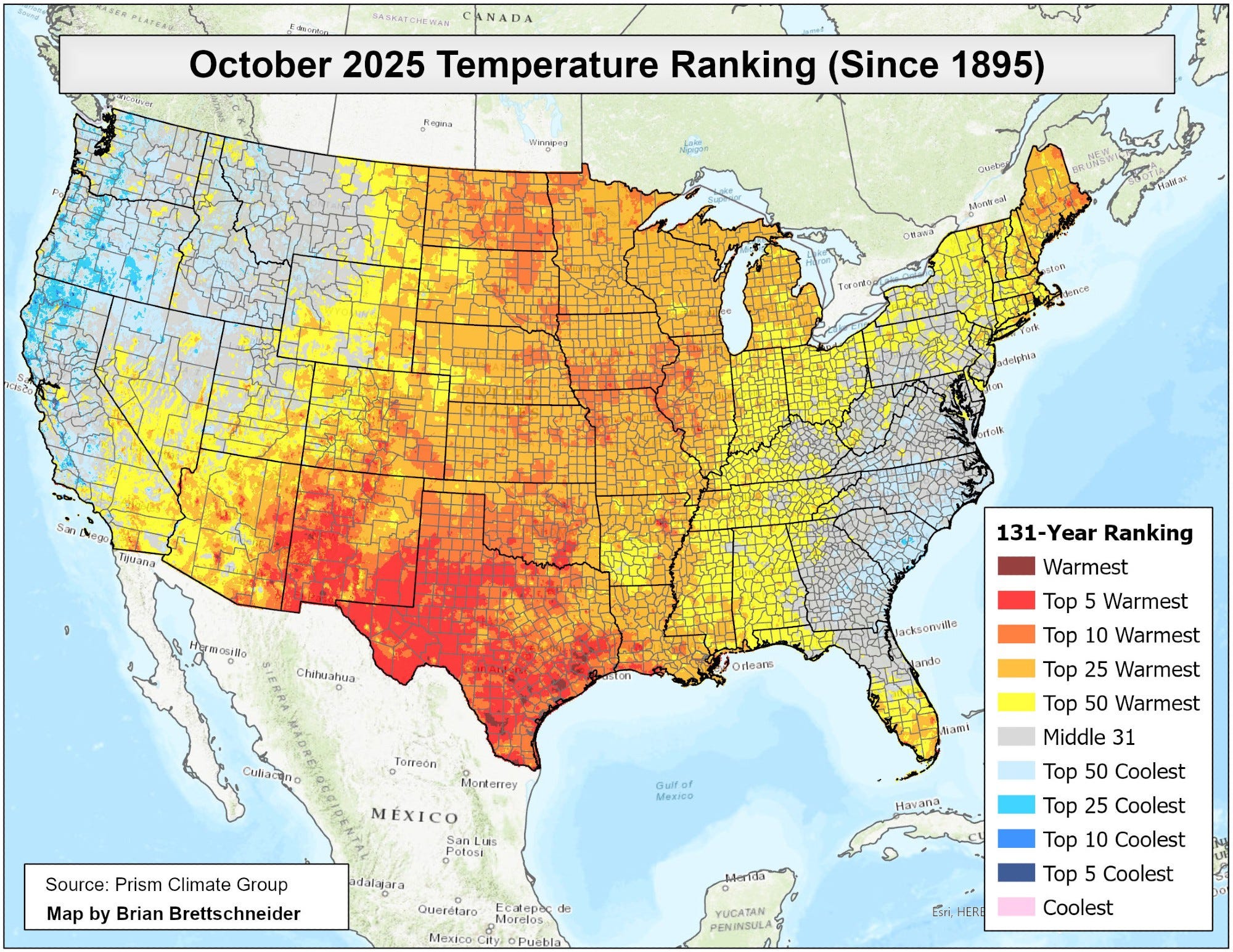
Many locations saw a top 10 warmest October, while much of Texas had a top 5 warmest month with a few spots in southern Texas seeing their warmest October on record.
Meanwhile, the 49th state saw an unusually warm and wet month (click on link above).
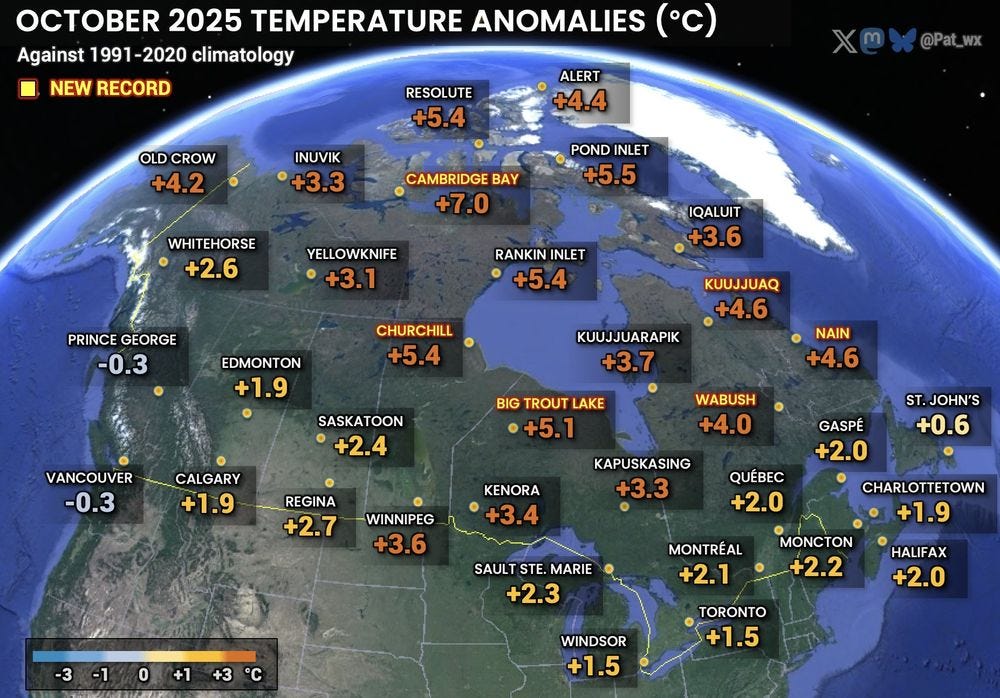
The warmth through the central and northeastern United States also extended north into Canada as this map Canadian meteorologist Patrick Duplessis shared on BlueSky shows. Several locations saw their warmest October on record including Churchill in northern Manitoba on Hudson Bay.
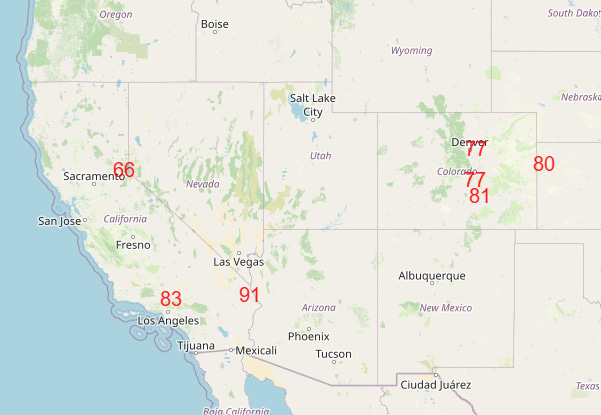
After a short pattern change the last few days that brought cooler weather to the central and eastern United States (freeze warnings and watches are in effect for Missouri and portions of adjoining states this weekend), this warmer than normal pattern for much of the country looks set to return this week. The warmth will initially be in the western states, where a number of record high temperatures are possible on Sunday (shown above).
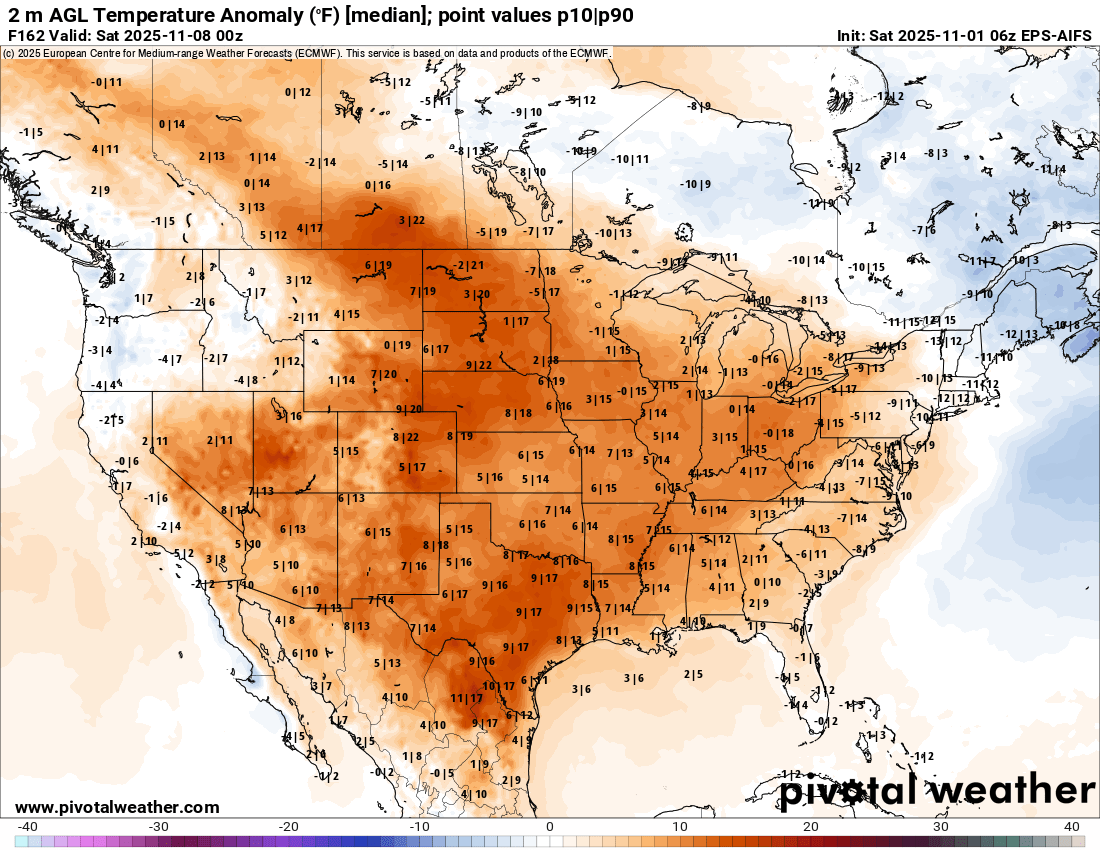
By the end of the week (Friday surface temperature anomaly from European AI ensemble shown above), warmer than normal temperatures look to overspread pretty much the entire country.
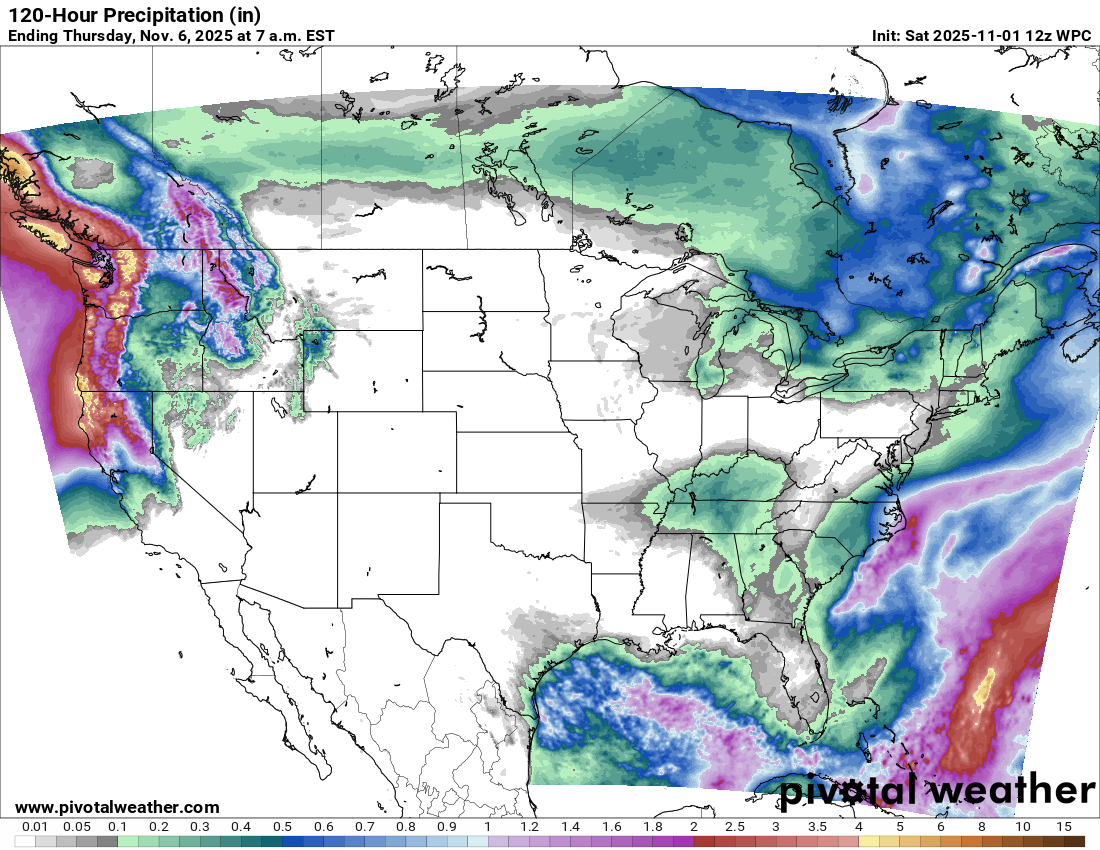
The precipitation forecast map for the next 5 days from the NWS Weather Prediction Center shows mostly dry weather for much of the country. The biggest exception will be in the Northwest, where a series of storm systems moving inland from the Pacific will bring several waves of heavy precipitation to the region along with gusty winds at times. With snow levels anticipated to be high, snowfall will be limited to the highest elevations with heavy rain being the primary precipitation risk. Flood watches are in effect for western Washington through tonight.
Note: The US weather community relies on the work of NOAA scientists who are exempt from the ongoing federal furlough due to the life-saving nature of their work. These federal employees are in their 32nd day of working without pay and without knowing when they will eventually receive pay. You can read more about this situation in this post.

 Balanced Weather
Leave a reply to Rajwantee Robinson Cancel reply