
Supercells produce very large hail in south Texas; a western Pacific tropical cyclone looks to have significant impacts this week.
I want to start off this morning by highlighting a story that might not get a ton of public attention but that needs awareness. Alaska Public Media reported that NOAA has canceled a contract with the Alaska Earthquake Center to collect seismology data that is crucial to the National Weather Service’s tsunami warning mission. Per the reporting, with the cancelation of this contract NOAA/NWS will lose access to data from dozens of seismology sites across Alaska, including several in the Aleutians and Bering Sea that the earthquake center has been maintaining for decades specifically for NOAA/NWS and the tsunami prediction mission:
(Alaska State Seismologist and Alaska Earthquake Center Director Mike) West said the change is a big deal. NOAA’s National Weather Service holds the federal responsibility for tsunami warnings, and has historically been a primary supporter of seismic data collection in Alaska. But the agency doesn’t actually collect much of that data itself…West said the Earthquake Center is grappling with the situation but that its NOAA data feeds and tsunami-specific work will wind down in November. “We are not going to continue operating those stations in the Aleutians that are entirely NOAA supported,” he said. “We’re not going to just keep doing it.”
The situation with NOAA/NWS having warning responsibility for phenomena they do not have primary data collection responsibility for is not limited to tsunamis — for example, the NWS has the primary mission for river forecasting and warnings in the United States, but collects very little of the data, relying instead upon other federal agencies (e.g., US Geological Survey and US Army Corps of Engineers) and state and local entities for the crucial river stage and streamflow data. In the past, NWS did have more of a hydrologic data collection role, but gradually reduced it due to budget shortfalls to the point that it is almost non-existent at this point.
While I obviously do not know, my speculation is that NOAA is canceling data collection contracts with state and local entities such as this one with the Alaska Earthquake Center and hoping that those entities will just keep collecting and providing the data as a public service. I saw it firsthand when NWS was pulling out of hydrologic data collection — when local communities would complain about the loss of river gages, NWS would encourage the communities to install their own gages and then share the data with the NWS for forecast purposes. To be fair, the USGS has pursued similar strategies over the last decade or so as its own budget has been reduced.
I understand that agencies such as NOAA/NWS and USGS are dealing with shrinking budgets and are having to make difficult spending decisions. However, the state of Alaska does not have tsunami warning responsibility, the NWS does. As Dr. West notes in the Alaska Public Media article, the data being lost from the Aleutians and Bering Sea is not just critical to Alaska:
The potential fallout isn’t isolated to Alaska. West provided an example: the 1946 tsunami that originated near the Aleutians, and killed more than 150 people in Hawaii. “The tsunami threats from Alaska are not just an Alaska problem,” West said.
Ultimately, our federal science agencies should be adequately funded and staffed to not only issue the warnings they are assigned responsibility for by law, they should also have the budget to be able to gather the data required for the issuance of timely warnings. States and local communities should not be expected to pick up the slack to try to ensure their citizens’ safety — that is the modus operandi of a mafia protection ring, not the federal government.
It should be noted that NOAA did not respond to Alaska Public Media’s requests for comment about the cancelation of the contract. While that is not surprising, I also hope that when the inevitable tsunamis come, that NOAA spokespeople do not try to blame the lack of this seismologic data (or the state of Alaska) for any less than timely or accurate warnings.
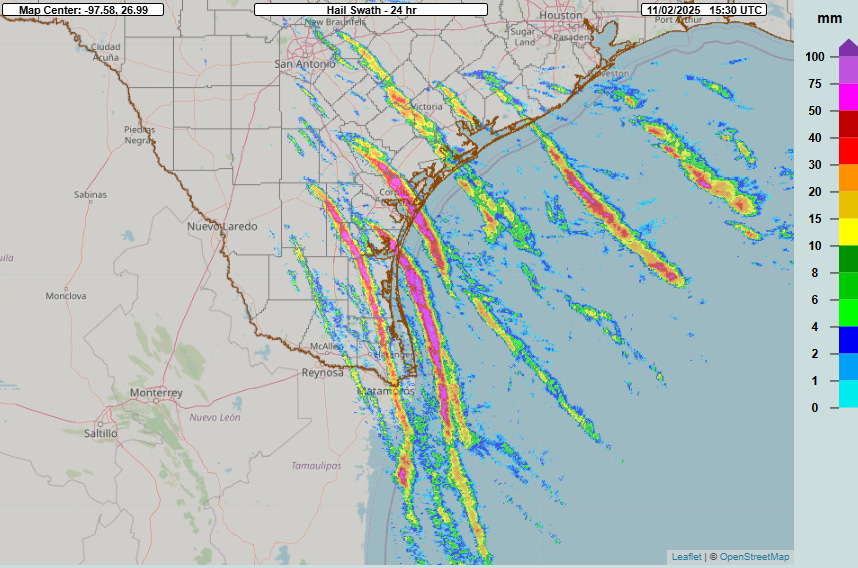
As far as weather is concerned, starting off this morning with a bit of a surprise local outbreak of severe thunderstorms over south Texas yesterday evening. While supercell thunderstorm development had been anticipated in this area in earlier forecasts, the primary risk had looked to be right along the coast and mainly offshore over the Gulf. SPC forecast updates issued late yesterday morning shifted that risk a bit farther inland, and as this Multi-radar Multi-Sensor System 24-hour Hail Swath product shows, that panned out as several intense supercell storms developed south and east of San Antonio, and moved southeast to impact the Corpus Christi and Brownsville-Harlingen metro areas.
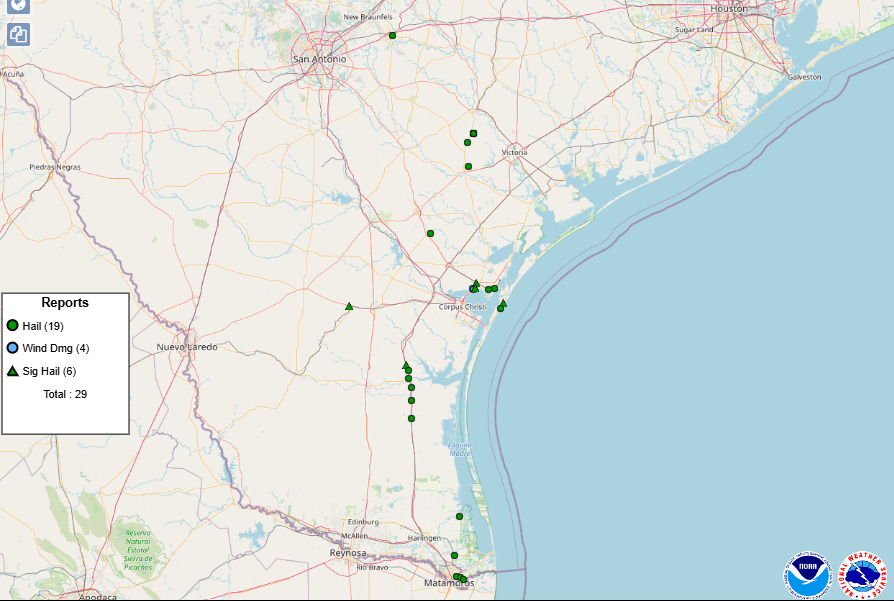
These storms produced more than 25 reports of severe weather, with a number of reports of significant (2” or larger) large hail. Hail up to a little larger than baseball sized caused significant to damage to vehicles in the Corpus Christi area, and half dollar sized hail was observed at the NWS Brownsville office.
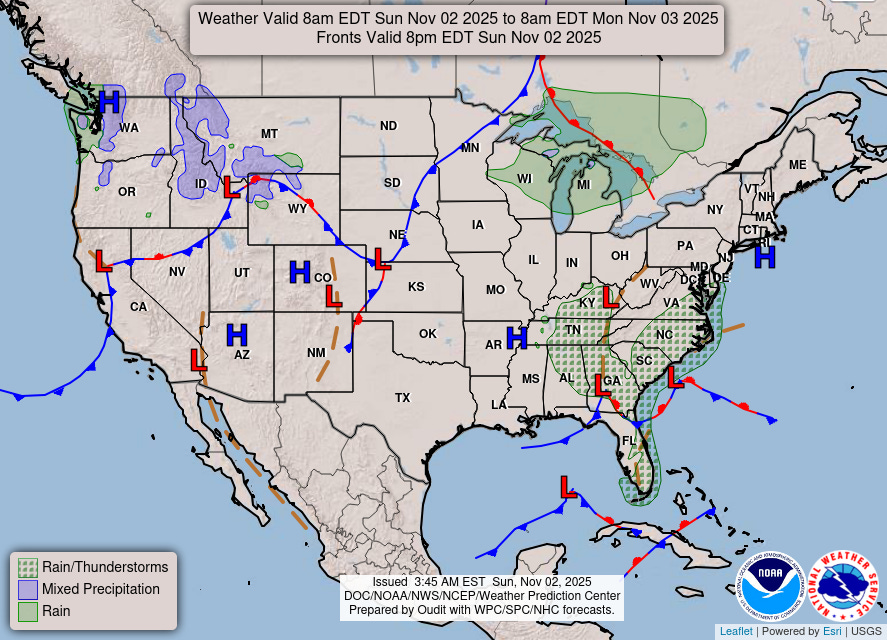
The weather today will be rather quiet across most of the country, with just a few areas of precipitation as shown in the Weather Prediction Center forecast map for today. Several record high temperatures are possible today in the Southwest and Rockies, and above normal temperatures will be spreading east across most of the country as the week goes on.
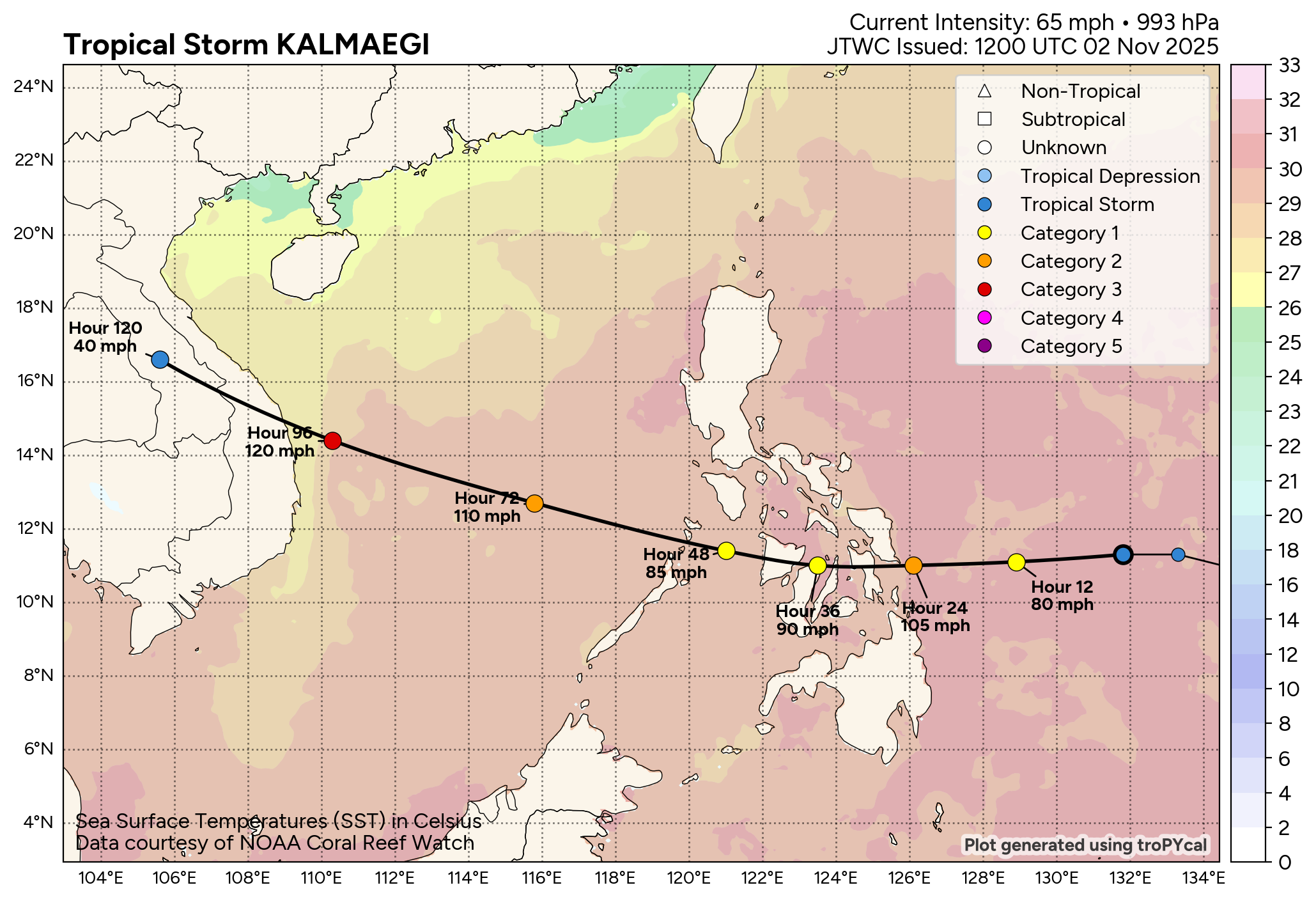
The biggest weather story this week will likely be Tropical Storm Kalmaegi, which is forecast by the Joint Typhoon Warning Center to rapidly intensify into a typhoon as it moves across the central Philippines over the next couple of days.
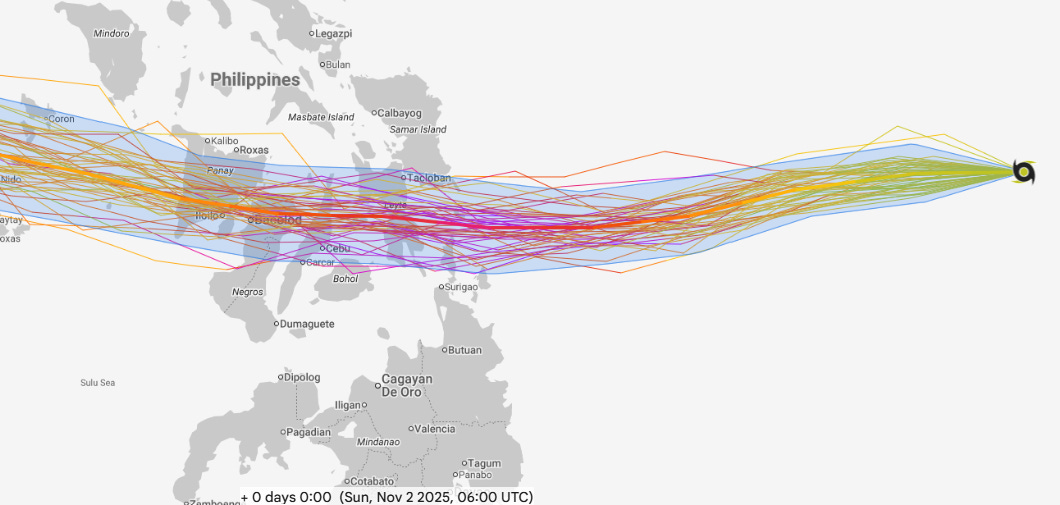
The Google DeepMind AI forecast system which has performed so well this season is even more bullish with Kalmaegi, intensifying it into a category 3 or 4 equivalent on the Saffir-Simpson Hurricane Wind Scale as it moves across the region near and south of the city of Tacloban, the same general area that was devastated by Supertyphoon Haiyan in 2013.
After passing through the Philippines, Kalmaegi is expected to reintensify and make landfall in central Vietnam later this week. I will have updates on Kalmaegi in posts this week, as well as in notes and on BlueSky as things evolve.
Note: The US weather community relies on the work of NOAA scientists who are exempt from the ongoing federal furlough due to the life-saving nature of their work. These federal employees are in their 33nd day of working without pay and without knowing when they will eventually receive pay. You can read more about this situation in this post.
 Balanced Weather
Leave a comment