
Record cold continues to invade the East today, but will be a distant memory by the end of the week. Fung-Wong continues the Philippines tropical cyclone woes.
Nov 10, 2025
Good Monday morning. The big national news in the last 24 hours has been the Senate narrowly voting to advance a bill to end the current partial federal government shutdown. I have my own (complicated and conflicted) opinions about this development, but figured that this was a good opportunity to recap — especially for new subscribers —what is facing the NOAA weather and climate entities in the FY2026 budget and talk a bit about what this bill might mean for these agencies.
First, I think it is important to stress that the shutdown will not be ending immediately. The vote that was taken last night in the Senate was a parliamentary motion to advance the bill for further consideration. The bill must now go through the Senate parliamentary process and receive final approval, and then go to the House for consideration and a vote, and then go to the President for signature. In the article I linked above, NBC News says that this process will take days.
If the bill is passed and does make it into law, the shutdown will end and federal employees will return to work. The bill contains language clearly stating that the funds appropriated through this bill should be used to provide back pay to all federal employees for the shutdown period per the law passed by Congress and signed by President Trump after the prolonged shutdown during the first Trump Administration.
While this bill does provide full 2026 appropriations for the Agriculture Department, most executive departments that were lacking a budget on October 1st will still be without a full year budget. The bill provides these departments with funding through January 30th based on their funding levels from FY2025, a so-called “continuing resolution.” Federal agencies are very used to operating under continuing resolutions, as it has pretty much become standard operating procedure for Congress to not have full appropriations bills passed at the start of the fiscal year on October 1. However, this particular bill has continuing resolution language that I think is unusual (someone can hopefully correct me if I am wrong):
SEC. 109. Notwithstanding any other provision of this Act, except section 106, for those programs that would otherwise have high initial rates of operation or complete distribution of appropriations at the beginning of fiscal year 2026 because of distributions of funding to States, foreign countries, grantees, or others, such high initial rates of operation or complete distribution shall not be made, and no grants shall be awarded for such programs funded by this Act that would impinge on final funding prerogatives.
SEC. 110. This Act shall be implemented so that only the most limited funding action of that permitted in the Act shall be taken in order to provide for continuation of projects and activities.
While prior continuing resolutions prohibited agencies from starting new projects not clearly authorized in prior years’ appropriations (and so does this one), the agencies were able to operate pretty much normally within the confines of their prior year’s budget levels. NOAA colleagues I have talked to in recent weeks had told me that they expected that the Office of Management and Budget (OMB) would limit funding allocations under a continuing resolution to just the funds needed to cover salaries and “must-pays” such as utilities, building rent, and supplies/equipment for operational needs. These sections of the bill (to me anyway) say that Congress is specifically directing the agencies to essentially operate in such a barebones manner for the duration of the continuing resolution, which is January 30. Obviously, the exact impact on each agency will depend upon the interpretation of this wording by OMB and departmental leadership, but I would anticipate for NOAA’s weather agencies this will mean that budgets will be very tight and that only very basic activities will occur through January 30.
Which brings us to the next aspect of this, which is the consideration of full year budgets for FY2026. Given that we are still days away from this bill becoming law, we will essentially only have about 10 weeks in which Congress will be able to work on the full year budgets and get them passed and into law before this continuing resolution expires. Plus, this is not really 10 work weeks as the holidays will remove significant periods of time. The bottom line is that I do not have a lot of confidence that Congress will be able to meet their self-imposed new deadline of January 30 for full year appropriations laws to be passed for all of the remaining departments and agencies.
To recap the potential FY2026 for NOAA’s weather entities, the administration’s budget for this year proposed substantial budget cuts and major permanent changes, including the elimination of the Office of Oceanic and Atmospheric Research (OAR), the NOAA line office responsible for weather and climate research in support of NOAA missions, while holding budget levels for NWS operations generally steady. The proposal did keep some research funding and activities in areas such as severe weather research and move them to the National Weather Service — but as I have discussed before, I have serious concerns about this concept.
As someone who was a long time employee of both NWS and OAR, I think that the NWS is naturally going to focus on the maintenance of operations over research and development. While the NWS certainly has organizational pieces that are focused more on the future and developing new science and technology, in my opinion some senior NWS leadership over the years has often not had sufficient (or, to be honest, much of any) interest or focus on moving forward with transitioning key research or implementing new technology that could improve key NWS mission areas such as short-fused warnings (i.e., severe thunderstorm, tornado, flash flood warnings). Again, to be fair, some of this recalcitrance is reasonable — the NWS’ primary mission is maintaining current services, and when budgets and resources are tight (as they almost always are now), the priority is going to be on keeping what the agency views as critical current services going. Still, I feel pretty confident that if OAR had been lumped into NWS and not its own entity, many key weather focused research-to-operations projects — including a number that eventually were transitioned to NWS and have improved NWS services — over the last 25 years would have been ended prematurely if the NWS had responsibility for them, and this is why I do not think that the administration’s idea of moving what they propose to keep as far as weather research into NWS is a good idea.
Congress has sent very clear messages through their own appropriations processes that they are not supportive of most of the administration’s plans for NOAA. Both the Senate and House appropriations committees approved funding bills that push back on the administration’s budget for NOAA and fully fund most ongoing research and weather satellite programs. Given how far apart the administration and Congress are in their vision for NOAA — and given how the director of OMB has made clear his view that the executive branch should be able to implement its vision for its agencies regardless of Congressional appropriations — I again am very skeptical of how much of this will be able to be resolved by a new deadline of January 30. Obviously, I will continue to provide updates as the situation evolves.
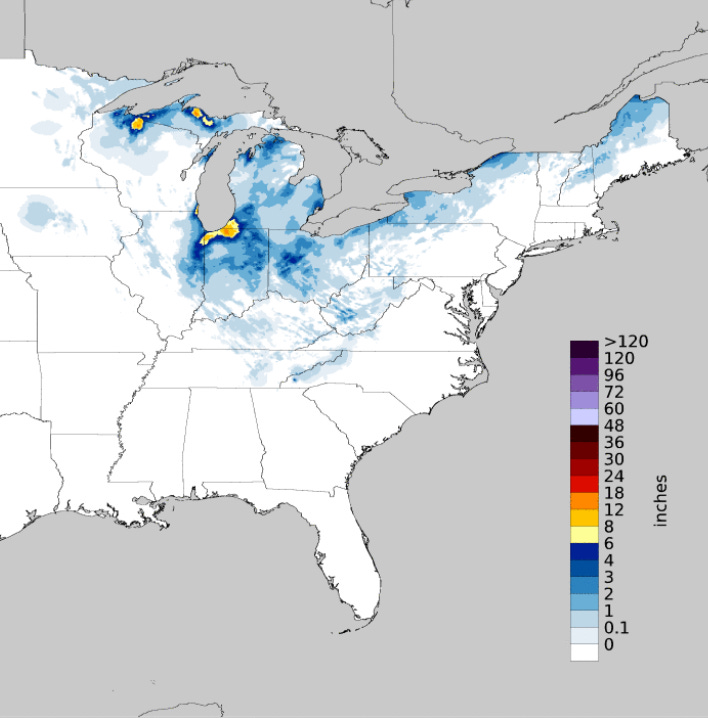
As expected, heavy lake effect snow bands occurred downstream of lakes Superior and Michigan over the last 24 hours. While heavy lake effect bands moved through downtown Chicago overnight with some thundersnow, the most persistent bands have been to the south/southeast and north of the immediate Chicago area as shown in the snowfall map above.
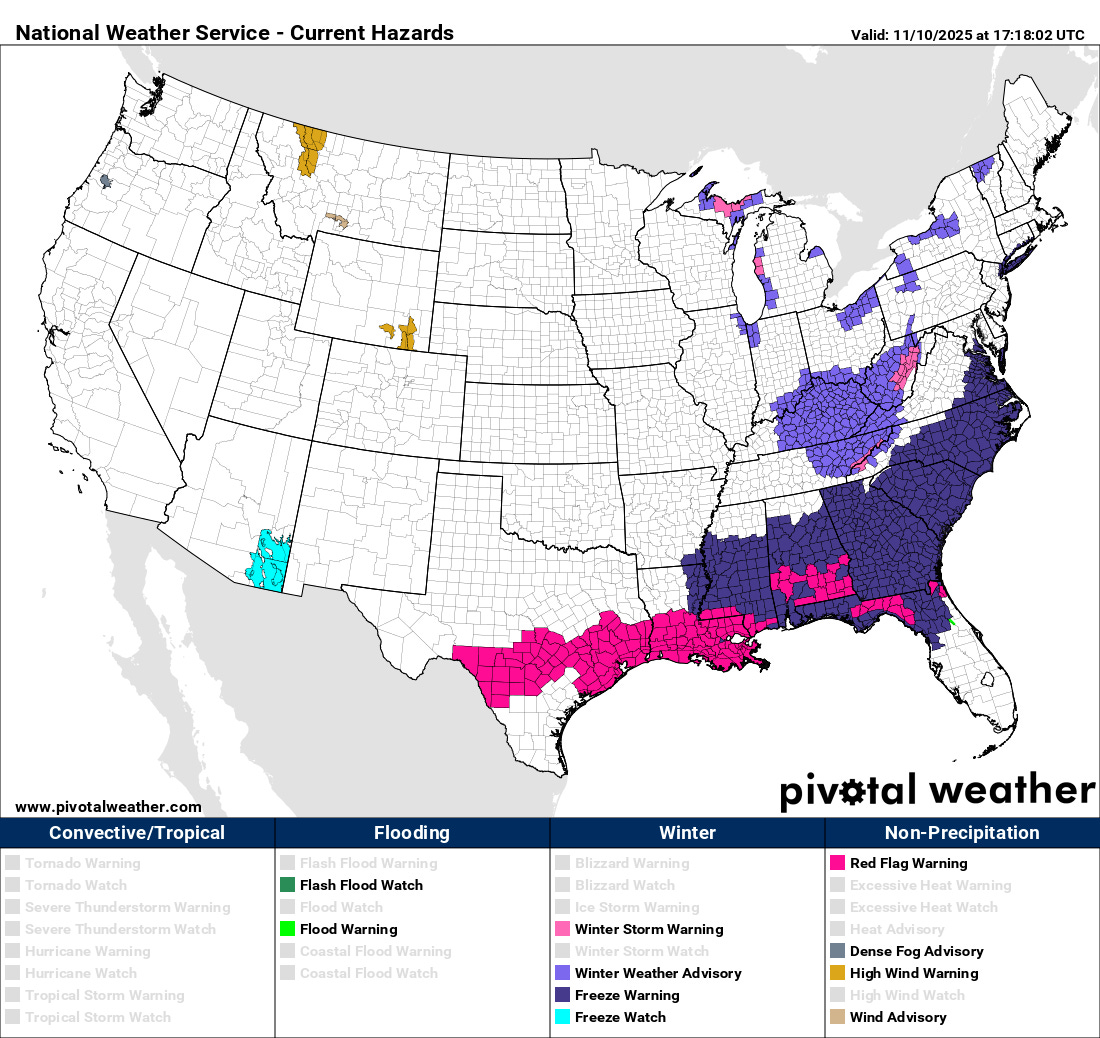
The lake effect snow in the western Great Lakes will be gradually winding down today, although heavy snow bands and areas of poor travel will continue this afternoon. Cold northerly winds passing across the still warm Great Lakes will cause moisture to move upslope in the Appalachians region, resulting in heavy snow showers that will cause hazardous driving conditions. Winter weather advisories are in effect for this region, with winter storm warnings in effect for the highest elevations of the central Appalachians where heavier snow is expected. Winter weather advisories are also in effect for the typical lake effect snow areas downstream of Lakes Erie and Ontario. Heavy lake effect snow bands are also expected in southwest Ontario off of Lake Huron. Meanwhile, gusty northerly winds and dry air/conditions will mean enhanced danger of wildfires for much of the Gulf Coast and south Texas, and Red Flag Warnings are in effect today.
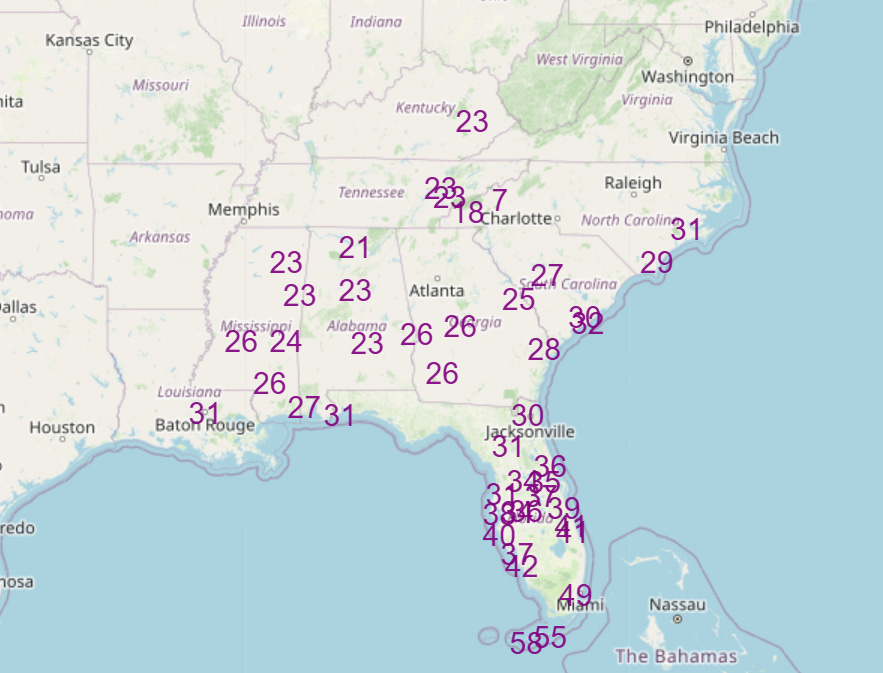
Record cold temperatures — both morning lows (shown above, from the NWS Weather Prediction Center) and daytime highs — will be widespread on Tuesday in the Southeast.
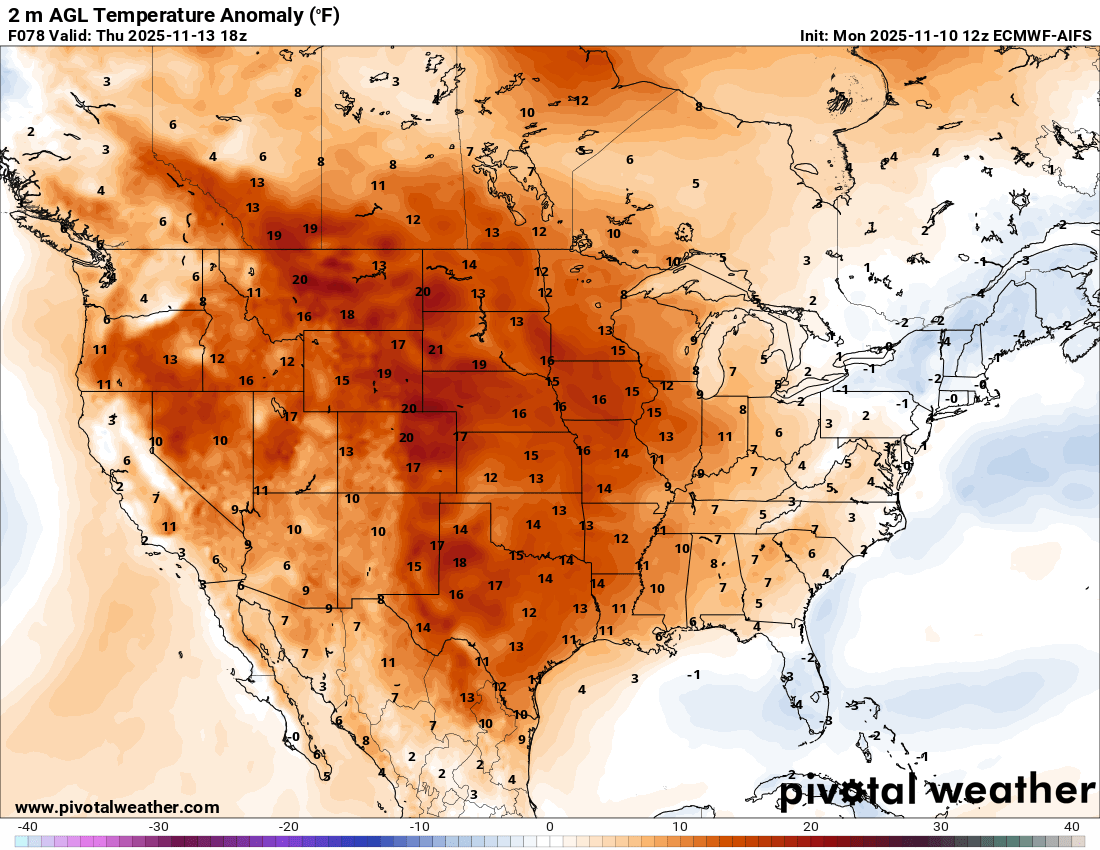
Again, this cold air intrusion will be very short lived, as temperatures will be above normal (in the central US, much above normal) for most the country by Thursday afternoon.
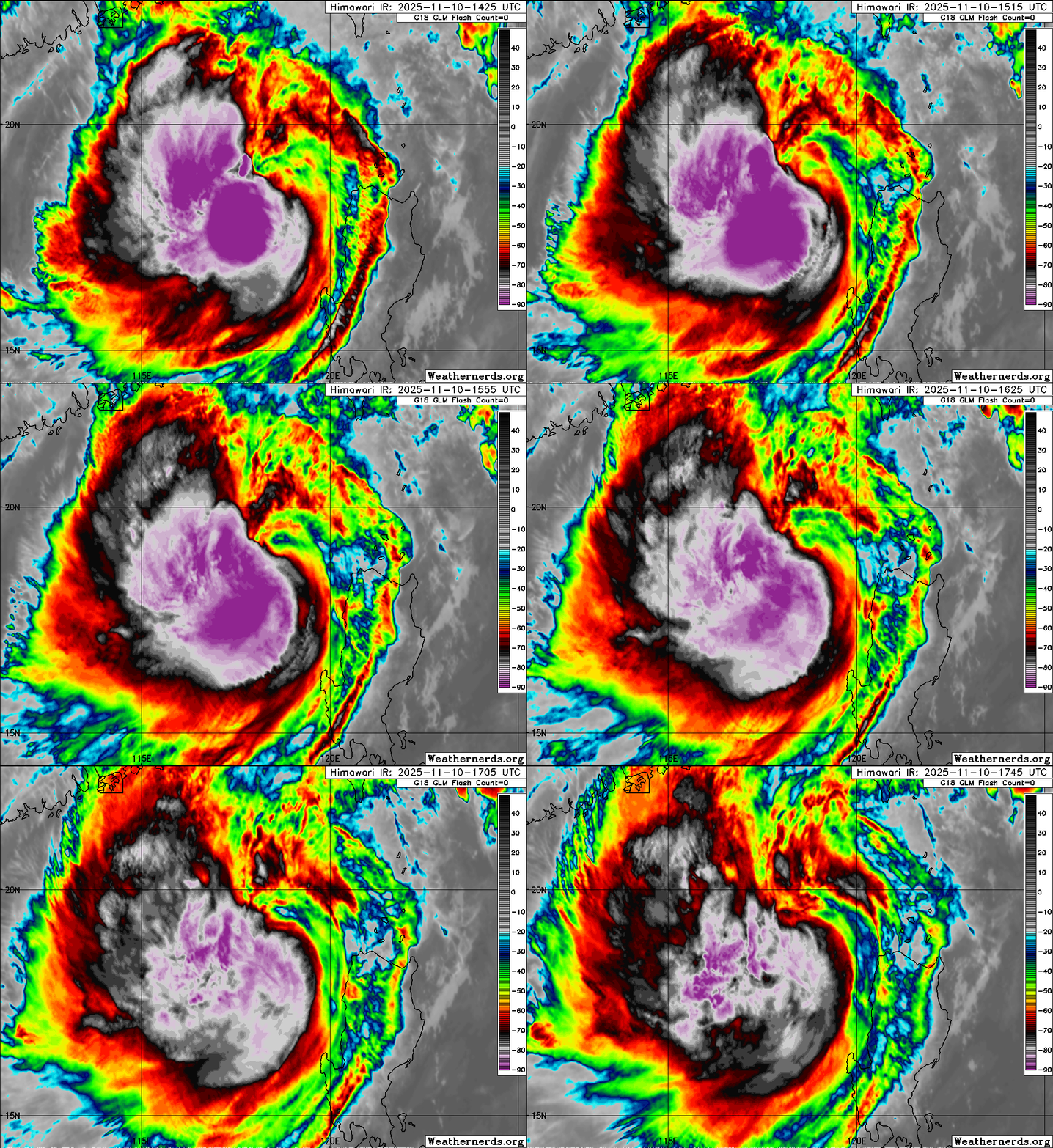
Typhoon Fung-Wong weakened over the last 24 hours as it passed over the northern Philippines, but remains a category 1 equivalent typhoon to the southwest of Taiwan this morning. Fung-Wong caused serious impacts in the northern Philippines, with 8 people reported dead and more than a million people displaced. It also forced the suspension of rescue and recovery operations for more than 100 people still missing in the central Philippines in the aftermath of Typhoon Kalmaegi, which killed at least 224 people there.
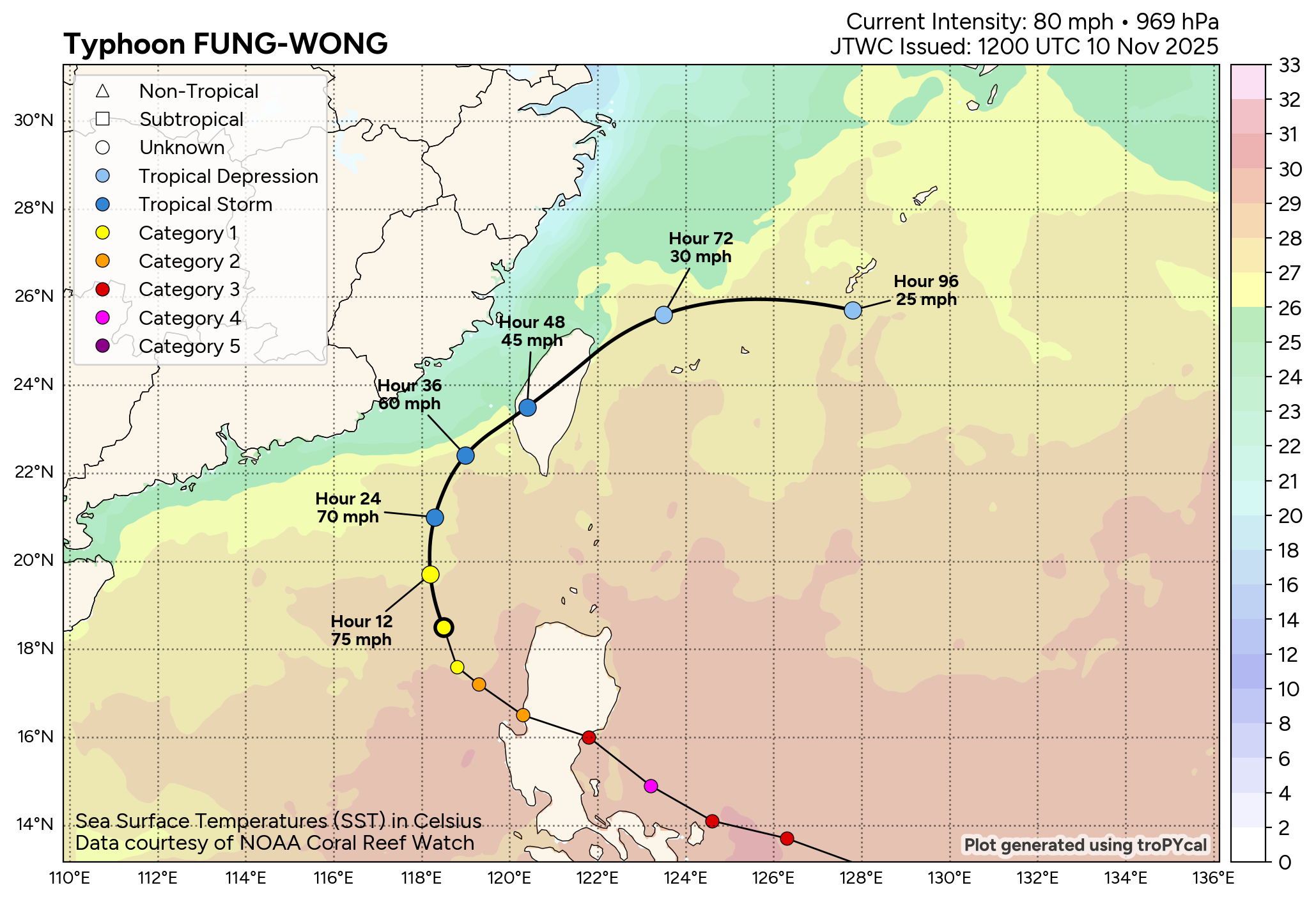
Fung-Wong is forecast to continue to weaken to a tropical storm as it approaches Taiwan from the southwest over the next couple of days, but is still expected to produce very heavy rainfall and potential flash flooding on Taiwan as it impacts the island. Once Fung-Wong dissipates in a few days, the global tropics — including the Atlantic and eastern Pacific — look very quiet for the next two weeks.
Note: The US weather community relies on the work of NOAA scientists who are exempt from the ongoing federal furlough due to the life-saving nature of their work. These federal employees are in their 41st day of working without pay and without knowing when they will eventually receive pay. You can read more about this situation in this post.
 Balanced Weather
Leave a comment