
Leaving after a short tenure as the agency and emergency management as a whole face a crucial juncture
Nov 18, 2025
The acting FEMA Administrator (agency director) David Richardson resigned on Monday. In a statement released exclusively to ABC News, Richardson essentially claimed to have taken on the post in the spring because nobody else was willing to do it. He says he knew time was of the essence because of the approach of hurricane season — and that now that hurricane season is nearly over he is free to move on. Meanwhile, CNN is reporting that Richardson stepped down because the Trump Administration was preparing to fire him.
Regardless of the exact circumstances of Richardson’s hiring or leaving, it is fortunate that the United States mainly avoided any significant tropical cyclone impacts during his tenure, because from all indications FEMA under his leadership was not in a good place. In late September, the Wall Street Journal published a critical expose of the agency, revealing deep dysfunction and mismanagement in the wake of the May St. Louis tornado. Richardson also came under criticism after the catastrophic July 4-5 Texas Hill Country Flash Floods for a lack of public engagement, along with reports of his unavailability in the immediate aftermath which supposedly slowed deployment of critical response resources to the region.
Richardson’s departure comes at a critical time for FEMA as an agency and for the future of emergency management in this country. Earlier this year, the administration established a “FEMA Review Council,” headed by DHS Secretary Kristi Noem, which is scheduled to imminently release an advisory report of recommendations on the future role and structure of the agency. In fact, the report was supposed to have been released by a deadline of November 17, but appears to have been delayed. Late Monday evening, Politico reported that the administration is considering moving FEMA headquarters to Texas, apparently at least in part because it hopes to lure current Texas Division of Emergency Management head Nim Kidd into the role of FEMA Administrator.
Meanwhile, a bipartisan group of Congressional representatives have introduced the Fixing Emergency Management for Americans (FEMA) Act, which the authors say will streamline “the federal government’s disaster response and recovery programs while also making FEMA a cabinet-level agency once again that is directly accountable to the President. The bill rewards effective state and local preparedness, protects taxpayers, cuts red tape, and ensures that relief efforts are fast, fair, and free from political bias.”
CNN reports that DHS Secretary Noem is deeply opposed to this legislation — primarily the removal of FEMA from DHS and moving it to cabinet level agency. It is important to note that prior to the formation of the Department of Homeland Security, FEMA was an independent agency from its inception in 1979, and was a cabinet level agency during the latter half of President Clinton’s administration.
Ironically, Richardson’s resignation came just as the primary annual emergency management meeting, the annual conference of the International Association of Emergency Managers, was getting underway in Louisville. I am here at the meeting to give a talk on Wednesday morning about the 20th anniversary of Hurricane Katrina, and about how the strong collaboration between the meteorology and emergency management communities during that event started me down the road of pursuing my master’s degree in emergency management.
As I participate in the conference, I will be very interested to hear attendees’ perspectives about the state of FEMA and what may evolve out of the FEMA Review Council report and FEMA act. Once this week is over and I have a chance to reflect, I will certainly be providing some updates to my own views about the state of our emergency management structure that I shared a few months ago. I continue to be very concerned about the administration’s idea of supposedly shifting more responsibility to state and local entities. Given that the US emergency management is already set up with the primary responsibility at the state and local level, I worry that that the administration’s approach will simply weaken FEMA and leave states and local entities that are already struggling having to try to do even more without a sufficient increase in resources. The recommendations for FEMA from the review council will be very telling in my opinion.
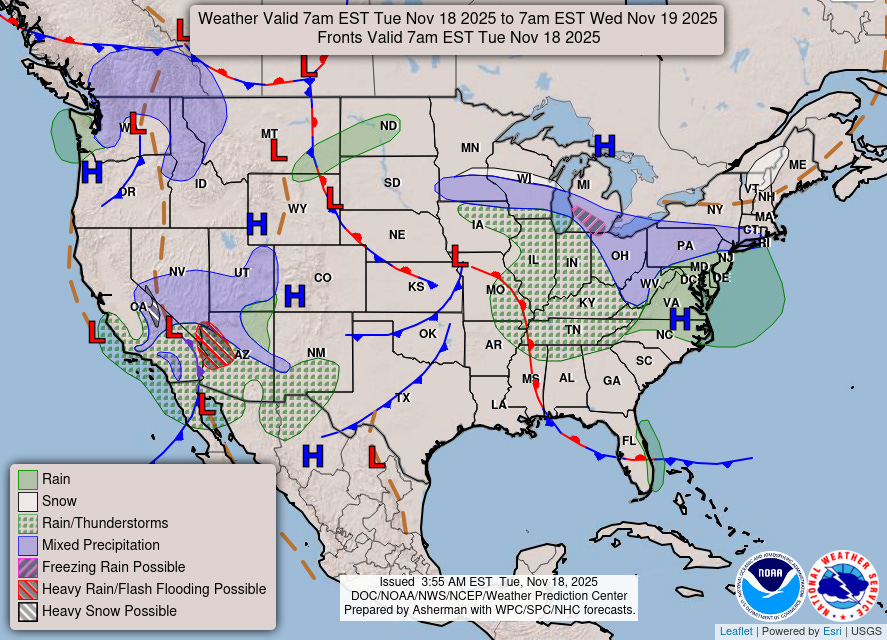
In today’s weather, the upper level storm system that brought additional heavy precipitation to California on Monday along with some more flooding issues to the Los Angeles region will move east into the Southwest today, bringing some heavy rain and mountain snows to the region. The Weather Prediction Center has a slight (level 2 of 4) risk of flash flooding for parts of western Arizona and extreme southern Nevada. Farther east, the storm system over the Midwest will continue to bring showers and thunderstorms to the mid-Mississippi and lower Ohio Valley regions, with a few severe storms possible. Light wintry precipitation will occur on the northern fringe of the precipitation area across the lower Great Lakes and northern Appalachians.

The Southwest system will continue to move slowly east on Wednesday, with additional shower and thunderstorm activity developing farther east across the Southern Plains and Ozarks.
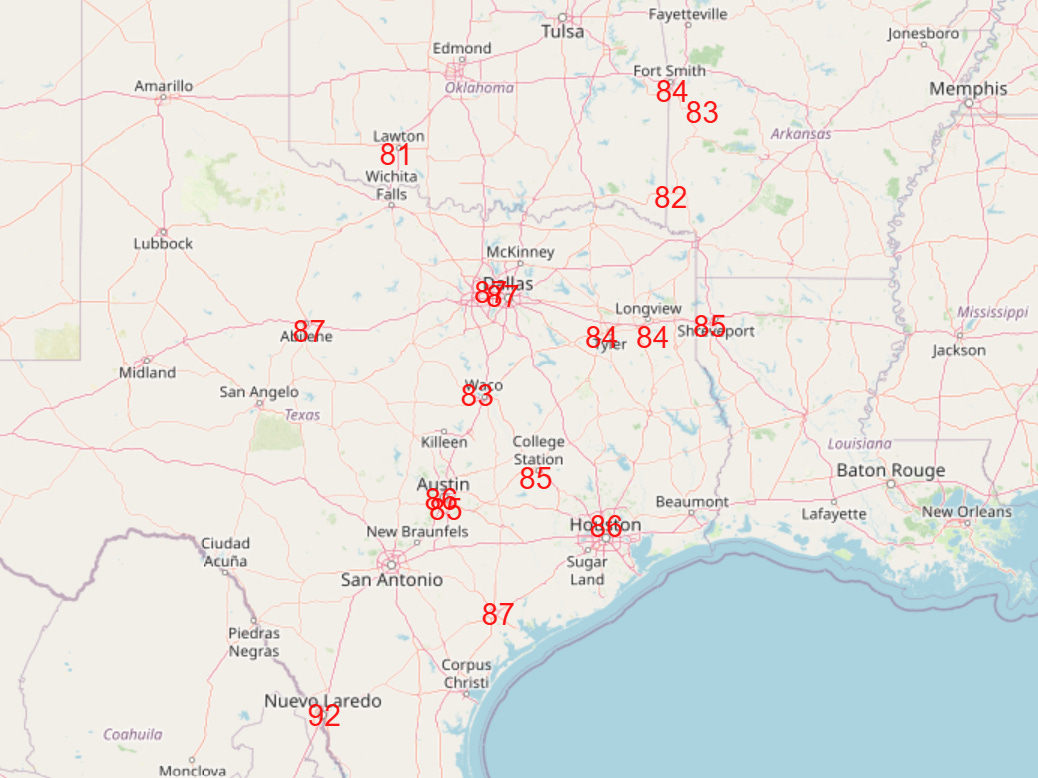
After a number of record highs were set across the south central United States on Monday — including at Dallas-Fort Worth (87F), Wichita Falls (87F), and Shreveport (85F) — more record highs are expected across the region today.
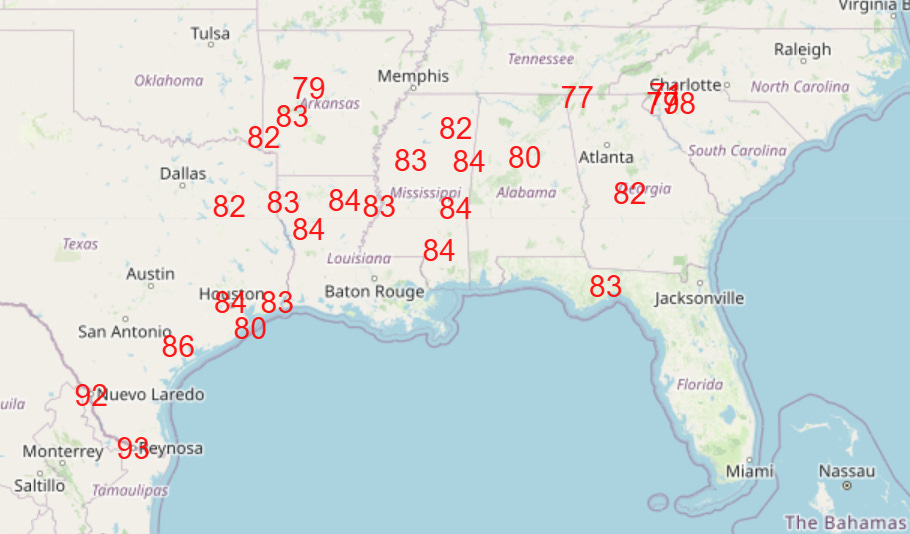
The record warmth will expand on Wednesday, with numerous record highs expected from Texas across the Southeast. Unseasonably warm temperatures will continue to dominate much of this region into at least early next week.
 Balanced Weather
Leave a comment