
Active weather for much of country today, along with more record warmth in the south
Nov 20, 2025
I am home from the International Association of Emergency Managers meeting, which as usual was an excellent conference with plenty of interesting, informative talks from emergency managers from around the country and indeed the world. Ironically, it almost seems as if the power-that-be were waiting for the country’s largest gathering of emergency management professionals to be in progress to start breaking major news about the Federal Emergency Management Agency (FEMA).
I talked on Tuesday about the resignation of acting FEMA director David Richardson and the crucial period that faces FEMA and emergency management in this country as the Trump Administration prepares a recommendation report on the future of the agency and Congress develops bipartisan reform plans of its own. Yesterday, multiple media outlets reported that the administration’s FEMA Review Council report was delayed — it had a deadline per executive order of Monday — because Department of Homeland Security Secretary Kristi Noem was making major edits to the 100+ page draft report that was delivered by the council.
The media stories on this development varied quite a bit in detail and perspective. For example, the New York Times article focused on quotes from DHS spokesperson Tricia McLaughlin that Sec. Noem was not altering the council’s findings and recommendations in her editing, although noting that the document was reportedly being reduced from 100 pages to around 20. The Associated Press was much more negative, saying:
…recommendations compiled by a council appointed by the president (were) slashed and amended by Homeland Security Secretary Kristi Noem’s office, according to three people familiar with the developments. The report “got nuked,” said one former FEMA official. The three people, who spoke to The Associated Press on condition of anonymity to discuss the issue with the media, said the report shrunk from over 160 pages to roughly 20. They said it left council members and other emergency management leaders concerned that some of the recommendations about the country’s disaster preparedness won’t make it into the final copy, which is expected around Dec. 12. The draft report’s downsizing reflects the Trump administration’s push to disengage the federal government from disaster management and the agency overseeing it, FEMA, pushing more responsibility for preparing, responding to and recovering from climate on states, tribes and territories.
Meanwhile, the Washington Post reported a slightly different perspective:
A panel appointed by President Donald Trump to review whether to eliminate the Federal Emergency Management Agency has instead concluded in a report that the agency should be more powerful and autonomous. Homeland Security Secretary Kristi L. Noem, however, wants to take FEMA in a different direction. The wrangling over the FEMA review council’s long-awaited report, which has been in the works for nearly 10 months, will help determine the fate of one of Trump’s controversial efforts to reshape the government and its ability to respond to disasters such as floods, fires and hurricanes. Noem, as the council co-chair, is responsible for finalizing the report and sending it to Trump for review. Her draft, which is not finished, recommends keeping FEMA within the Department of Homeland Security and largely removing FEMA from its direct role in disaster relief, instead turning it into more of a grant-making operation, according to five people familiar with the situation who spoke on the condition of anonymity to discuss the private deliberations. The council’s earlier draft did not recommend those changes, but rather that FEMA gets elevated to a Cabinet-level office. Noem’s office also wants to reduce the federal government’s share of disaster-related costs to 50 percent, with states having to fund the other 50 percent with cash, which some council members staunchly opposed, according to a person familiar with the situation.
Obviously, we will learn much more when the report is actually released. However, I think it is important to understand the FEMA Review Council which was appointed by President Trump is made up of a number of emergency management and high level government officials from states that are frequently impacted by disasters, including Texas Governor Greg Abbott (R) and director of emergency management Nim Kidd, Florida emergency management director Kevin Guthrie, as well as former Mississippi governor Phil Bryant (R). These are people who have a deep familiarity with the role that FEMA plays before, during and after disasters. Given that nobody I have talked to in the emergency management community is in favor of eliminating FEMA, I am not overly surprised that it sounds like their recommendations were much more in line with the bipartisan Congressional FEMA act, including making FEMA a cabinet-level agency.
If it is true that Sec. Noem is making wholesale changes to the council’s document, it is very concerning. As I have stated multiple times in earlier posts, to me the administration’s outlined plans for FEMA show a deep misunderstanding of the emergency management system in this country and a lack of awareness of the roles played by local, state and federal emergency management entities. I do not believe that anyone involved in the emergency management community believes that FEMA is not in need of serious reform, but those reforms should be guided by professional emergency managers at all levels working with elected and career government officials who have significant experience in disaster management.
The IAEM council issued a statement yesterday in response to the media reports:
The IAEM-USA Council is aware of public speculation regarding the ongoing FEMA Review Council process. As practitioners who participated in the listening sessions and submitted a formal white paper, we are eagerly anticipating the Council’s final report. Our focus remains on the recommendations that strengthen emergency management capabilities nationwide and improve services to the communities we serve. We will not comment on rumors, but we look forward to supporting reforms that benefit the American public.
Hopefully, those ideas that truly strengthen emergency management capabilities will eventually prevail as this process moves forward.
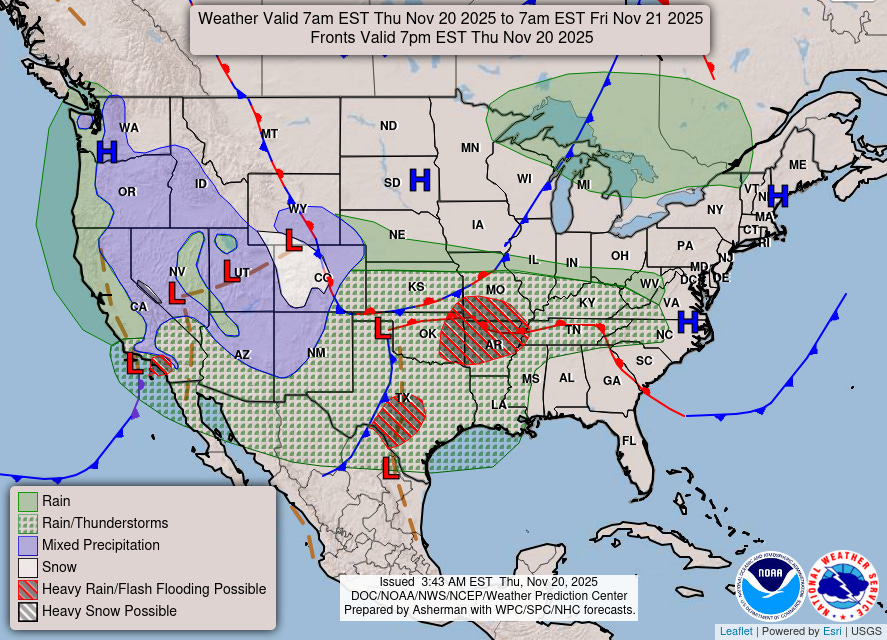
A fairly active weather day is anticipated across the country today. A storm system moving through the south central United States will continue to spread areas of strong thunderstorms across the region. Multiple rounds of storms with heavy rainfall could lead to some flash flooding, and slight (level 2 of 4) risk areas are in place as shown on the Weather Prediction Center map above (red hatched areas). WPC also has a small moderate (level 3 of 4) risk in the center of their area over Texas as heavy rainfall has already occurred in this area and additional storms could cause more significant flash flooding.
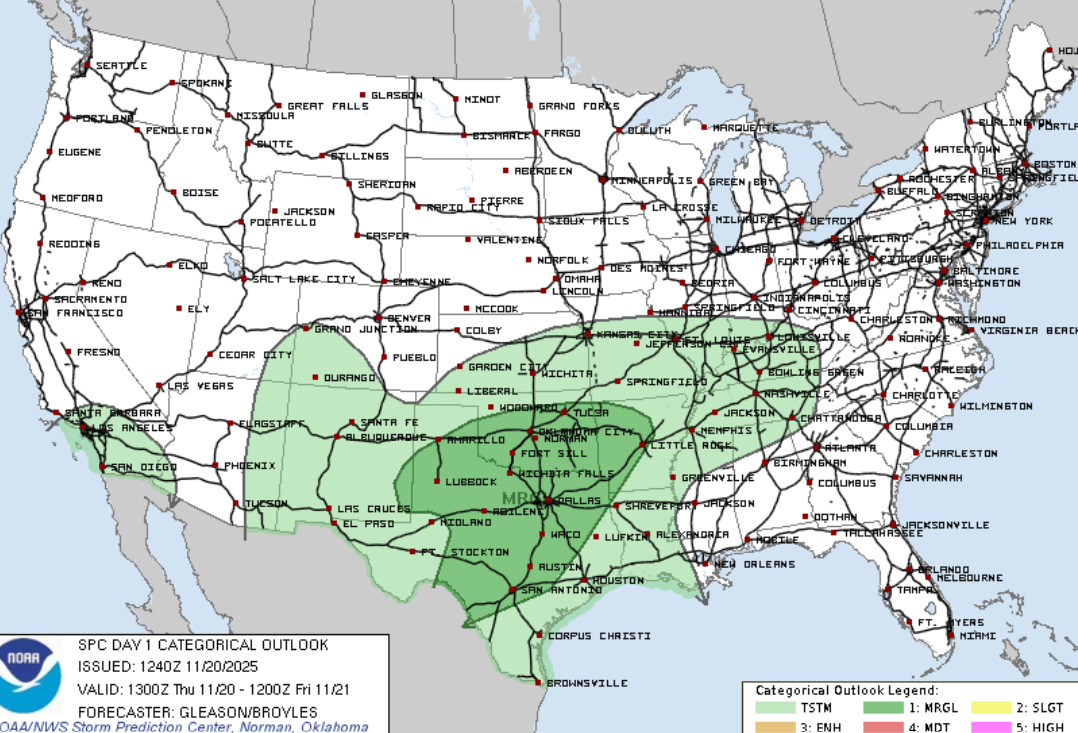
A few severe storms are also possible in this region, and a marginal (level 1 of 5) risk is in place from the Storm Prediction Center.
Another storm system coming into the West will bring more rain and mountain snowfall. Heavy rain in a now rather waterlogged southern California could bring some additional flooding problems, and a level 2 risk of flash flooding is also in place there.
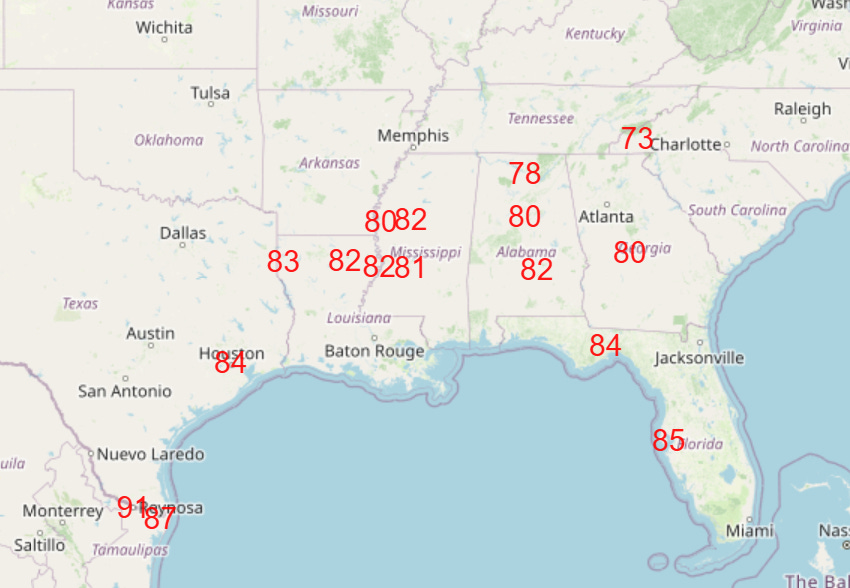
Unseasonably warm weather continues to be another big story, as dozens of record warm temperatures — both highs and lows — were set over the south central and southeast United States on Wednesday. More records are anticipated today (forecast record highs shown above) — and this unseasonable and at times record warmth will continue into the weekend for most of these areas.
 Balanced Weather
Leave a comment