
Shortsighted plan would (in my view) cause irreparable harm to global atmospheric science research
Dec 17, 2025
Happy hump day. Today is one of those days where there is so much going on I really do not know how to even start this newsletter — so I will open with personal story time. Yesterday was my birthday, and I spent it with my lovely wife doing things we enjoy: lunch and margaritas at a new to us and fabulous Mexican restaurant in southwest OKC, a stroll through the outlet mall, and then an evening event for her literacy charity Little Read Wagon distributing free books and playing Christmas bingo with kids at a free laundry event. As we were wrapping that up and getting ready to leave to grab a quick dinner at McDonald’s, my phone started to explode with text messages and notifications about this story.
Office of Management and Budget (OMB) director Russell Vought announced via a statement to USA Today — and a similar post on X — that “The National Science Foundation will be breaking up the National Center for Atmospheric Research (NCAR) in Boulder, Colorado. This facility is one of the largest sources of climate alarmism in the country. A comprehensive review is underway and any vital activities such as weather research will be moved to another entity or location.” He told USA Today that efforts to dissolve NCAR will begin immediately, with the plan being to fully close the center’s Mesa Lab — one of the most important facilities for global atmospheric science research — in Boulder, CO.
I think an important place to start the discussion of this story is in how it is being reported by the media. Almost every headline about this story — USA Today, NBC News, The Washington Post, The Denver Post, etc. — refers to NCAR as a “climate research center.” In my opinion, this framing is misleading and plays into the Trump Administration’s desired messaging about their plans to close NCAR. Bottom line— NCAR is an important climate research center (and there is obviously nothing wrong with that!) but it is also so much more than just a “climate research center.”
NCAR was established by the National Science Foundation in 1960 “to provide the university community with world-class facilities and services that were beyond the reach of any individual institution” for atmospheric science research. NCAR is operated by the University Corporation for Atmospheric Research (UCAR), a consortium of 120 universities with atmospheric science research programs, utilizing funding provided by NSF.
NCAR does do important climate research, but the research supported and conducted there absolutely runs the gamut of atmospheric science from microscale meteorological processes to planetary scale waves, looking at how to improve our understanding of and forecasts for impacts such as severe storms, droughts, floods, space weather, etc. Many of the severe weather forecast tools I use and share in my newsletters come directly from the legendary Mesoscale and Microscale Meteorology (MMM) group at NCAR. Retired National Hurricane Center forecast branch chief James Franklin noted on BlueSky last night that “NCAR developed the GPS dropsonde, which revolutionized the understanding of tropical cyclone structure, improved forecasts, and validated remote sensing platforms, as documented in over 400 peer-reviewed publications in the last 25 years. And that’s just one of NCAR’s countless advances.”
In his statement, Vought said about the NCAR dismantling that any “vital activities” such as weather research will be moved to another entity or location. To me, this shows complete ignorance of how science actually works. The NCAR Mesa Lab — along with support facilities in Wyoming and Hawaii — is a unique facility with world class scientific resources ranging from supercomputing to reconnaissance aircraft. From the earliest days of my undergraduate work in the mid-1980s, I knew that the NCAR Mesa Lab in Boulder was really the Mecca for cutting edge atmospheric research, and it was one of my career highlights to finally get to be (briefly) there for work in the late 1990s.
The idea that you can just pull “vital” weather research activities out of a unique, vibrant scientific environment like the Mesa Lab and expect that they will just continue to roll along in the same manner somewhere else is ludicrous in my opinion. The very fact that you have world class scientists brought together to work on atmospheric science problems varying from climate change to severe thunderstorms to artificial intelligence to social science is the how and why you get the groundbreaking advances that have come from NCAR.
It took 65 years to get NCAR to where it is today, and while I have no doubt there are ways in which it can be improved, dismantling it over a matter of months is not “improvement.” USA Today noted that Roger Pielke, Jr. — a senior fellow at the American Enterprise Institute and noted voice of pushback against his perception of climate alarmism and politicization of climate science — said that while NCAR/UCAR is far from perfect, it is “a crown jewel of the U.S. scientific enterprise and deserves to be improved, not shuttered.”
Media outlets including USA Today and The Colorado Sun, noted that the administration’s announcement of NCAR’s breakup and closure of the Mesa Lab comes as there has been an escalation of tensions “between between Colorado’s Democratic leaders and the Trump administration over Tina Peters, the former Mesa County clerk serving a nine-year prison sentence for orchestrating a breach of her county’s election system in search of evidence of electoral fraud. Trump has promised to retaliate against Colorado unless Peters is released. Peters, a Republican, uncovered no evidence of election wrongdoing.”
Within this context, I think it is important to reiterate that the Trump Administration has also announced plans to eliminate NOAA’s Office of Oceanic and Atmospheric Research (OAR), and that four of OAR’s ten research labs and associated university cooperative institutes are also based in Colorado. As with the NCAR dismantling, the administration has said that it intends to continue critical weather research programs from OAR by moving them to other NOAA line offices, but I have my doubts about how effective such research programs will continue to be if they are embedded within operational agency structures and cultures.
While the administration has announced all of these massive cuts to weather research, they have not been implemented yet, and Congress has to date shown little interest in supporting the administration’s plans with pushback coming from both sides of the aisle. Clearly, as with other agencies, the administration plans to move forward with at least the NCAR dismantling and shuttering of the Mesa Lab without waiting for approval from Congress. How much bipartisan opposition from Congress or other government officials they may receive remains to be seen.
It is incredibly ironic to me that this issue has come to a head at the time that a parade of storm systems across the West has been causing massive societal impacts. After days of flooding in the Pacific Northwest, today the focus is on high winds, as an intense low pressure system moving along the US/Canada border is causing widespread damaging winds across much of the Northwest quarter of the country.
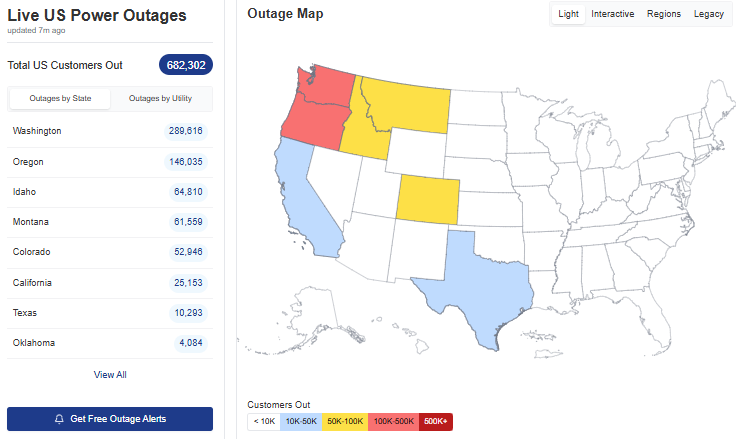
Winds have gusted to over 100 mph in spots, and per the website PowerOutage.us nearly 700K customers are without power across the West, including more than 400K in Washington and Oregon.
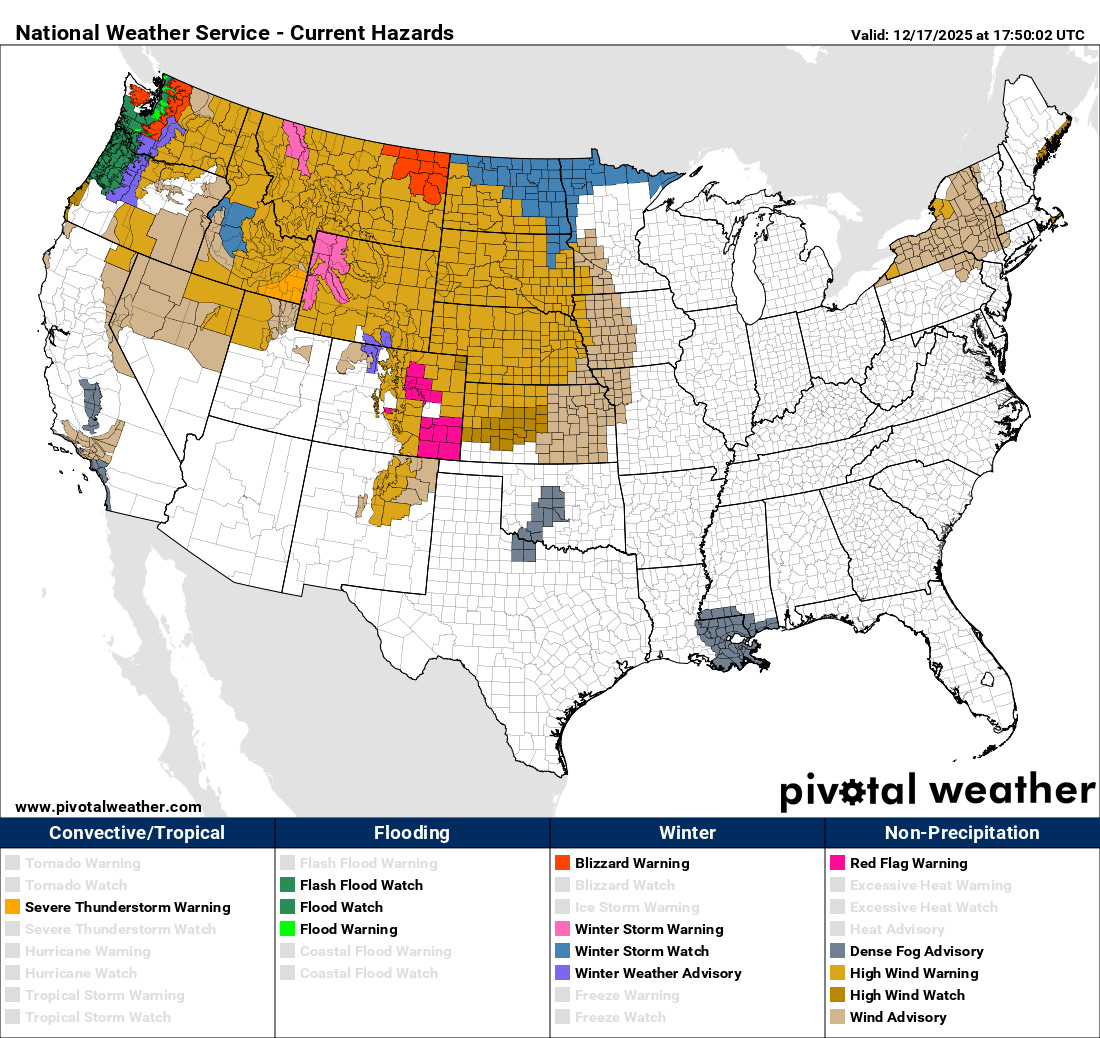
High wind warnings are in effect for many areas, and additionally the combination of wind and heavy snow has resulted in blizzard warnings for the higher elevations of Washington state as well as parts of northeast Montana.
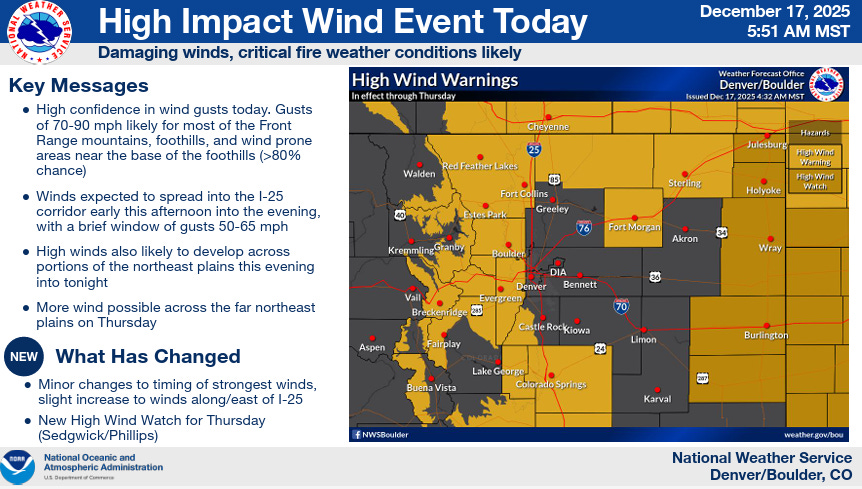
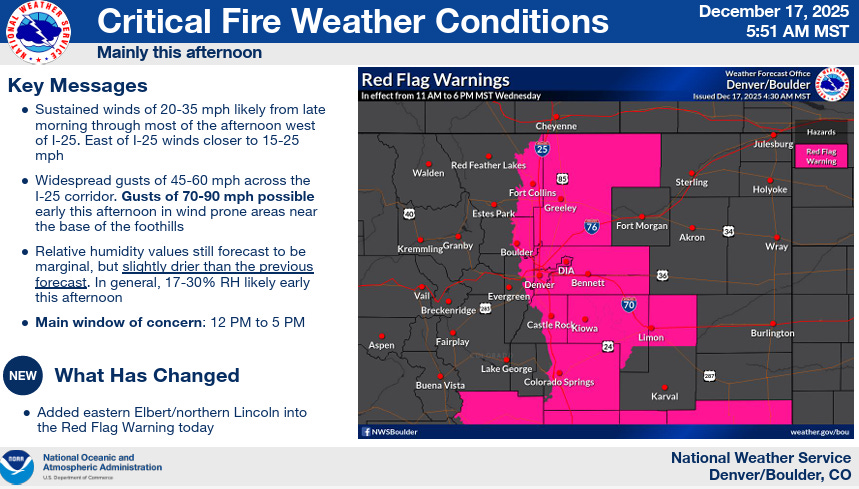
The Denver/Boulder area is at particular concern for damaging winds and associated wildfire danger today as a damaging downslope wind event is anticipated for the Colorado Front Range mountains and foothills. Wind gusts of up to 90 mph are anticipated, and power utilities are implementing proactive power cutoffs to try to reduce the likelihood of power infrastructure initiated wildfires. In a further twist of irony, the NCAR Mesa Lab is actually closed today due to this situation.
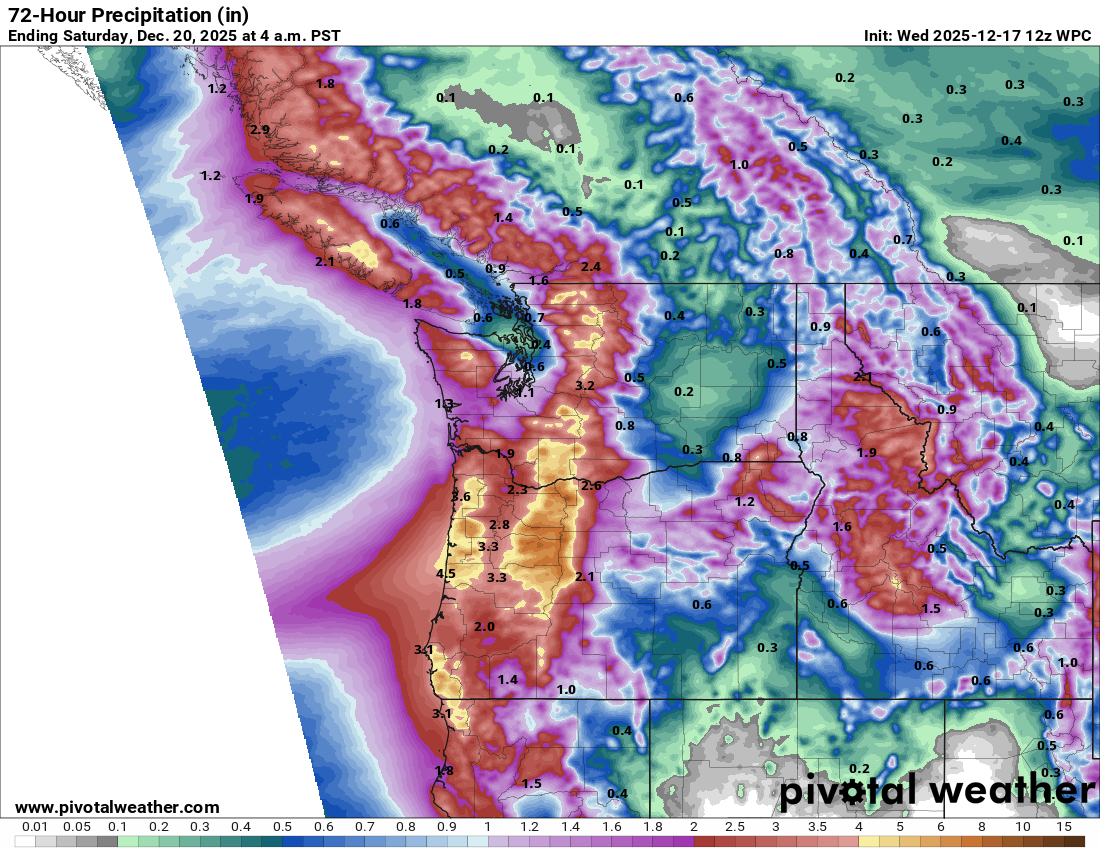
Meanwhile, another major atmospheric river fueled heavy rainfall event is anticipated in the Pacific Northwest the next couple of days, this one targeted on western Oregon. This will again be a relatively warm system with snow levels abnormally high during much of the event, leading to another risk of significant flooding.
Given all of the actual weather going on — and other aspects I did not even get a chance to dive into such as the record warm temperatures anticipated for large parts of the country in the coming days — I am planning to do video weather briefing later today to go into more detail about all of this. Paid Balanced Weather subscribers can participate in this briefing live as part of their benefits, and I will send an email to them with information on the time on how to participate this afternoon.
 Balanced Weather
Leave a comment