
Severe weather possible in parts of the central US next couple of days
Mar 05, 2026
First off, apologies for this post being later in the day than normal, I had a very busy morning with (very worthwhile!) meetings that put me behind.
Before I get into the core of today’s newsletter, I should acknowledge the breaking national news that Kristi Noem is out as Secretary of Homeland Security, and President Trump has nominated Sen. Markwayne Mullin (R-OK) as her replacement. This is important from the perspective of this newsletter given that the head of DHS is also of course the department level head of the Federal Emergency Management Agency (FEMA).
Given that this news just came out, I am not really going to try to speculate on what specifically this change might mean for FEMA and the future of its still pending FEMA report that is supposed to provide recommendations to guide reform of the agency. I will say, though, given that there were numerous reports that Sec. Noem was taking a hands on approach to overseeing FEMA and the work of the FEMA review council, her departure could be a significant inflection point for the agency. I am sure there will be much more reporting in coming days on what her departure — and the nomination of Sen. Mullin — may mean for FEMA.
Another potentially important development at the federal level was outlined in an excellent article by NBC News’ Evan Bush, namely the introduction of a bill today in the House to establish a National Weather Safety Board.
The bill, called the National Weather Safety Board Act, calls for an independent board of at least seven members appointed by the president and confirmed by the Senate, with backgrounds in meteorology, social sciences and emergency management, among other disciplines. The board would be styled after the National Transportation Safety Board (NTSB), which investigates all civilian aviation accidents, along with other disasters.
The proposed board would investigate severe weather disasters, have subpoena power to obtain testimony and evidence, and issue reports of findings and recommendations to agencies like the National Weather Service, Federal Emergency Management Agency and Army Corps of Engineers.
The bill was introduced by Rep. Eric Sorensen (D-IL), the only meteorologist currently serving in Congress. As Evan notes in his article, this is a concept that has roots back at least two decades as has been reported on frequently by Andy Revkin in his Substack, but which gained traction after last year’s Texas Hill Country Flash Floods that killed more than 100 people. Rep. Sorensen talked about how that event spurred him:
“I immediately saw that politicians were making it political, and we need to make real change so that that type of disaster doesn’t happen again,” Sorensen told NBC News. “We’re going to have the brightest people in an independent board that will produce the findings that Congress needs to create the policy that will keep people safe.”
As I have mentioned in previous posts, I am an ardent proponent of this concept. The NTSB has been an incredibly critical player in the dramatic improvement of aviation safety in this country through their legally mandated post-accident investigations and ability to issue binding recommendations on the various sectors of the aviation industry based on their investigations. No such similar mechanism exists in the disaster field, leaving any investigations up to individual government agencies with limited ability to issue comprehensive recommendations that would improve preparedness, warnings, or response. Many past discussions of a concept for a disaster review board have included all disasters, i.e., earthquakes, tsunamis, etc. — and this is what I would certainly hope we would eventually see implemented.
Sticking with just the weather aspect now since that is what this new bill focuses on, historically the National Weather Service has conducted “service assessments” after major weather events — in fact, on this webpage you can find publicly available copies of all the NWS service assessment reports back to 1957. Initially, these reports primarily focused on the meteorology of a given event and the quality of NWS forecasts and warnings — but with time, they also included more comprehensive analyses of the societal response with social scientists and emergency managers added to the meteorologists that had traditionally made up service assessment teams.
I was a member of several service assessment teams during my tenure at NOAA, and early on I felt that it was an important mechanism for understanding how the NWS had performed during an event and where improvements could be made — and as social science became more important within the NWS, I was glad to see that aspect included. However, with time I became increasingly disillusioned by the process as I saw recommendations made by service assessment teams languish for years and be ignored by the agency. Increasingly the service assessment process also became more political, with senior leaders having the ability to essentially veto team recommendations that they felt were impractical or potentially controversial.
In recent years, the NWS has apparently stopped doing service assessments at all, as there has not been a national level service assessment conducted since the review of the July 2022 flash floods in eastern Kentucky that killed 43 people. I am assuming that budget and staffing constraints have kept the agency from being able to invest the resources needed to properly conduct these assessments.
The primary focus of the National Weather Service is on the protection of life and property from hazardous weather events. While it might seem natural that conducting these post-event reviews should be an important aspect of their mission, the reality is that they have not been properly budgeted or staffed for this to be a priority. Furthermore, as one of fellow recently retired long-time NOAA/NWS leaders put it to me earlier today, “it’s time for the weather service to stop grading their own tests.”
Right now, not only does the NWS conduct their own service assessments, they are also responsible for collecting and “certifying” the hazardous weather damage and impact reports that they then use to calculate their own warning verification statistics. In a perfect world, I think we would have an independent agency that would be responsible for all of the necessary effort to determine the accuracy of federal natural hazard warnings and forecasts, as well as conducting comprehensive societal evaluations after major disasters with the goal of producing actionable recommendations to make tangible improvements. While it might not be possible to mandate that non-federal organizations would have to abide by those recommendations, at a minimum it should be mandatory for federal agencies such as NOAA, USGS, and FEMA to implement the recommendations.
As Evan Bush notes in his article, while there have been efforts to jump start the development of a disaster review board in the past that did not really go anywhere, there are some reasons to be a bit more hopeful right now. NOAA Administrator Dr. Neil Jacobs voiced his support for such a board during his confirmation hearings last year. A new weather enterprise trade group, the American Weather Enterprise Association, is also aligned with the effort and has worked with Rep. Sorensen. AWEA’s executive director is Doug Hilderbrand, a longtime NWS leader in hazardous weather preparedness and partnerships, and his organization’s entry into the political environment behind this bill is also a positive sign. Hopefully, there is now at least some chance tangible progress can be made toward a more independent and rigorous process to evaluate and improve our societal preparedness and response to disaster.
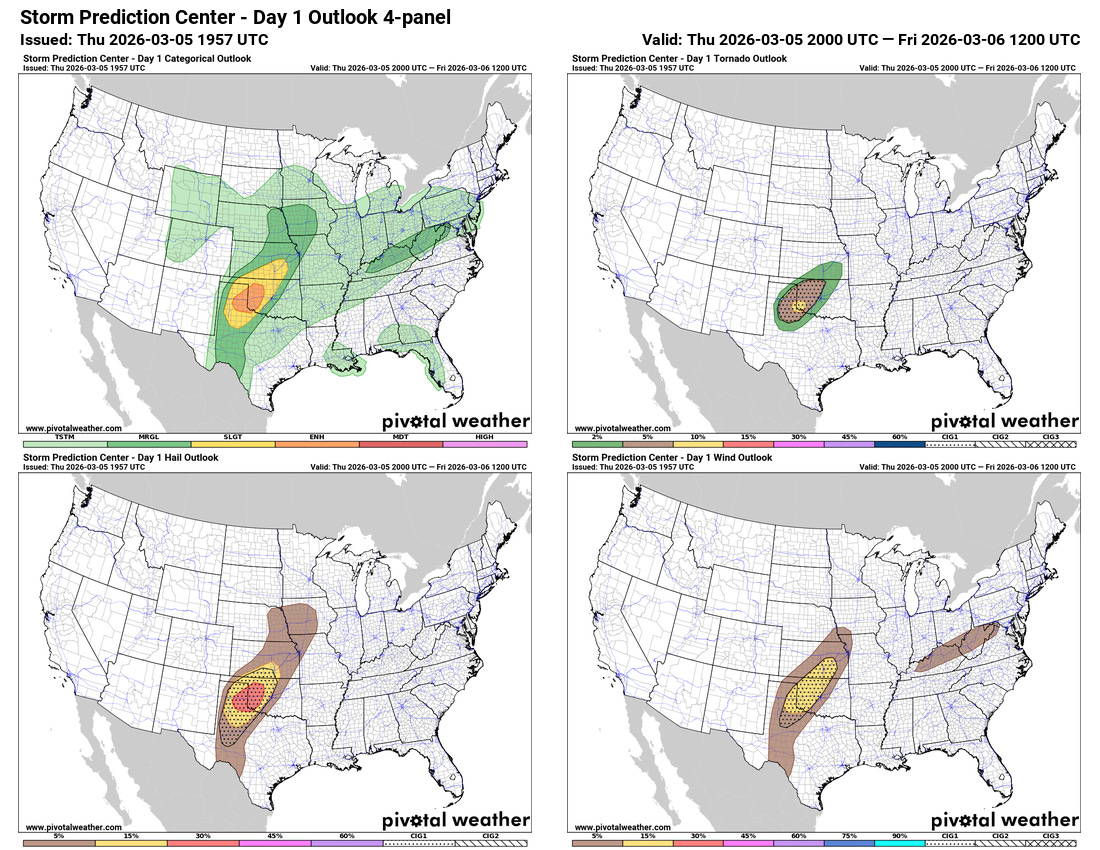
Once again, I have spent most of this post talking about federal science news, but given the severe weather risk the next couple of days, I definitely want to spend a few minutes talking about that. For this afternoon and evening, scattered supercell severe thunderstorms are expected to evolve across parts of the Texas Panhandle and western Oklahoma as an upper level disturbance lifts northeast across the region. The NWS Storm Prediction Center (SPC) has an enhanced (level 3 of 5) risk of severe weather for this setup, with very large hail being the primary risk. A few tornadoes are also possible, and given forecast levels of wind shear, a strong tornado could occur. The tornado outlook in the upper right hand corner has the new CIG1 (conditional intensity group) encompassing the 5 and 10 percent tornado probabilities areas (for more on the SPC CIG product, click here.) SPC noted in a recent discussion that a tornado watch will likely be issued soon for parts of the Texas Panhandle and western Oklahoma.
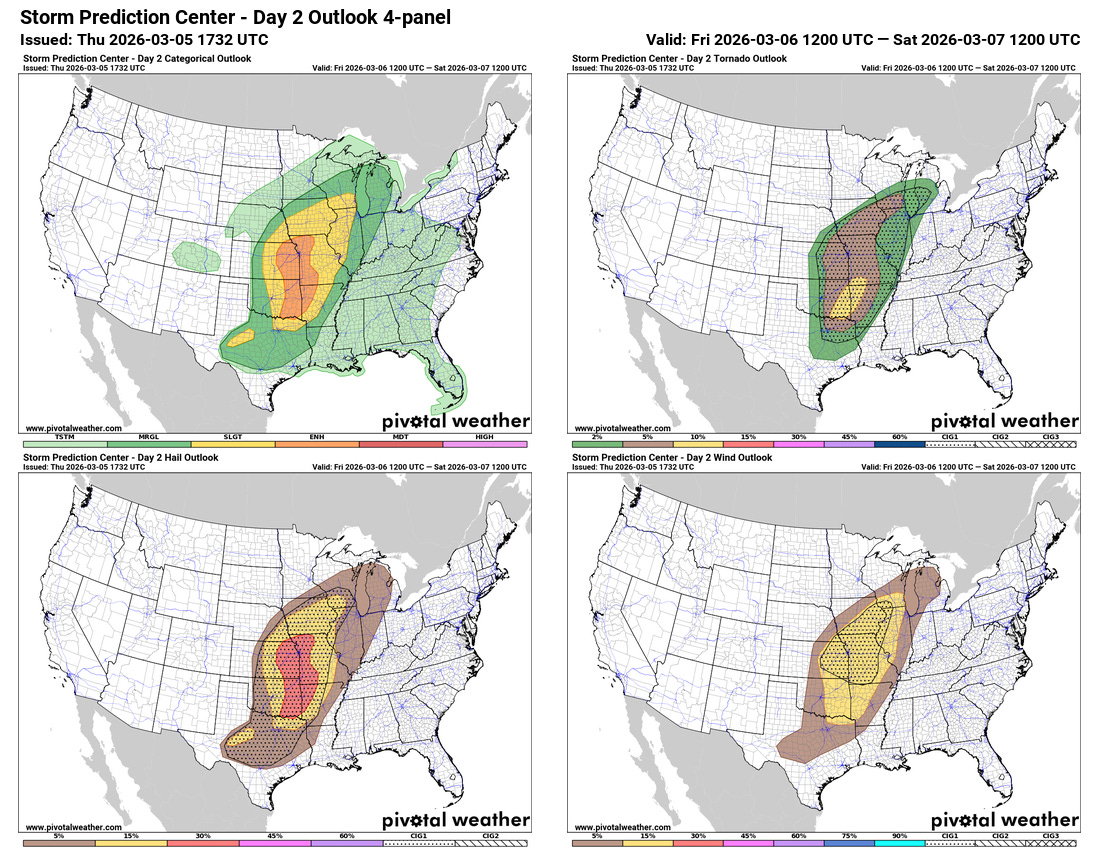
As this weather disturbance continues northeast on Friday, additional severe thunderstorms are anticipated, and another enhanced risk area is in place as shown above. A line of severe storms is expected to evolve Friday afternoon and evening, and impact parts of the mid-Missouri Valley into the Ozarks of southwest Missouri and northwest Arkansas. All modes of severe weather will be possible with this line. Farther south across eastern Oklahoma and into northeast Texas, the development of thunderstorms is more uncertain, but if storms do form, they would likely be supercells with the potential for large hail and tornadoes. Again, while this does not look like a “major” severe weather outbreak, a couple of strong tornadoes are possible both with the line to the north and any supercells to the south.
 Balanced Weather
Leave a comment