
And concerning signs about how OMB is allocating money to the science agencies
Apr 02, 2026
On Tuesday, the Trump Administration announced a sweeping reorganization of the US Forest Service (USFS). This reorganization will include moving the agency’s headquarters from Washington to Salt Lake City and ending the agency’s current regional structure and closing regional offices in favor of 15 state focused administrators that would be political appointees.
The reason why this has importance to the atmospheric science community is that USFS plays an important role in the federal meteorological framework. USFS manages weather and climate observing networks, operates fire weather forecasting centers, and conducts climate and fire weather and behavior research. While the potential impacts on the USFS operational weather observing and forecast services are unclear, the deputy chief of fire and aviation management said there would be no changes to the agency’s operational firefighting workforce. Given that much of the weather operations of USFS are in support of that firefighting, it can be hoped that the impacts will be minimal.
Where more concerning impacts seem likely is on the USFS climate and fire weather research. As part of the planned reorganization, all of the more than 50 USFS research and science stations will close and be “consolidated” into a single research and science center in Fort Collins, CO. I am not an expert on the USFS or its wildfire and forestry related weather and climate research. However, given what knowledge I do have about those subjects, it is hard for me to argue with this perspective shared in a post from the “More than Just Parks” Substack:
More than fifty research and development facilities across thirty-one states. Gone. Consolidated into a single location in Fort Collins, Colorado. And “consolidated” is doing a lot of heavy lifting in that sentence, because what it actually means is that decades of place-based, long-term ecological research — the kind that literally cannot exist anywhere else because it depends on specific forests, specific watersheds, specific ecosystems studied over generations — will be snuffed out.
You cannot move a thirty-year watershed study. You cannot relocate a decades-long old-growth monitoring program. You cannot box up a forest and ship it to Colorado. When these facilities close, the experiments die. The datasets end. The partnerships with universities that took generations to build collapse. And the institutional knowledge of the scientists who ran those programs walks out the door, because the administration damn well knows most of them won’t follow a forced relocation to a single consolidated office that has nothing to do with the ecosystems they’ve spent their careers studying.
This is the most respected forestry research program on the planet. It’s the reason we understand wildfire behavior, forest disease, watershed health, carbon storage, old-growth ecology, and climate adaptation. It’s the scientific backbone that every responsible land management decision depends on. It’s the envy of land managers across the world. And they’re destroying it.
The post also points out that the move of the USFS headquarters to Salt Lake City and consolidation of the research centers will likely result in the loss of a high percentage of the most experienced scientists and administrators in the agency, similar to what was seen when the Bureau of Land Management was reorganized during the first Trump Administration. Again, it is important to recognize that this massive restructuring of our national forestry agency is being done by executive action, with no action being taken by Congress.
Speaking of executive action without Congressional approval, yesterday the NOAA Cooperative Institute at the University of Colorado — CIRES — posted a video sharing that most of the scientific functions it performs for NOAA’s Global Monitoring Lab (GML) will be halted soon due to a lapse of funding. GML performs a variety of long-term climate and atmospheric observing activities that would be seriously impacted by a hiatus in work.
From what I can understand in speaking with NOAA colleagues and my understanding of the overall budget situation, funding for this work is included in the most recent NOAA appropriation passed by Congress. However, it has not been allocated by the Office of Management and Budget (OMB) to NOAA and hence down to GML to be sent in a grant to CIRES. This seems to be supported by this statement in the video posted by CIRES:
Federal funding for these positions has been approved but not released. CU Boulder, CIRES, and NOAA leadership are actively advocating for its release. We remain committed to this science and the people who make it possible.
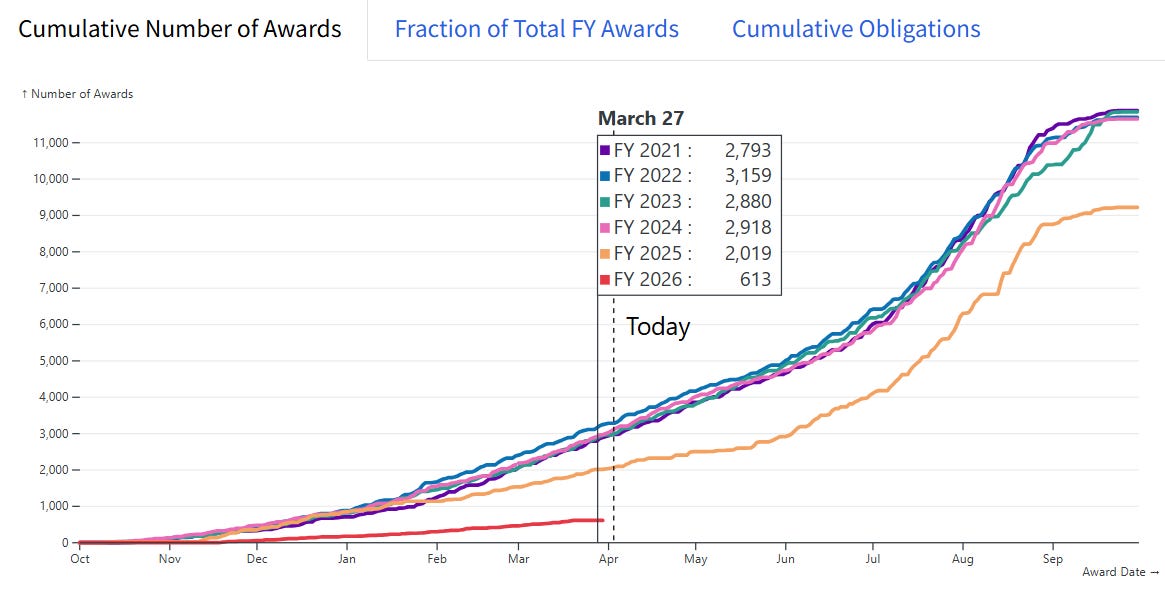
This issue with appropriated funding not being allocated by OMB — or potentially not being awarded by the agency — also can be seen with the National Science Foundation (NSF). This graphic from the website GrantWitness.us based on publicly available data shows the number of NSF grant awards that have been made in each fiscal year back to 2021 — you can see that 2026 has seen a fraction of even the number of awards made in 2025, which was in its own right much below previous years.
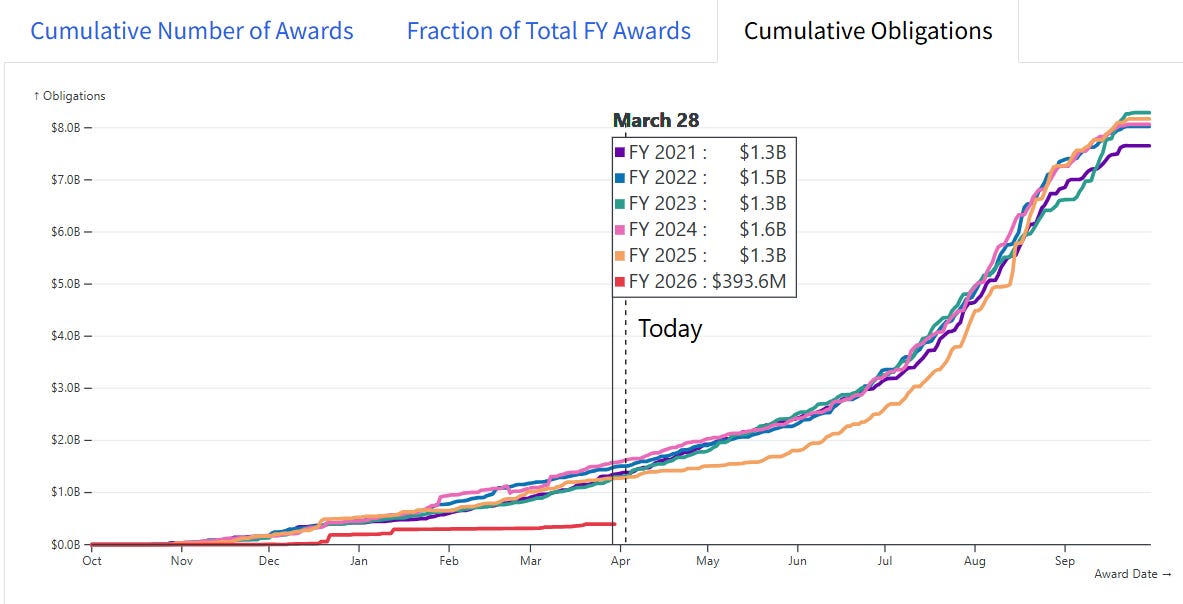
This can also be clearly seen in the total amount of grant funding that has been awarded by NSF to date. While the Trump Administration was seeking a massive reduction to NSF’s budget in FY26, Congress actually approved (and the President signed) appropriations with only a very slight (~3.5%) reduction over FY25. However, to date the money allocated for NSF grants is clearly well below typical.
Given the administration’s desire to significantly reduce NSF (and NOAA) research budgets, it is hard not to see this allocation strategy by OMB as a way to work around Congressional intent to fully fund this research. To be clear, Congress’ support of this work was very bipartisan in nature.
I can say from experience that the deadlines for preparing the extensive paperwork needed to process and approve grants are already fast approaching, and the window for NSF and NOAA to be able to fully execute their budgets will be closing quicker than external observers might realize. I am hearing about a variety of research projects supported by NOAA and NSF funding that are in the same danger that CIRES is reporting for its GML work. Supporters of atmospheric science research, and scientific research in general (NIH funding also shows a similar trend to NSF), should be very concerned about these developments.
 Balanced Weather
Leave a comment