
NOAA grant data shows agency awarding grants at a much slower rate than previous years, likely showing administration strategy to reduce scientific spending through budget execution
Apr 03, 2026
More breaking federal science budget news today as the Trump Administration released its proposed federal budget for Fiscal Year 2027, which starts October 1 of this year. At a macro level, this proposed budget would once again be disastrous for science in general, and atmospheric science in particular, with massive cuts proposed. The one exception to this is the National Weather Service, for which the administration is requesting a small budget increase.
At this stage, the budget numbers are relatively high level, only really allowing one to see what the administration is prioritizing at the agency and large programmatic level. Eventually, detailed proposed budgets will be released for each agency which will provide more granularity in what the administration’s goals are. Having said that, here is what the administration outlined in their release today.
National Oceanic and Atmospheric Administration (NOAA)
For operations, research and facilities, the main NOAA budget authority that enables daily operations and most purchasing and grants (except large procurements), the administration is proposing a total direct program budget of $3.337B for FY27, which represents an approximate 33% cut over actual FY2026.
- As it did last year, the FY27 budget eliminates the Office of Oceanic and Atmospheric Research (OAR), or NOAA Research, effectively eliminating all NOAA research labs and cooperative institutes. In fact, the budget document does not even acknowledge the existence of OAR — in spite of the fact that Congress rejected the elimination of OAR and more or less fully funded NOAA Research for FY26.
- The budget appears to eliminate the NOAA Sea Grant office and its outreach and extension programs (it is not mentioned in the budget document).
- The National Weather Service has a proposed topline budget of $1.368B, an increase of $8M over FY26 (less than 0.1%). The agency also has a proposed procurement budget of $136M, an increase of $32M over FY26.
- The National Environmental Satellite, Data and Information Service (NESDIS), the NOAA entity that oversees the nation’s weather satellite and climate data programs, has a proposed topline of $321M, a decrease of $77M or about 19%. As the procurer of satellite systems, NESDIS has a much larger procurement budget, and that number for FY27 is $1.255B, a small ($13M) reduction over FY26.
National Science Foundation (NSF)
The topline proposed FY27 research and science budget figure for NSF is $3.409B, a decrease of $3.811B or about 53%. With regard to programs that support research related to weather and climate, the Geosciences directorate has a proposed budget of $426M, which is a decrease of 44%. Funding for the Social and Behavioral Sciences program, which supports research that helps the weather community understand how people might utilize weather warnings and information, is eliminated in the FY27 President’s Budget. The budget does propose a small (1.5%) increase to the budget that funds NSF’s operations and agency management.
National Aeronautics and Space Administration (NASA)
The NASA Science appropriation — which (per the budget document) funds NASA’s Earth Science, Planetary Science, Heliophysics, Biological and Physical Sciences, and Astrophysics — has a proposed topline FY27 budget of $3.894B, a reduction of $3.356B or about 42%. This is the appropriation that funds most of NASA’s atmospheric sciences and space weather research.
Obviously, all of this is very concerning with regard to federal atmospheric science. Of course, similar proposals were made by the administration in their proposed FY26 budget, and were almost universally rejected by Congress in the actual FY26 appropriations that were signed into law. Long time federal budget watchers have usually said that one should pay limited attention to the POTUS budget rollout other than for discerning administration priorities and goals because Congress has the ultimate power of the purse.
However, I think that the Trump Administration actions over the last 15 months make it clear this administration is much more willing to take unilateral action with regard to federal budgets and agency organization, even if it is contrary to Congressional appropriations or resolutions. In his introduction to the budget document, Office of Management and Budget (OMB) Director Russell Vought seems proud of these efforts, saying that “every tool in the executive fiscal toolbox has been utilized to achieve real savings” in the face of “wasteful Government spending that the Congress and the prior administration had allowed to continue.”
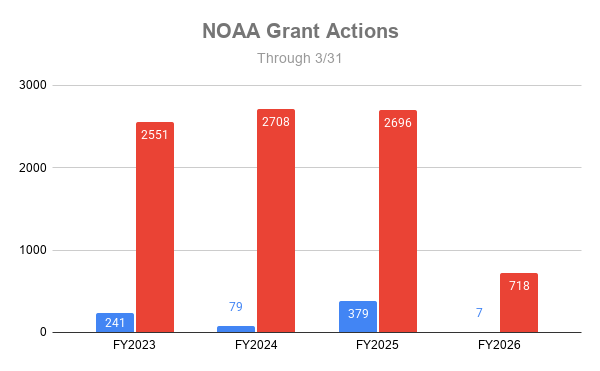
As I discussed in a post last July, Vought has made many public statements trying to establish executive power over spending, saying Congressional appropriations are “a ceiling, it is not a floor…you don’t have to spend every penny of that.” My post yesterday showed examples of where OMB is apparently executing on that strategy, with NSF grant actions running well behind previous years. I have utilized the data available at USASpending.gov to take a similar look at NOAA grant actions, and found that new NOAA grants so far in FY2026 through the end of March total 7, in comparison to 379 through the same time last year and a 3-year average of 233. Looking at total grant actions — in other words, not just new grants but also renewals, extensions, new financial awards for ongoing grants, etc. — NOAA has executed 718 so far this year, compared to 2696 in FY25 and a 3-year average of 2652.
Given the continued priority to slash and essentially eliminate NOAA’s research programs as outlined in today’s FY27 budget release and the past statements of the OMB Director, it seems likely that these grant statistics are the result of an intentional strategy to cut funds for NOAA research and grants through withholding allocations of Congressionally appropriated funds. If this continues, it will have important real-world impacts on NOAA research and the employees performing it.
For example, new reporting on the funding situation I referenced yesterday at the NOAA Global Monitoring Lab (GML) indicates that the funding to the University of Colorado supporting the GML scientific work actually expired on March 24, and that the employees performing the work will be furloughed May 15 if the already appropriated funding is not released. I am hearing similar situations of weather-related research projects supported by NOAA or NSF funding in danger of having to be halted due to funding which Congressional appropriations suggests is available, but has not been released through the grant process.

I want to finish this otherwise rather downbeat newsletter with some positivity and hope. Most of you have probably already seen this picture of our home planet illuminated by moonlight and aurorae that was taken last night by the Artemis II astronauts just after finishing the trans-lunar injection maneuver that is propelling them toward the moon. I think it is important to remember that science and human ingenuity continues to help us better understand our planet, our universe, and our place in it — and enable us to all share in the awe-inspiring wonder that a picture like this provides. While we may have differing political opinions and ideas on how best to achieve our scientific goals, hopefully we can all agree that the pursuit of science, and particularly science to better understand our home planet, is of immense value and worth supporting as we can.
 Balanced Weather
Leave a comment