
We need to redouble our efforts to work together to improve warnings and forecasts
May 11, 2026
Welcome to a new work week. Last week, the Pulitzer Prizes were announced, and writer Aaron Parsley from Texas Monthly won the Pulitzer for feature writing for his first-hand account of what he and his family experienced when their vacation home along the Guadalupe River was swept away in the July 4th flash floods. It is an incredibly poignant, gut-wrenching story that left me in tears — but also helped to remind me of the importance of the work of the weather and emergency management communities I write about here.
Last week, Aaron released a follow-up article on how he and his family are coping with the aftermath of the tragedy they endured last July. The entire piece is very compelling, but given my experience I was particularly interested in a section near the end where he visited the National Weather Service office in New Braunfels, TX to meet with the meteorologist who was working and issuing the flash flood warnings the night of the event, Jason Runyen. Aaron writes of his amazement in how kind and sensitive Jason and the other staff he met were — I am not at all surprised, though. The NWS — and the weather community more generally — is full of compassionate, dedicated public servants who are passionate about their mission of applying science to protecting society. They are a big reason why I have chosen to spend part of my retirement trying to better educate the public about their work and why it is so important.
One particular excerpt from the article I want to highlight:
Runyen pauses to carefully, politely ask me a question. He wants to know if I was aware of the flood watch issued on July 3.
I was not.
He wants to know if I received any text alerts when his team issued flash flood warnings.
I did not—I’d actually turned off such warnings on my phone.
He wants to know whether I’d have done anything differently had I been aware of his team’s efforts.
I honestly don’t know.
You must get frustrated, I say, that people don’t take warnings more seriously.
Runyen says he doesn’t fault anyone for ignoring or missing his team’s alerts, though the limited reach of their efforts weighs on him. “I’ll be honest,” Runyen says. “After this flood, I felt hopeless.”
But at the American Meteorological Society conference in Houston in January, Runyen was encouraged by the discussions he heard about how to improve watch-to-warning time gaps, more-sophisticated weather modeling, increased funding for sensors and radar, and promising research on the social science behind getting people to heed public warnings. “There’s a lot of work following this flood,” he says, “a renewed effort among the weather enterprise to mitigate something like this.”
In my opinion, Jason is absolutely right about the renewed effort in the weather community about flash flooding that has been triggered by the July 4th Texas event. My fellow retired NOAA colleague John Lewis was an on-duty meteorologist during a similar catastrophic flash flood: the June 2010 middle of the night flash flood that swept through the Albert Pike campground in Arkansas, killing 20 people. John wrote a long piece on his own Substack last week about his perspective on the July Texas event based on his own experience with the Albert Pike flood. I strongly encourage you to read the entire article — but this excerpt is key:
Flash Flood Warnings have always been nebulous as far as the location of a hazard. They will inform you of rain amounts and the possibility of life threatening high water, but they seldom answer exactly where. If I’m not sure my location will be impacted, why should I be overly anxious? A tornado can be tracked in the middle of the night, but not a horrific flood without reports or some mode of detection (such as a river gauge). It’s the difference between here (explicit) and someplace (vague). In the end, this was a surprise (more like a bombshell) to forecasters. They didn’t know about it until it was too late. I’ll write it again. THEY DIDN’T KNOW.
What John is saying that while NWS forecasters have the tools to know in a general sense that heavy rainfall is impacting a particular river basin or community — most of the time they do not have the tools to know precisely how a river or stream is responding to that rainfall.
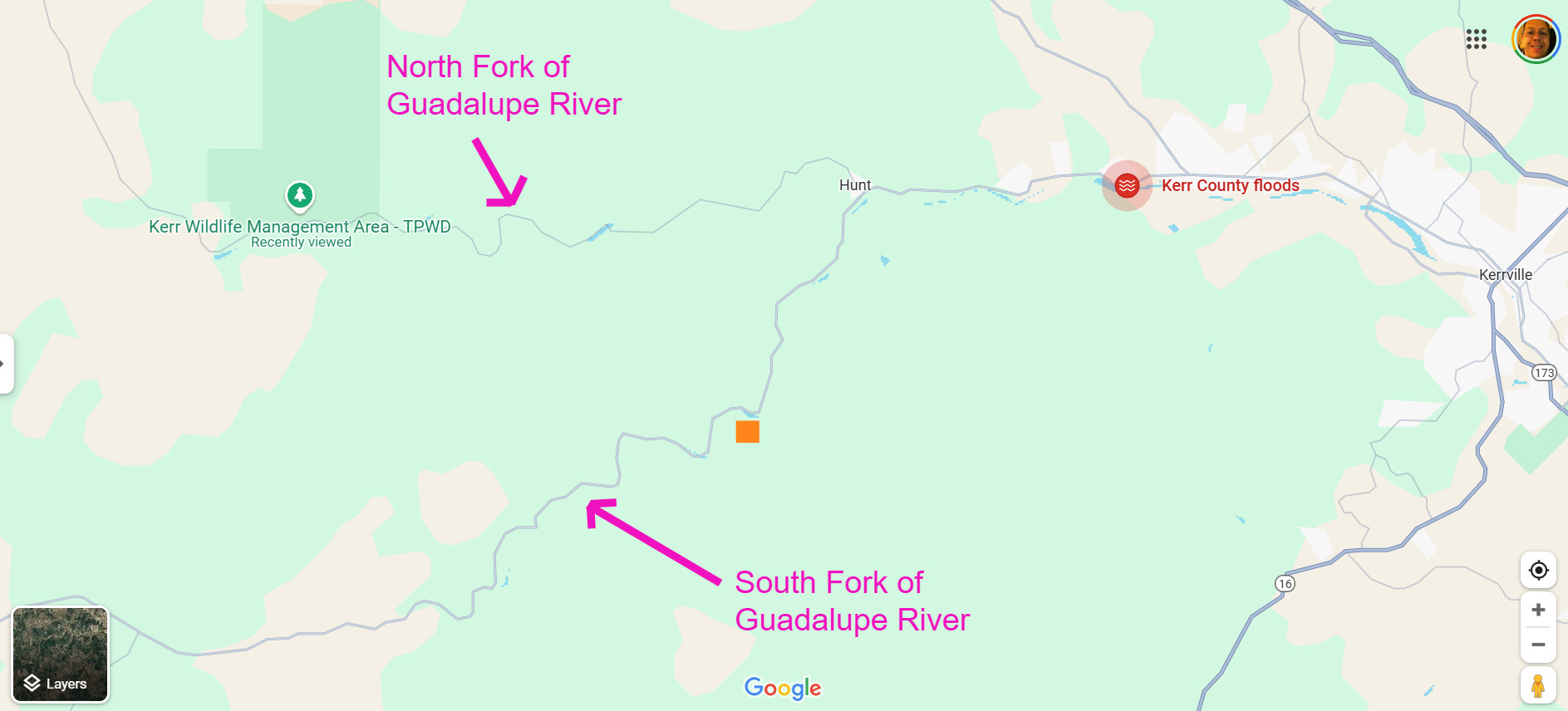
In the case of the Guadalupe River flood, the first streamflow gage on the river is at Hunt, at the confluence of the north and south forks of the river. Camp Mystic (yellow dot on map above) — and the house where Aaron Parsley’s family was on the morning of July 4th — were along the south fork of the river where no real-time streamflow data was available to NWS forecasters, i.e., they did not know the magnitude of the flash flood wave until it was well past those points.

Luckily, NOAA research has developed tools that give NWS forecasters key information using remote sensing data such as radar to help fill these data gaps. Above is the 3 hour rainfall ending at 4 am CT that morning from the National Severe Storms Lab developed Multi-radar Multi-sensor System (MRMS), showing the incredible rainfall that fell right on top of the south fork of the Guadalupe.

This unit streamflow product from the MRMS FLASH (Flooded Locations and Simulated Hydrographs) system is specifically designed to provide forecasters with guidance on how streams and other vulnerable areas are being impacted by rainfall produced runoff using fast-running hydrologic models and radar derived precipitation estimates. In this case, values greater than 20 suggest potentially catastrophic flash flooding.
As John alludes to in his post, the NWS forecasters that night had no direct observations or reports of flash flooding until the event was well ongoing — they had to issue warnings and try to alert people based solely on their expertise and products such as this. This is why I highlighted in my April 30th post about Camp Mystic not opening that the NWS issued a flash flood emergency at 4:03 am: flash flood emergencies typically require ground truth reports, and the fact that the NWS forecasters issued an emergency before the flood wave reached the streamflow gage at Hunt and in spite of not being able to reach anyone on the ground in the impacted area is to their credit. Obviously, more streamflow gages on this and other flash flood prone streams would be a huge benefit to the NWS and emergency management community — along with many other potential improvements that could be made with improved post-analysis of events that a national disaster survey entity could provide.
Of course, timely issuance of warnings and alerts is just one part of the process — receipt and understanding of the warning and proper action by the public is another. Aaron Parsley noted in his discussion with Jason Runyen that he did not receive any of the cell phone alerts that were generated by the NWS warnings that night because he had “turned off such warnings on his phone.” He is not alone.
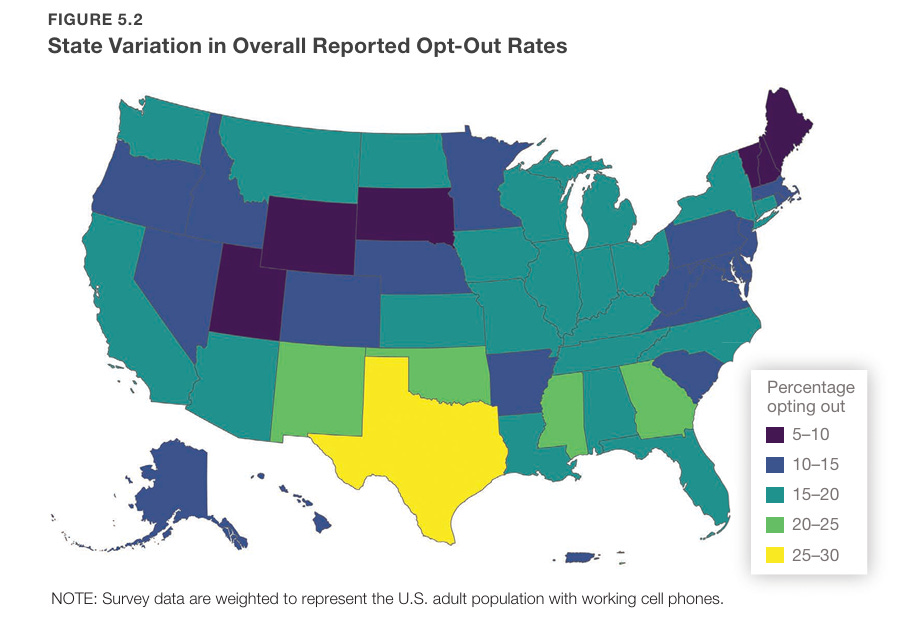
In fact, a 2024 RAND analysis found that Texas has the highest rate of people opting out of cell phone alerts, with 29.5% opting out of at least one of the types of emergency alerts received by cell phones. Weather and flood warnings do not happen in a vacuum — they are an alert that has to navigate our societal communication and media framework to be received and acted upon. This is why the weather community has focused so much effort in recent years on supporting and conducting social and behavioral science (SBS) research to better understand this complex process and hopefully be able to improve it.
Unfortunately, both social and physical science research continue to be in danger. Just in the last month, the National Science Foundation announced the elimination of their Social, Behavioral and Economic sciences directorate and the Trump /administration restated its desire to eliminate the NOAA Office of Oceanic and Atmospheric Research (OAR). OAR is the line office where the multi-year research and development of the extensively used MRMS system discussed above was developed, and has been a major contributor to the growing efforts to apply social science to improving societal use of weather forecasts and warnings.
Events like the July 4th Texas flash floods — and the stories of impacted people such as Aaron Parsley and his family — demonstrate why the work of the weather enterprise and its partners in emergency management is truly a life or death effort. Both those of us in the enterprise and the broader public need to treat it — and our societal and governmental support for it — that way.


Leave a Reply