
New leadership will be tasked with implementing “FEMA Report” released last week
May 12, 2026
Yesterday President Trump formalized what has been rumored for nearly a month by formally nominating Cameron Hamilton to be the new FEMA Administrator (director). As a refresher, Hamilton was the acting director of FEMA early in the Trump Administration, but was fired after testifying to Congress that he did not “believe it is in the best interest of the American people to eliminate the Federal Emergency Management Agency.” This contradicted the position of then Department of Homeland Security Secretary Kristi Noem (and reportedly the President) that FEMA should be eliminated.
Federal law requires that the FEMA Administrator…
shall be appointed from among individuals who have—
(A) a demonstrated ability in and knowledge of emergency management and homeland security; and
(B) not less than 5 years of executive leadership and management experience in the public or private sector
It is expected that whether Hamilton’s background meets these requirements will be will be raised as a potential issue in confirmation hearings. He spent a decade as a Navy SEAL before becoming an emergency management specialist at the US State Department and emergency medical services director at DHS.
Interestingly, NPR reports that since his dismissal:
Hamilton has spoken out against the Trump administration’s approach to helping survivors of disasters. Under Hamilton’s successor, FEMA was slow to help those who had survived hurricanes, tornadoes, floods and wildfires. Secretary Noem, who was fired from her position at DHS in March, required that she personally sign off on all contracts over $100,000, creating a bottleneck for the fast-moving disaster agency. In one case, after deadly floods hit central Texas last summer, tens of thousands of calls to FEMA from survivors went unanswered because call center contracts had been allowed to expire.
Noem repeatedly defended her decisions, arguing that FEMA was running efficiently. But Hamilton raised the alarm about Noem’s policies. They imposed “entirely new forms of bureaucracy now that is lengthening wait times for claim recipients, and delaying the deployment of time sensitive resources,” Hamilton wrote on the networking website LinkedIn. In the same post, he said claims that the administration’s policies were causing FEMA to run more efficiently could amount to “lying.”
Obviously, Secretary Noem was herself dismissed. New DHS Secretary Markwayne Mullin appears to be trying to utilize the long-awaited release of a report from a Presidential appointed council tasked with developing a plan to reform FEMA to start focusing the agency toward his vision, saying last week, “we need to refocus FEMA and get it back to what its mission originally was.”
In a further sign that Mullin is trying to move things in a different direction, today it was reported that Karen Evans, the acting head of FEMA for many months, was being replaced as acting director by Robert Fenton. Fenton is a long-time and well-known leader within FEMA, most recently serving as the Regional Administrator for FEMA Region 9 (California, Nevada, Arizona, Hawai’i and the Pacific territories).
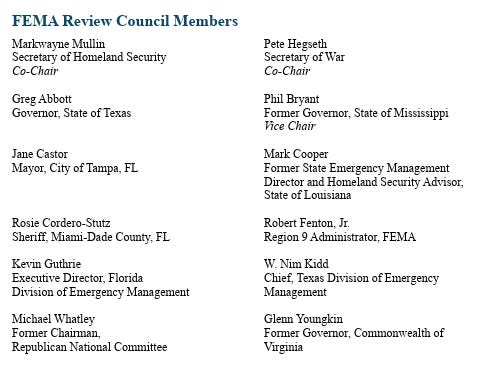
Fenton was the lone current FEMA employee on the FEMA Review Council, which was primarily made up of political and emergency management leaders from Republican led state and local governments. The report itself in my opinion suffers by relying on a couple of key core assumptions.
The first is — as stated several times in the report — that “FEMA as a brand and as an agency has been irreparably damaged by the last four years of mission creep and programmatic failures.” The idea that the four years of the Biden Administration was somehow the turning point that made FEMA into a struggling, unfocused agency is laughable to me. Just as the many issues I talk about currently facing the NWS did not just develop in the 18 months of this administration, FEMA’s many issues are the result of years (decades?) of decisions by political and agency leaders. This has to be fully acknowledged if productive change is going to happen.
The second issue with the report is the idea that somehow there needs to be a “change” to the emergency management structure to make states and locals the primary entities responsible for disaster management. As I have said multiple times in earlier posts, the emergency management structure in this country is already setup for local emergency managers and services to be the initial “line of defense;” when that is overwhelmed, state resources are called into play, and when that is overwhelmed, states can request federal resources.
Reading between the lines, what I sense from the report’s call for (as the report puts it) “empowering states to take the lead” is a reduction in federal oversight and overhead and more direct funding to the states. To be clear, FEMA’s bureaucracy is almost certainly overblown and bloated, and there are undoubtedly ways to streamline and speed up the process by which aid gets to the public that needs it — and those sorts of solutions need to be pursued.
However, while the report calls for these sorts of changes, it also states that FEMA needs to be the developer of national minimum standards in areas such as training, emergency manager professional requirements, National Incident Management System (NIMS) standards, etc. The problem is that states inherently have uneven resources and face wildly different types and frequency of disasters. Developing these sorts of standards are one thing — ensuring that states can and are actually meeting them is another. If a new FEMA does not have the infrastructure and funding to ensure that minimum thresholds are being met, we run the real risk of having an emergency management system where vulnerability to disaster is determined by what state and locality you live in. Obviously, there are lots of aspects to our lives that are that way and perhaps we as a country are okay with this framework for disaster management — but we need to be clear-eyed that this is the direction we appear to be heading.
FEMA undoubtedly needs serious reform, and while I have these concerns at a high level about this report, there are also productive concepts and ideas that can help in the needed change for the agency. The future of FEMA is a story that I obviously will be discussing much more in coming months — and I am opening comments to everyone on this post in the hopes of generating some discussion about these important topics. I will be doing another short video later today to provide a weather update.


Leave a Reply