
Owners withdraw state application to operate after state report to legislators detailed major failures in preparation at camp where 28 people died in July flash flood in Texas Hill Country
Apr 30, 2026

The owners of Camp Mystic, the Christian girls’ camp in the Texas Hill Country where 27 campers and counselors and owner Dick Eastland perished in a devastating flash flood along the Guadalupe River on July 4th, announced on Thursday in a statement that they were withdrawing their application to the state for an operating license in 2026.
No administrative process or summer season should move forward while families continue to grieve, while investigations continue and while so many Texans still carry the pain of last July’s tragedy…rather than risk defending our rights under Texas law in a manner that may unintentionally effect further harm, we choose rather to withdraw our application for the 2026 camp season.
Twenty-eight precious lives were lost. We recognize that no statement and no decision can undo that loss or ease the burden carried each day by parents, siblings, loved ones, survivors, first responders and our beautiful Kerr County community. We also recognize that over 800 girls want to return to Camp Mystic Cypress Lake this summer. Our special bond with our Camp Mystic families does not change or end with the announcement. We love each of you. This decision is intended to remove any doubt that Camp Mystic has heard the concerns expressed by grieving families, members of the Texas House and Senate investigating committees and citizens across our state. Respect for those voices requires that we step back now.
This decision comes after a Texas legislative hearing Monday in which Casey Garrett, the investigator tasked by the Texas legislature with investigating the tragedy at Camp Mystic, presented the summary findings from her investigation:
Camp Mystic hadn’t prepared counselors and staff with adequate emergency training, an evacuation plan or emergency preparedness supplies such as life jackets or ladders, Garrett said. Counselors performed “heroic actions,” she said — but did not execute a safe evacuation plan because there was none. As a result, Garrett concluded, neither grown adults nor college-age counselors had the preparation or organization to take advantage of the time they had to get girls out of cabins safely after the National Weather Service pushed out the first flood warning.
I have been following and analyzing this event intently since the flash flood occurred. The findings of this investigation appear to confirm what I talked about in a detailed analysis of the event I made last fall after visiting the area where the flash flood occurred: in spite of extensive evidence available showing the extreme vulnerability that the area around Camp Mystic has to catastrophic flash flooding, the camp had essentially no plan for how to keep campers and counselors safe in the event of a rapid onset flash flood.
While this lack of planning was likely the primary cause of the large loss of life at Camp Mystic, nearly 100 people died in other parts of Kerr County when the river rose more than 25 feet in less than an hour. The Department of Commerce Office of Inspector General released a report last week detailing the findings of their investigation into the performance and staffing of the National Weather Service for the flash flood event. Concerns about the role of potential NWS performance issues arose in the immediate aftermath of this tragedy as there had already been ongoing media reports about staffing and resource woes at the agency leading up to the event.
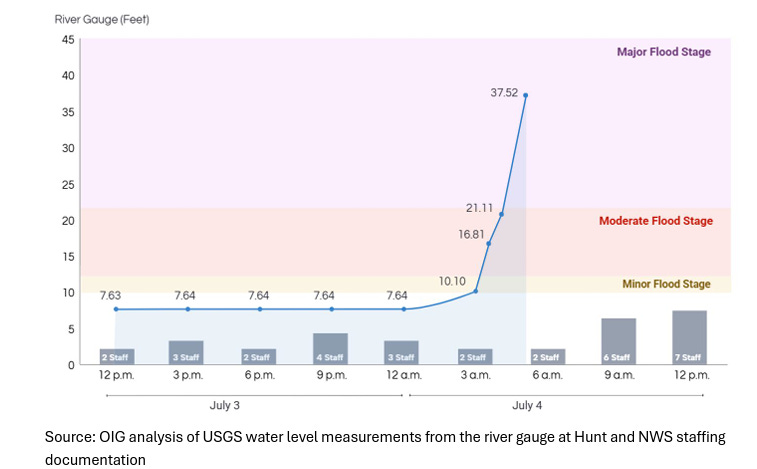
As I reported at the time, in spite of vacancies at the office including the senior positions of warning coordination meteorologist and science and operations officer, subjectively the warning performance seemed to have been pretty good. So I was somewhat surprised to see in this chart from the OIG report that there were only 3 meteorologists on duty at the NWS Austin/San Antonio office at midnight as the heavy rainfall event began to ramp up. That number dwindled to only 2 by 2 am and for the remainder of that midnight shift period (ending at 7 am). This means that the office staffing levels were really more or less what one would expect for any “routine” midnight shift with no extra staffing. While to be clear the two lead meteorologists on duty told the OIG investigators that the staffing “was sufficient from their perspective at the time, and in hindsight, to support the flash flood event that unfolded” — I will categorically say as someone who was a NWS weather forecast office (WFO) meteorologist-in-charge for more than a decade, I would not be comfortable with the idea of an event of that magnitude happening with only two people on duty.
Having said that and in total fairness to these two dedicated NWS staff members that handled the event, they must have properly prioritized their warning and decision support duties as the OIG report also found that the warning services and outreach were well done. Flash flood warning lead times mostly exceeded goals established by the Government Performance and Results Act (GPRA), and extensive efforts to coordinate with local officials were performed. This section of the report summarizes the office’s actions:
A flash flood warning (an urgent alert that flash flooding is in progress or imminent) was initially issued to portions of Kerr County, including Hunt, at 1:14 a.m. on July 4. This warning was broadcast via WEA, the EAS, and NWR. Based on data from the USGS river gauge at Hunt, the water level began rising to 10 feet around 3 a.m. and crested at 37.52 feet at 5:10 a.m. In coordination with the WGRFC (ed., West Gulf River Forecast Center), the Austin/San Antonio WFO also began issuing river flood warnings along the Guadalupe River: one at 3:19 a.m. for the region between Hunt and Kerrville, and one at 3:33 a.m. for the region between Kerrville and Comfort, Texas. Following the issuance of the river flood warnings, WFO call logs indicate unsuccessful attempts to contact the Kerr County emergency management coordinator at 3:39 a.m. and 4:42 a.m. and three unsuccessful attempts to contact the Kerr County Sheriff’s Office between 3:40 a.m. and 3:43 a.m.
WFO staff said they could not obtain real-time observations of an ongoing flash flood upstream of Hunt because they were unable to contact either the Kerr County emergency management coordinator or the sheriff’s office, and because there are no river gauges upstream of Hunt on the South Fork of the Guadalupe River. Therefore, they decided to upgrade the existing flash flood warning threat tag from considerable damage to catastrophic damage, with flash flood emergency wording based on the observed radar and rain gauge data. Flash flood emergencies are exceedingly rare situations when extremely heavy rain is leading to a severe threat to human life and catastrophic flood damage. The Austin/San Antonio WFO issued a flash flood emergency for the Guadalupe River near Hunt at 4:03 a.m. on July 4 through a flash flood statement (providing updated observations and impact information) and subsequently broadcast it via WEA and NWR.
Based on the direct evidence of a deadly flood wave moving downriver observed by the Guadalupe River gauge at Hunt, the Austin/San Antonio WFO issued a second flash flood emergency via a flash flood warning at 5:34 a.m. This new alert covered the river between Hunt and Kerrville, which WFO personnel said was to ensure it would be issued via WEA along that portion of the Guadalupe River. By 5:40 a.m., WFO call logs indicate the first reports of rescues taking place along the South Fork of the Guadalupe River upstream of Hunt, as well as rescues along the Guadalupe River in Hunt.
I added the bolding to the discussion of the flash flood emergency because I want to emphasize the importance of that issuance and the tremendous work of the NWS meteorologists. The decision to issue a flash flood emergency is a very serious one given the noted rarity and implications of such an alert, and typically is not done without coordination with local and county emergency officials who can confirm that serious flood impacts are ongoing. The fact that the NWS forecasters made the decision to move forward with a flash flood emergency based solely on radar and observational data is testimony to their expertise and ability to intuitively understand the seriousness of the unfolding situation, and I cannot overstate how much I applaud their efforts.
Obviously, I do not know what led to the fact that there were only two meteorologists on duty for most of this event at the Austin/San Antonio NWS office. One would have to assume that staffing shortages — the OIG report found that 6 of the office’s 19 hydrometeorological positions were vacant — combined with it being a major holiday played a key role. Luckily, it certainly seems based on the warning performance that two experienced lead meteorologists who could reasonably handle this catastrophic event were the two people working.
Ultimately, though, with a public safety agency as important as the NWS, we should not have to rely on “luck” — the NWS should be resourced with funding and staffing levels to ensure that sufficient numbers of adequately trained and supported meteorologists and technicians are available 24×7 to handle the agency’s important mission. While I know the incredibly dedicated NWS staff will do everything in their power to ensure that their mission is met, recent severe weather events and numerous conversations with colleagues lead me to the inescapable conclusion that our luck is running out.
The NWS just initiated a new recruitment effort to try to fill the many positions that are needed to help rebuild staffing levels — but this will take time and the extensive experience that was lost with the mass of retirements and departures last year will take years to reconstruct. How the current administration and Congress move forward with NOAA and NWS budgets and oversight in coming years will play a huge role in the quality of weather warnings and services our nation will have going forward.
 Balanced Weather
Leave a comment