
ProPublica publishes disturbing article on flash flooding in Ruidoso, NM over the last couple of years
4 hours ago
I have spent my morning reading two articles online related to emergency management and meteorology that have left me literally infuriated and ready to try to spur positive change. So, for better or for worse, Balanced Weather readers are going to get my emotionally tinged thoughts on these articles that I consider must reads.
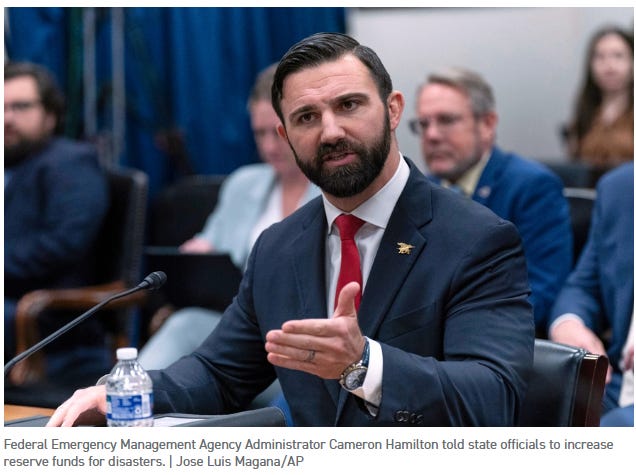
The first is an exclusive story from Politico in which they reported on the speech given yesterday by FEMA Administrator Cameron Hamilton at the National Emergency Management Association (NEMA) annual forum in Little Rock. NEMA is the non-profit professional organization of the emergency management directors of the 50 states as well as the territories and District of Columbia — so Hamilton was speaking at one of the most important meetings in the emergency management community, and his audience was primarily all of the nation’s state emergency management directors.
Hamilton appears to have taken this opportunity to outline again the Trump Administration vision that the burden for disaster responsibilities should shift to the states, which was also outlined in an internal FEMA memo earlier this month.
“Every state must have the appropriate financial reserves” and other abilities “to ensure that recovery efforts can start immediately and not necessarily be held up simply because of the federal [disaster] declaration process,” Hamilton said, according to a recording of his remarks obtained by POLITICO. “A future that I hope we would shoot for is one where we wouldn’t require as many disasters because the capability of states is so high and so substantial,” Hamilton added, referring to presidential authorizations of federal disaster aid.
This obviously sounds wonderful in theory — but as I have outlined in earlier posts, this will be much more difficult to achieve in practice. While disasters need to be managed by those closest to the people impacted, states (and counties/cities) have very uneven levels of resources, hazard vulnerabilities, and experience with disasters. This is why the emergency management system in this country is already organized in a federal manner in which locals bear the primary responsibility for disaster response and management, but can ask for state and federal assistance when an event exceeds their capacity.
There is no question that FEMA needs reform, refocus and improvement — and certainly it is fair as part of discussing such reform to explore the need for states to increase their resource commitment to emergency management and bear more responsibility. In his remarks to NEMA, Politico reports Hamilton said FEMA will focus increasingly on “reducing risk and building capacity across the nation” so that disasters cause less damage and states are better-equipped. FEMA focusing more on mitigation and capacity building would of course be a positive — however, FEMA’s actual actions in recent months does not suggest this is the direction they are headed.
Furthermore, Hamilton’s remarks once again suggest that FEMA is being led by people who truly do not understand emergency management. This remark particularly concerned me:
The Trump administration plans to launch “national mutual aid,” whereby states help each other recover from damaging storms, floods, wildfires and other events, Hamilton told state emergency management leaders.
Ummm — we already HAVE a national mutual aid system. The Emergency Management Assistance Compact (EMAC) has literally been a part of the national emergency management system in one form or another for decades. When I was working closely with the emergency management community as meteorologist-in-charge of the NWS Jackson, MS office, EM colleagues were often deployed to other disasters around the country to help respond. EMAC already provides procedures by which both physical and human resources can be shared in times of disaster.
A lot of what I have read and seen about FEMA and emergency management in the last year or so comes across to me as people who are generally unqualified and unfamiliar with emergency management suggesting ideas that have already been thought of or even implemented by those actually working in the field (like EMAC). Again, there is no doubt that change and improvement is needed for FEMA and our emergency management system. But until we start actually relying on those who have expertise in the field and the current system to help guide those changes, I have serious concerns as to whether we will see actual progress.
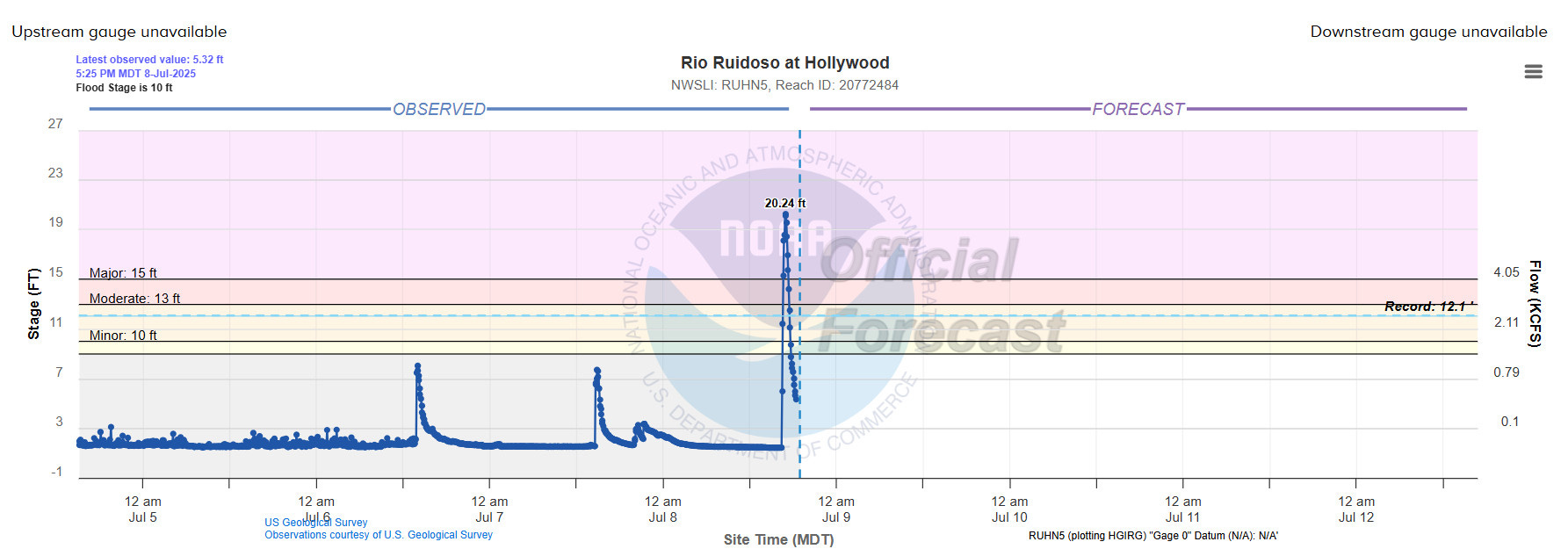
The other story I want to highlight today is an incredible piece from ProPublica about flash flooding in Ruidoso, NM — with a focus on the flash flood event of July 2025 in which three people were tragically killed. I wrote extensively about that flood when it happened, including discussing how the city had seen multiple flash floods in recent years, partially due to burn scars left from wildfires. The event on 8 July 2025 as shown in the gauge data above blew past the prior record set in 2024 by 8 feet.
ProPublica’s article is extensively investigated and reported, and goes into detail about how after the record flood in 2024 city and state officials ignored concerns about the potential for additional (worse) floods and likely contributed to lack of preparedness and increased risk during the July 2025 flood. Two of the fatalities were children on vacation from west Texas whose family was unaware the RV park they were staying in was in a floodplain. I strongly encourage you to take the time to read the whole piece.
The last paragraphs of the article are what left me particularly emotional:
The village (Ruidoso) continued to advertise tourism in West Texas. During the summer, a digital billboard near the Trotters’ house flashed a Ruidoso promotion. Sebastian (father of the children who died) saw it when he filled up on gas. Just upstream of the closed (Ruidoso Downs) race track, a mobile home park was mostly full. Children played in the street, and occupied trailers sat above the river. The park’s managers said they were following local rules. “I don’t think it’ll ever flood again like that,” said one. The Rio Ruidoso babbled. It looked welcoming. On a summer day, you could go put your toes in.
“I don’t think it’ll ever flood again like that.” The same thing people in Kerrville, TX said after the July 4 2025 flash floods — only to have it flood even more extensively a year later. Flash floods are real and deadly — but we know the areas that are vulnerable and can mitigate a lot of the potential loss of life with proactive measures. But we have to take the risk seriously. What has been incredibly frustrating to me in my research of the Texas Hill Country flash floods and now reading this ProPublica report on Ruidoso is how unserious many government and civic leaders are about the risks.
And ultimately, these decision makers are not (usually) the ones paying with their lives — it is children, or people traveling to recreational areas and unaware of the danger. While I have said in past newsletters about the need for a National Disaster Safety Board that the ultimate goal of such an entity should be to learn lessons to reduce the impacts from future disasters, it also seems clear that we need mechanisms to hold people accountable when their decisions knowingly put people in harm’s way. Most flash flood deaths are not as random as for a hazard such as a tornado — they happen in areas where the vulnerability is known and rather predictable. We as a society have to actively account for that vulnerability in effective ways — and hold people accountable when we do not.
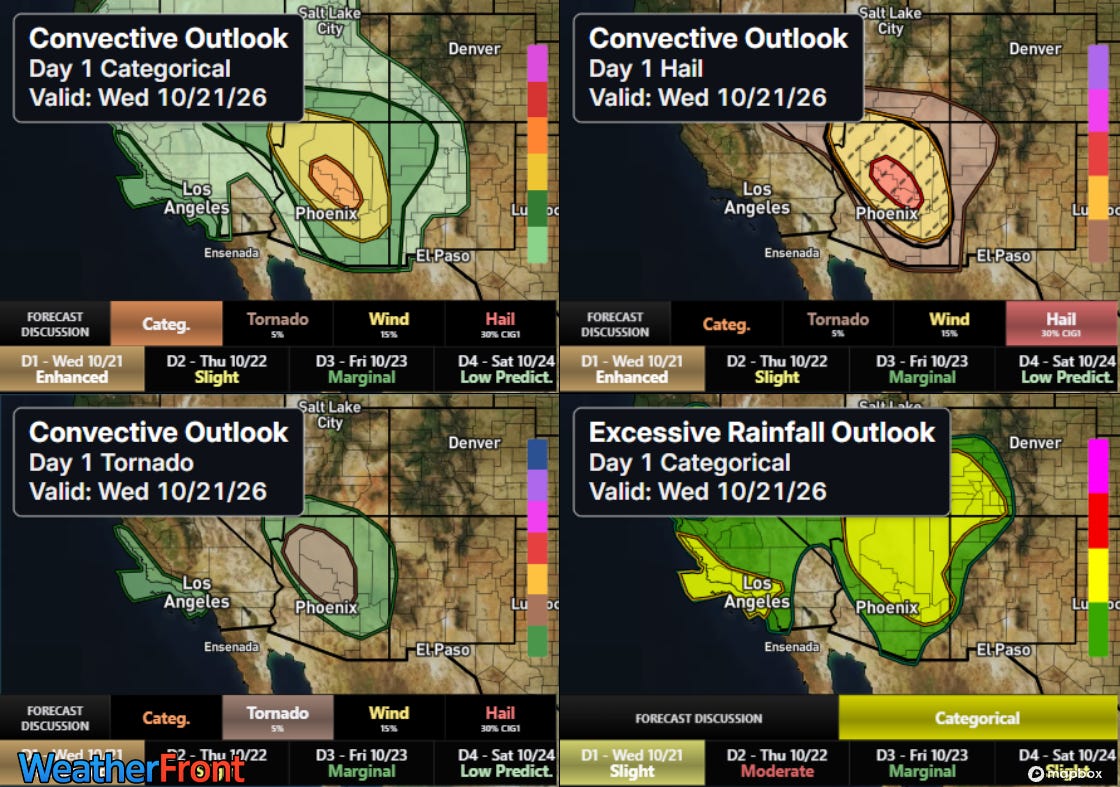
Turning quickly to actual weather, the main impacts in the US today into tonight will be in the Southwest, where an unusually strong upper level system will interact with tropical moisture from the remnants of Hurricane Trudy to produce strong to severe thunderstorms with heavy rainfall and potential flash flooding.
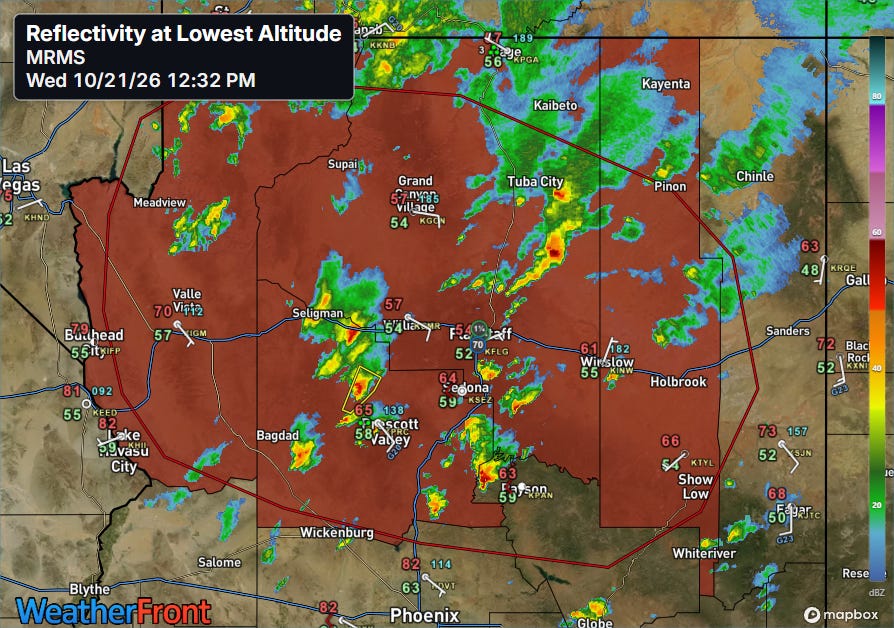
It has already been an active morning across northern and central Arizona with several severe thunderstorm and tornado warnings. There have been multiple reports of hail up to ping-pong ball sized hail from a supercell storm in Flagstaff, and the storm also produced a measured wind gust of 72 mph at the official observation site at the Flagstaff airport. A tornado watch is now in effect for the region — and to give some idea of the rarity of this sort of a severe weather event here, one of my colleagues noted this is the first tornado watch for the region since 2010.
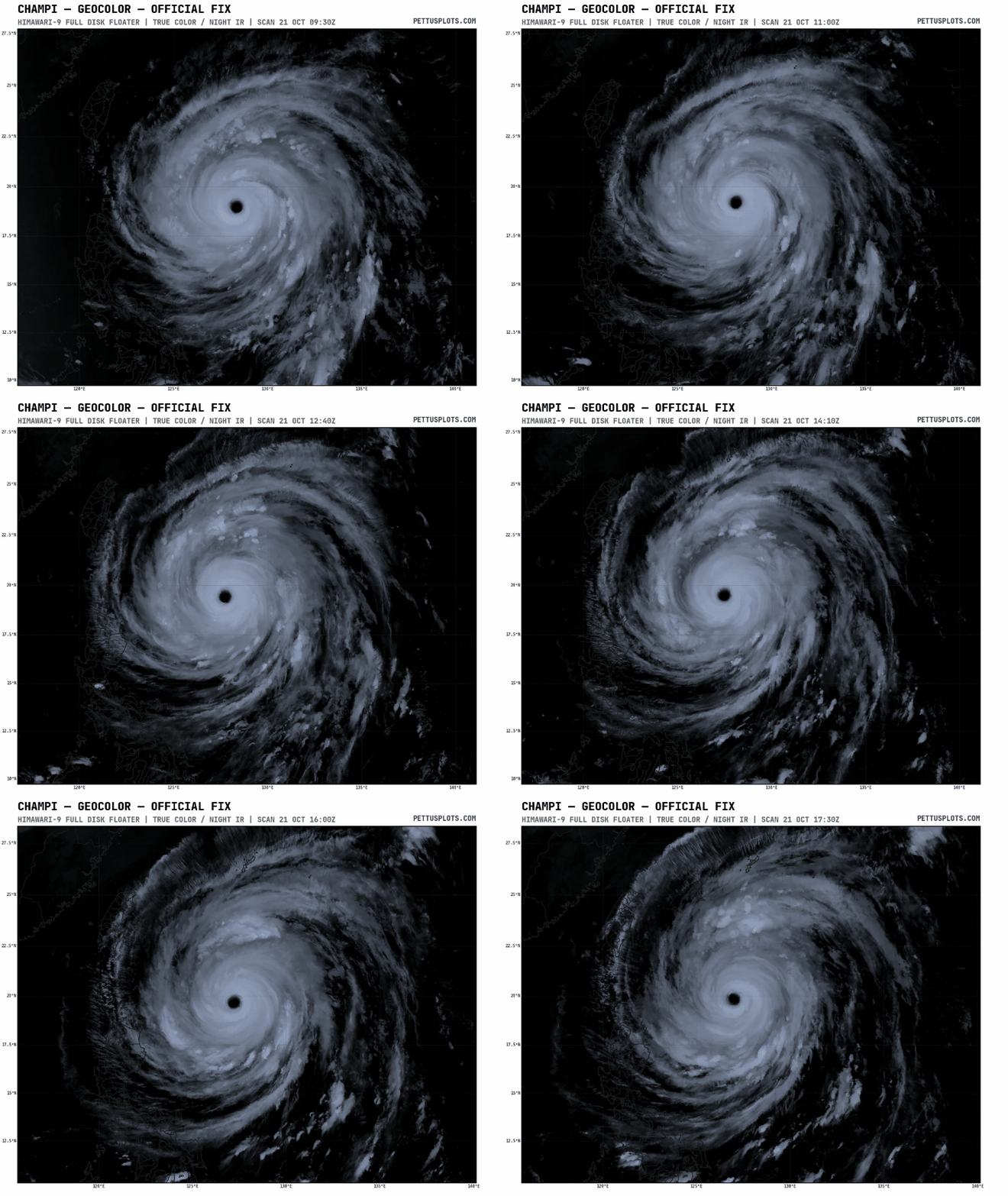
Meanwhile, Champi continues as an incredibly impressive super typhoon with maximum sustained winds estimated at 165 mph.
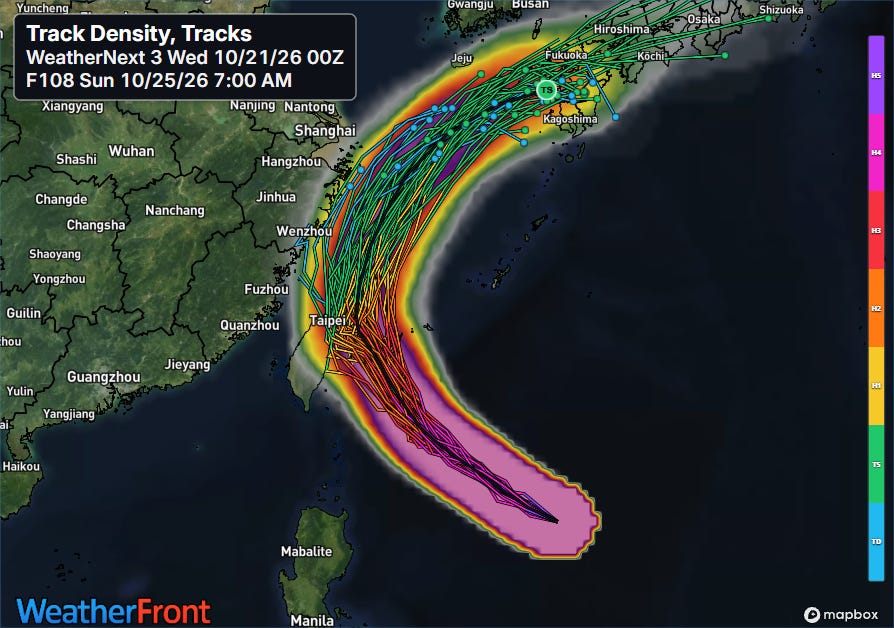
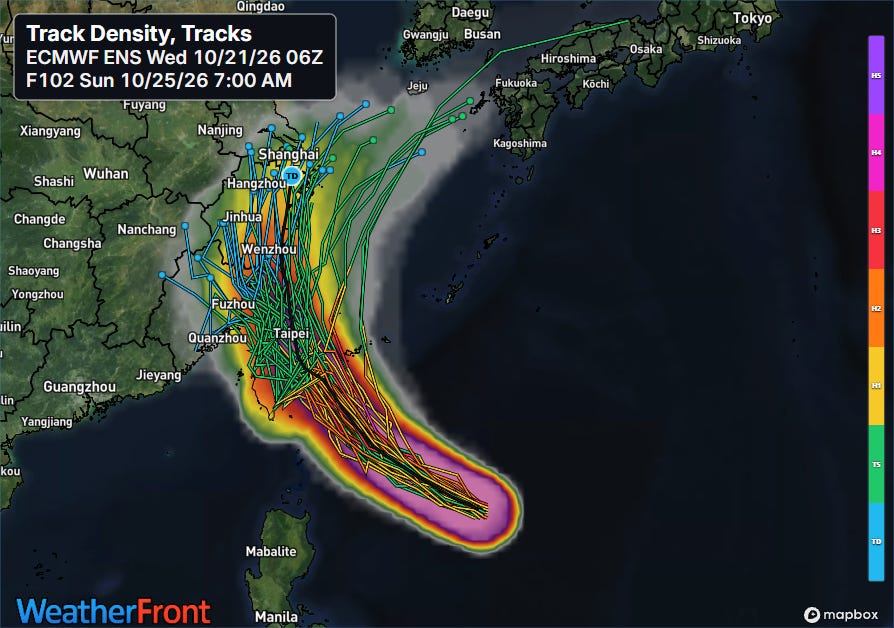
The “battle” between the AI and physics based models has continued, although the AI models have trended a hair to the southwest (latest Google DeepMind at top) while the physics based models (Euro ensemble below GDM) have been trending more to the right with more members missing Taiwan. The official forecasts continue to lean strongly toward the AI models — but we will need to keep an eye on any deviation more to the left that could imply a greater risk to Taiwan.


Leave a Reply