
Moves to House of Representatives for consideration in lame duck session
3 minutes ago
Late Tuesday evening, the Senate passed by unanimous consent bill S.3923, formally known as the Weather Research and Forecasting Innovation Reauthorization Act of 2026 — or Weather Act for short. This bill is a reauthorization of the initial Weather Act which was passed by Congress and signed into law by President Trump in 2017. This new bill is a bipartisan effort that was crafted and championed by the leadership of the Senate Commerce, Science and Transportation Committee: Sen. Ted Cruz (R-TX) and Sen. Maria Cantwell (D-WA).
I discussed this bill in detail when it was introduced in February and approved by the committee in March — you can go back to those articles for all of that background. It is important to recognize that while authorization bills discuss funding levels, they do not actually appropriate money. Rather, they codify Congressional intent for agency programs and operations and set funding targets necessary to accomplish that Congressional intent. This Weather Act authorization bill outlines in detail Congressional priorities and expectations for NOAA’s weather agencies and programs — priorities and expectations which past hearings have shown to often be at odds with Trump Administration plans.
The bill brings together a number of concepts and proposals from other bipartisan weather related bills introduced by Congress in recent years. Per committee press releases about last night’s passage, the highlights include:
- Reauthorize multiple weather forecasting programs while advancing next-generation forecasting technologies and improving research-to-operations transition efforts.
- Improve forecasting for flooding, hurricanes, tornadoes, droughts, landslides, wildfires, and atmospheric rivers.
- Establish an atmospheric river forecast improvement program to advance accurate, effective and actionable forecasts, and warnings for atmospheric rivers, and require the United States Geological Survey (USGS) and NOAA to incorporate risks from atmospheric rivers into landslide preparedness and response planning.
- Enhance public communication of weather risks — including through NOAA weather radio —to ensure warnings are clear, timely, and actionable.
- Modernize NOAA’s aging radar network through planning and deployment of next-generation weather radar and targeted efforts to close radar coverage gaps, including gaps in flash-flood prone and under-observed regions such as the Texas Hill Country.
- Improve coastal marine fog forecasting where dense fog can disrupt shipping and maritime commerce.
- Advance long-range weather forecasting to support farmers, ranchers, and water managers by improving weather outlooks weeks to months in advance.
- Establish an official Fire Weather Services Program within NOAA and fund the research and acquisition of new technology to improve forecasts of wildfire conditions.
- Direct the National Integrated Drought Information System to advance and deploy next generation drought monitoring technologies and use observations from State or regional hydrological monitoring projects.
I have written extensively on the weather community’s (and my own) growing concern about the deteriorating condition of the national Doppler weather radar network. This act would codify in law the Radar Next effort to procure and deploy a new national radar network by “the date on which the existing system is projected to no longer meet operational requirements, or September 30, 2037” — whichever is earlier.
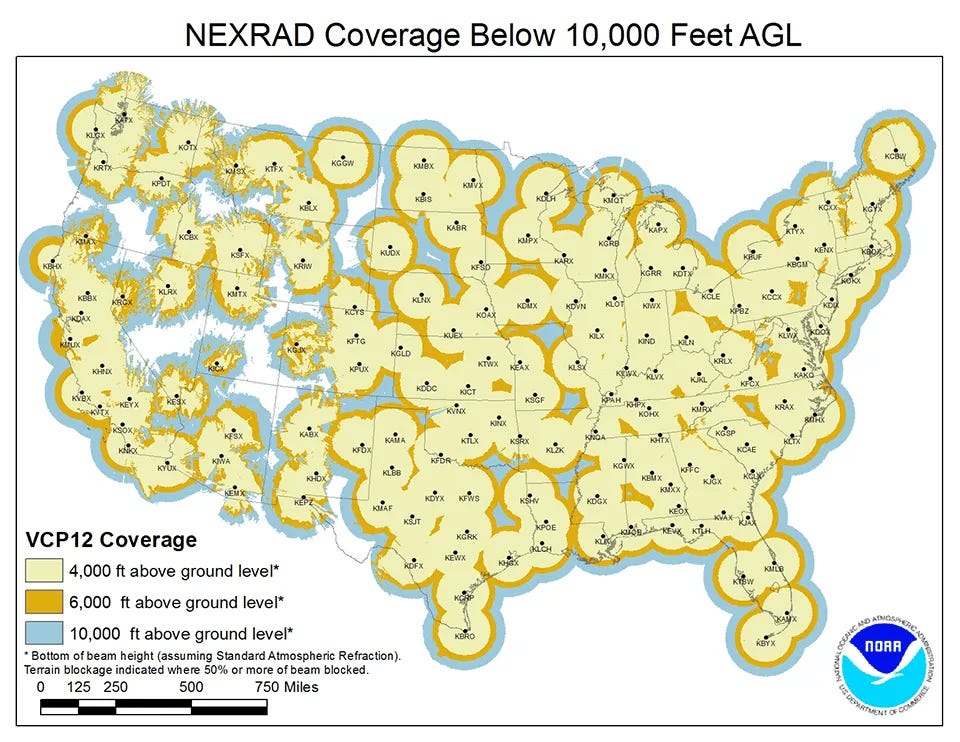
The act would also require NOAA to establish a weather radar testbed to evaluate “commercial radars with the potential to replace or supplement the NEXRAD system” and provide “technical assistance for the use of small, gap-filling radars with private and local partners in regions where geographical topography prevents the full use of large systems or in locations where such systems may not be commercially viable.” Gaps in low level radar coverage have become an increasing concern in the weather community and Congress in recent years, with a number of ongoing local efforts organized to procure gap-filling radars as well as development of commercial gap-filling radar networks. The Weather Act makes clear Congressional intent that NOAA support and embrace these efforts as the agency looks toward the next generation of national weather radar coverage.
The Senate approved bill now moves to the House for consideration. House leadership’s specific plans for considering the bill are unclear (to me anyway), but the main Senate Commerce Committee press release on the bill includes favorable comments from House Science Committee leadership on both sides of the aisle and says that the bill as passed…
“reflects a bicameral agreement on the legislation (S.3923) reauthorizing many weather forecasting and hazard communication programs at the National Oceanic and Atmospheric Administration (NOAA). In light of this agreement, it is anticipated that the House of Representatives will take up and send the Weather Act to the President’s desk before the end of the 119th Congress.”
It should be noted though that a similar Weather Act reauthorization bill was approved by the House in 2024 and was being pushed in the Senate during the 118th Congress’ lame duck period but did not gain final passage. It remains to be seen what the ultimate future of this bill will be.
The bill itself is nearly 400 pages long. Given that it brings together a dozen other bills as well as reauthorizing a number of weather programs discussed in the original 2017 Weather Act, it is obviously way too much content to cover in a single post. I will be following the progress of the bill through the legislative process in the coming days, and sharing details on some of the bill’s highlights in upcoming posts.


Leave a Reply