
Rejects administration desired cuts and organizational changes, promotes funding for NWS and improving weather forecasting
4 minutes ago
After passing the Weather Act Tuesday evening, the Senate continued to produce federal weather science news as the Senate Appropriations Committee released the text of its planned Commerce, Justice and Science (CJS) appropriations bill to fund federal agencies for Fiscal Year 2027. The CJS bill funds the major science agencies focused on weather and climate, including NOAA, NASA and the National Science Foundation (NSF).
From a very high level perspective, the Senate bill appears to keep the funding levels for these three core science agencies flat or with slight increases over 2026. Importantly, the bill definitively rejects the significant cuts and reorganizations requested by the Trump Administration in their FY2027 budget request. This includes rejecting (again) the elimination of NOAA’s Office of Oceanic and Atmospheric Research (OAR, NOAA Research), as well as rebuffing major cuts to NSF research directorates and elimination of standalone STEM Education funding.
Along with releasing the text of the budget bill, the Appropriations Committee also released the Explanatory Statement, which provides the detailed funding levels for individual agencies and programs and offices within those agencies — as well as providing specific policy instructions for the agencies.
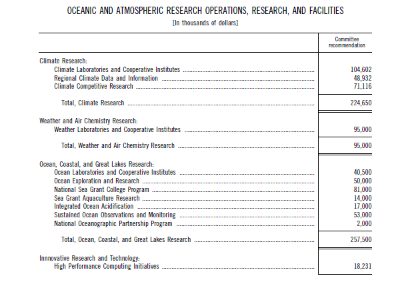
Looking at the NOAA agencies starting with OAR, the specific funding levels for individual programs are generally flat or show slight increases. The statement would direct NOAA to continue a number of programs that the Trump Administration has wanted to eliminate, including NOAA Sea Grant and the Regional Integrated Sciences and Assessments program. It also provides $12M in funding for FY2027 to continue the VORTEX-USA tornado research program.
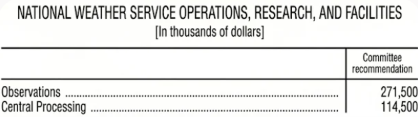
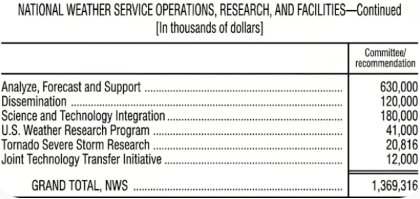
Most of the NWS budget lines show some small increase over last year. In particular, the bill provides an additional $6.5M in the Analyze, Forecast and Support budget specifically for NWS hiring. This is welcome — but I will note unless something has changed with recent agency reorganization, additional AFS funding would support hiring primarily of meteorologists, not electronics technicians or IT staff. Given the numerous recent NWS comms and IT issues and concerns about the Doppler radar network, these positions are just as critical and need to be beefed up as well. What the nation saw yesterday with the massive FAA comms failure and resulting nationwide ground stop is a demonstration of the vulnerable infrastructure that faces numerous critical federal agencies including the NWS. Having more meteorologists will not help the NWS if they do not have the infrastructure to produce and deliver timely warnings and forecasts.
Other key directives and items from the explanatory statement regarding the NWS include:
- Direction for NOAA to consolidate “all funding for the acquisition, integration, evaluation, and operational use of commercial weather data-currently distributedacross multiple programs and line offices into a single Program,Project, and Activity [PPA]. The Committee believes that establishing a unified PPA will significantly improve transparency, budget accountability, coordinationacross NOAA line offices, and strategic management of commercial data acquisitions. The consolidated PPA shall include commercial satellite data, radio occultation data, aircraft-based observations, ship-based observations, radar data, marine observations, and other commercial weather observation data and associated integration activities.” There has been a growing bipartisan effort in recent years by Congress to direct NOAA to be more aggressive in evaluating and utilizing commercial data as the commercial observing sector has grown and expanded into areas such as radar and satellite. This directive would require NOAA to present a detailed plan for a consolidated PPA/office focused on commercial data within the agency by FY2028.
- Provides an additional $4M for the acquisition and evaluation of new commercial data, with a focus on commercial aircraft, ship-borne and radar networks.
- Provides $35M to expand the National Mesonet Program.
- Directs NOAA to develop within 9 months a strategic plan “for developing and prioritizing the implementation of high-resolution probabilistic forecast guidancefor hazardous weather and water events using a next-generation weather forecast and warning framework.” The statement calls this a “Warn-on-Forecast Program Strategic Plan,” but in my reading of the directive — including additional language that goes into detail about what is desired including social science (SBS) research — it sounds much more to me like a call to implement the NSSL-developed Forecasting a Continuum of Environmental Threats (FACETs) program for severe weather and flash flooding. While Warn-on-Forecast is an important part of FACETs, it also includes Probabilistic Hazard Information and Threats-in-Motion (TIM) and the SBS research needed to make all of it useful to the public. Given that FACETs was an important aspect of my own work at NSSL, I am sure I will have more to say about this assuming it remains in the budget language — and (shameless plug) if you want to learn more about TIM , watch this interview our Debris Ballers podcast just released with with NWS meteorologist Kevin Laws who is responsible for implementing TIM and improving the NWS warning program.
- Encourages NWS to continue its AI language translation for weather services and transition it into a formal operational program.
- Requires the NWS to complete and submit an after action report on the March 6, 2026 southwest Michigan killer tornadoes.
- Requires NOAA to submit within 60 days budgetary needs to complete the Precipitation Frequency Atlas 15 for the entire US and its territories.
- Requires NESDIS to continue the Regional Climate Centers, another entity the Trump Administration has pushed to eliminate.
Of course, this is just the draft bill. Before any of this would become law, it must come up to the full Senate for a vote and potential amendments — and then once passed would have to go to the House for approval and be signed by the President. However, it is an important initial sign as to what a bipartisan approach for budgeting and directing the weather science agencies will be in this lame duck session of Congress. It is also not uncommon for the explanatory language of the Senate to be adopted whenever a yearlong continuing resolution is used to fund the government — so seeing the initial cut of this language is also particularly valuable.
I will be following the legislative progress of FY2027 funding in the coming weeks as this Congress wraps up, and keeping everyone updated as I learn more.


Leave a Reply