
A national disaster safety board is a great idea – but a good initial step would be to start truly evaluating the NWS
Jul 23, 2026
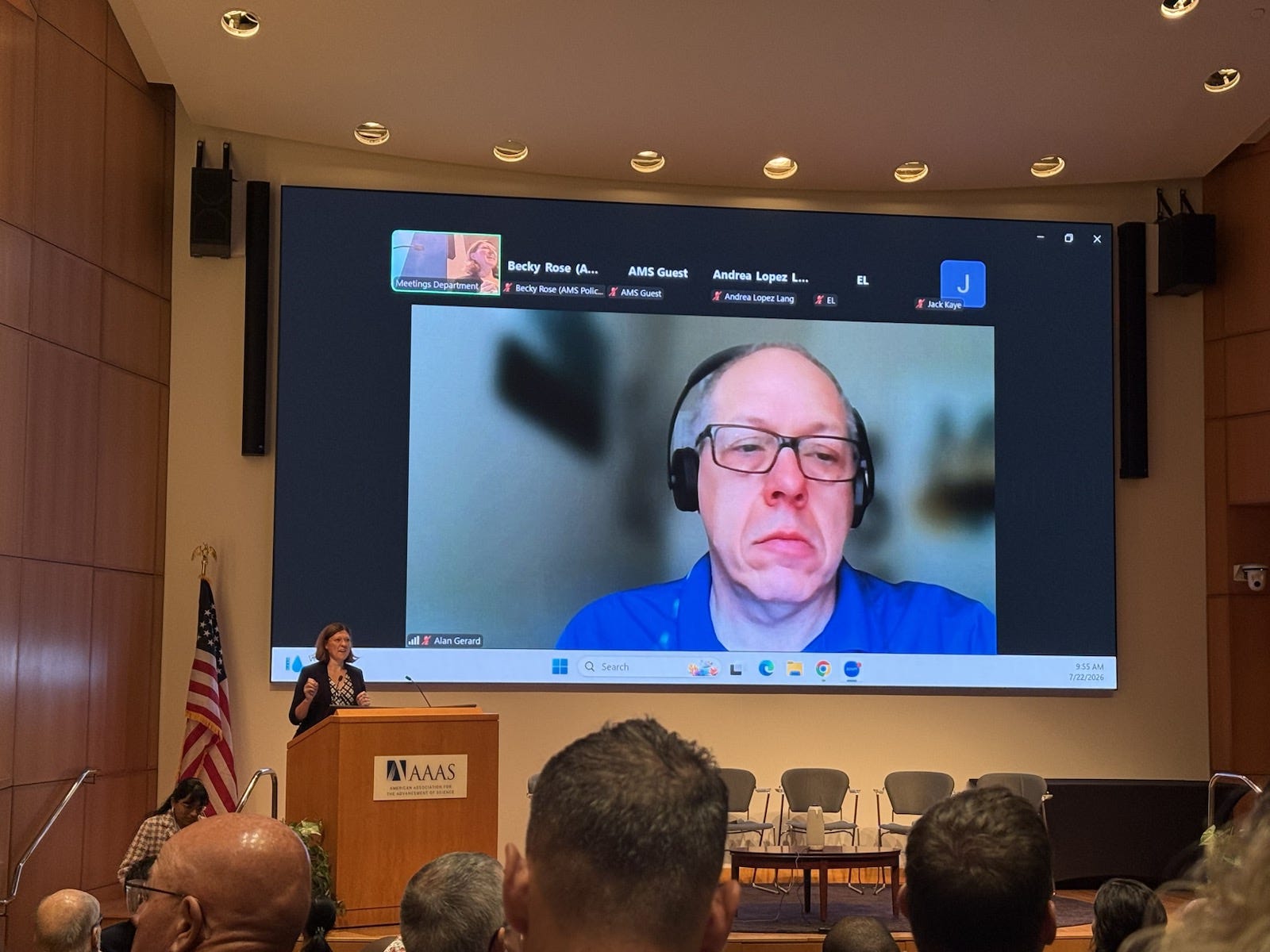
Yesterday I had the opportunity to participate remotely in a panel discussion at the American Meteorological Society’s 2026 Joint AMS Washington Forum and Summer Community Meeting. I was joined on the panel by UCAR Senior Scientist Dr. Kim Klockow-McClain and Gillespie County, TX emergency management director Ashley Morris. Our panel was a follow-up to the keynote address from Rep. Eric Sorensen (D-IL), who spoke about his National Weather Safety Board (NWSB) Act which would establish an entity similar to the National Transportation Safety Board (NTSB) for investigating weather disasters.
I have made clear in earlier posts my support for such a concept — although I do have some specific concerns with the proposed bill as written. For example, a primary criterion for triggering a NWSB investigation would be if a weather event is declared a federal disaster, which in my opinion would result in an unwieldy number of events needing to be studied — and might result in events that would be more meaningful as far as providing insight about the warning system or emergency management being overlooked.
At a big picture level, I think a disaster board at the federal level needs to be all-hazard, not weather specific. Right now, there is no independent entity that is taking a deep dive into the societal and scientific aspects of natural disasters — whether that be a hurricane, earthquake, or tsunami — and determining where we can make improvements to our warning systems, preparedness activities, etc. Such post-event evaluations need to be done by an interdisciplinary mix of highly qualified physical scientists, social scientists and engineers.
One of the potential complications of the establishment of a NWSB at a federal level is that many of the key governmental and emergency management decisions that greatly influence the societal outcomes of a weather event are made at a state or local level. For example, much of what we have learned in the year since the July 4th Texas Hill Country floods has shown that issues with county and local emergency management and response — and even disaster preparedness decisions by private entities like Camp Mystic — likely played the biggest roles in the catastrophic loss of life in that event. Obviously, federal NWSB recommendations would not necessarily be legally binding on state, local and private entities — but hopefully public findings and recommendations would result in those entities taking constructive steps to be better positioned in any future events. Such findings and recommendations would of course help other entities around the country improve their preparedness and response as well.
Regardless of the future of this National Weather Safety Board bill, an initial step that could be taken that would not require Congressional action would be a dramatic improvement to the service evaluation process for the National Weather Service. The most recent episode of the Debris Ballers podcast I co-host was about the complete breakdown of the NWS Service Assessment process — an agency level post-event evaluation of NWS services has not been undertaken since the July 2022 Southeast Kentucky flash flood event.
As we discuss in the podcast, the service assessment process was becoming bogged down in bureaucracy and politics even before it was apparently abandoned — and this is symptomatic of a deterioration in the agency’s overall service evaluation process that I witnessed throughout my NOAA career. When I first started in the NWS, each NWS state forecast office had a designated Weather Service Evaluation Officer (WSEO). The WSEO role was a focal point duty assigned to one of the forecasters to review warnings and forecast products issued by the NWS offices in the state and provide feedback, as well as to administer certification examinations and identify opportunities for improvement to services. At least in theory, these duties in the post-modernized NWS were supposed to transition to each office’s Warning Coordination Meteorologist (WCM) and Science and Operations Officer (SOO) — but in practice, other managerial responsibilities grew and the WSEO roles became marginalized.
Part of the reason for this was that the emphasis on service improvement and warning verification died at an organizational level. Back in the 1990s, each NWS regional headquarters had a division or at least a group of employees whose responsibility was to evaluate services provided by the local offices in the various NWS program areas (e.g., severe weather, fire weather, aviation, etc.) With time, those positions became much more bureaucratic in nature and their emphasis on performance evaluation withered. Now, the NWS is in the process of a complete organizational restructuring which will eliminate the roles of regional headquarters — meaning even less oversight of the services provided by the 122 local NWS offices.
Ultimately, given the life safety role of the NWS, the evaluation of its warning and forecast services should not be done through the agency self-policing itself. An independent agency like the NWSB that could evaluate the NWS within the context of the entire weather, water and emergency management structure across our country would be optimal. Lacking that, though, I do not believe there is any reason the Department of Commerce and NOAA could not establish an entity within the Office of the Inspector General with responsibility for conducting forecast and warning verification and evaluating NWS services.
The OIG conducted an effective investigation into the NWS actions relevant to the July 4th Texas Hill Country Flash Floods. A unit of the OIG with properly qualified staff could provide much more independent and dedicated evaluation of NWS services than what is currently being done by the agency itself — which from my external perspective appears to be quite ineffective. The bottom line is that we will obviously continue to experience natural disasters, and we should have organized processes to ensure that we are doing everything we can to reduce the loss of life and impacts to society. Right now, both at an interagency and individual agency level, those processes with regard to weather disasters are woefully inadequate. We need to do better.
Programming note: I am intending to post semi-regularly again — but family commitments and travel after the passing of my mom will mean those posts will not be as frequent or consistently timed as they typically have been.


Leave a Reply